Are you struggling to achieve that perfect, minimalistic aesthetic in your latest project? Selecting the right recessed linear LED light fixtures is the secret to high-end architectural integration, but getting the technical specs right can be a minefield.
Well, you’re in for a treat because I’ve put together the definitive recessed linear LED light fixture guide 2026.
I’ve updated this guide to cover everything from trimless “plaster-in” solutions and continuous run configurations to the latest in tunable white tech and acoustic sound-absorbing modules. Whether you are designing for corporate offices or modern residential interiors, this approach will help you ensure high-performance even illumination every time.
Let’s dive right in.
Overview of Recessed Linear LED Light Fixtures
Recessed linear LED lighting has become the definitive standard for modern architectural environments. As we move through 2026, these fixtures are no longer just functional utilities but essential design elements that define the geometry of a space. Our recessed linear LED light fixture guide 2026 highlights how these systems provide a seamless transition between light and structure, offering a clean, unobstructed aesthetic that traditional bulky fixtures cannot match.
What is Recessed Linear LED Lighting?
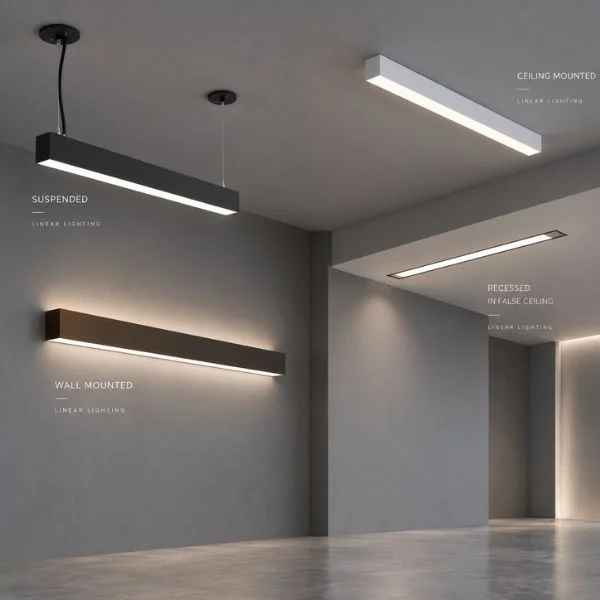
At its core, recessed linear LED lighting consists of elongated luminaires installed directly into a hollow opening in a ceiling, wall, or floor. Unlike surface-mounted or pendant lights, the housing is hidden, leaving only the lens or the “line of light” visible. This creates a flush finish that maintains the integrity of the architectural plane while delivering powerful, directed, or ambient illumination.
The Evolution of Architectural Linear Design
The shift from traditional fluorescent tubes to advanced LED technology has revolutionized linear design. In 2026, the focus has moved toward miniaturization and connectivity. Early linear models were limited by bulky ballasts and wide profiles; today’s systems offer ultra-slim apertures and modular capabilities. This evolution allows architects to create continuous, unbroken runs of light that can navigate corners, transition from walls to ceilings, and integrate perfectly with smart building ecosystems.
Key Components of a Recessed Linear System
A high-performance recessed linear system is engineered for longevity and precision. To ensure peak performance, our systems comprise several critical elements:
- Extruded Aluminum Housing: Acts as a durable frame and a highly efficient heat sink to prolong LED life.
- LED Light Engine: High-density LED boards that ensure “no-dot” spotting and superior color rendering (CRI).
- Precision Optics/Diffusers: High-transmission acrylic or polycarbonate lenses that optimize light distribution and minimize glare.
- Integrated or Remote Drivers: Advanced power supplies that support dimming protocols like 0-10V, DALI, or wireless mesh.
- End Caps and Joining Kits: Essential hardware for creating light-leak-free continuous runs and clean terminations.
Key Benefits of Recessed Linear Lighting
Choosing the right lighting is about more than just visibility; it’s about how a space feels and functions. In our recessed linear LED light fixture guide 2026, we highlight why these systems have become the go-to choice for high-end developments. They offer a perfect mix of “invisible” design and powerhouse performance.
| Feature | Primary Benefit | Best For |
|---|---|---|
| Flush Mounting | Zero visual clutter | Minimalist interiors |
| Continuous Runs | Uniform, shadow-free light | Hallways & large offices |
| Advanced LEDs | 50,000+ hour lifespan | Low-maintenance commercial use |
| Low Profile | Saves vertical space | Low-plenum ceilings |
Sleek and Minimalistic Aesthetic Appeal
I always tell my clients that the best lighting is felt, not seen. These fixtures sit flush with the surface, creating clean, sharp lines that emphasize the architecture rather than the hardware. This “quiet” design language is essential for modern interior design, allowing the room’s features to take center stage. For a broader look at how these elements work together, explore our architectural lighting complete guide.
High-Performance Even Illumination
Standard bulbs often create “hot spots” or uneven shadows. Our linear systems use high-quality diffusers to provide uniform light distribution across the entire length of the run. Whether you’re lighting a gallery or a workstation, you get consistent, flicker-free brightness that reduces eye strain and improves focus.
Space-Saving Architectural Integration
One of the biggest wins with recessed lighting is how it handles tight spaces. Because the housing is tucked into the ceiling or wall, you don’t lose any “headroom.” This makes them ideal for modern offices or residential basements where every inch of vertical space matters. They integrate directly into the building’s “bones” for a seamless look.
Energy Efficiency and Long Lifespan
In 2026, efficiency isn’t just a bonus—it’s a requirement. These fixtures utilize the latest LED chips to deliver high lumen output while pulling minimal wattage.
- Lower Utility Bills: Up to 70% more efficient than traditional options.
- Reduced Maintenance: Rated for years of continuous use without bulb changes.
- Eco-Friendly: Lower heat emission reduces the load on your HVAC system.
Mounting Types and Profile Options
In this recessed linear led light fixture guide 2026, I focus on how the mounting method defines your space. The profile you choose dictates the labor involved and the final architectural “vibe” of the room.
Flanged Recessed Fixtures for Standard Ceilings
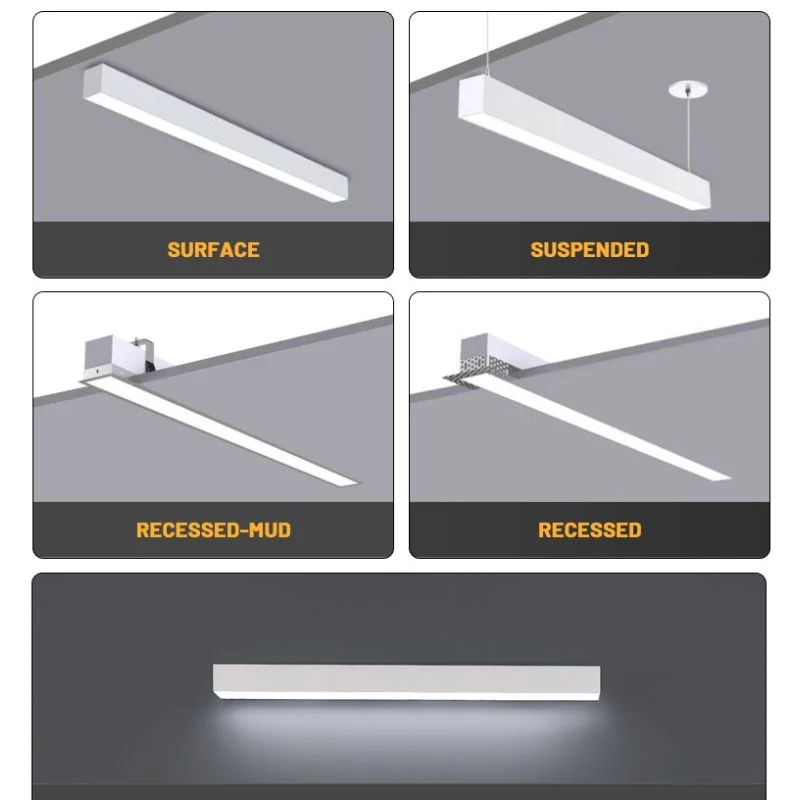
Flanged profiles are my go-to for straightforward projects. These fixtures have a visible rim (the flange) that overlaps the ceiling cutout, covering any rough edges or imperfections in the drywall. They are reliable, easy to install in both new builds and retrofits, and provide a framed, clean-cut look.
Trimless “Plaster-In” and Mud-In Solutions
For that high-end, minimalist aesthetic, trimless is the standard. We use a “mud-in” flange that is screwed directly into the drywall and then plastered over. Once the ceiling is painted, the frame becomes part of the structure, leaving only the crisp line of light visible. It’s the ultimate way to achieve a seamless architectural finish.
T-Grid and Drop Ceiling Linear Modules
Commercial environments usually feature suspended grids. We offer linear modules designed specifically to sit within or replace parts of a standard T-bar system. These are incredibly popular for school classroom linear lighting because they snap into place quickly and provide the high-output, glare-free illumination required for learning environments.
Perimeter and Wall-to-Ceiling Configurations
Perimeter mounting allows us to wash walls with light or create a “floating ceiling” effect. By placing the linear fixture at the junction of the wall and ceiling, you can highlight textures or expand the perceived size of a room. This setup is often used to transition light from horizontal to vertical surfaces.
Mounting Selection Quick-Reference
| Mounting Style | Best Use Case | Visual Impact | Install Complexity |
|---|---|---|---|
| Flanged | Office retrofits / Wood ceilings | Clean, framed border | Low |
| Trimless | High-end residential / Galleries | Seamless “Light from nowhere” | High |
| T-Grid | Classrooms / Corporate offices | Grid-integrated | Medium |
| Perimeter | Feature walls / Hallways | Architectural depth | Medium |
When planning your 2026 lighting layout, I always suggest matching the mounting type to the ceiling’s structural material first. While round linear light patterns are gaining ground for creative zones, the standard linear recessed profile remains the backbone of modern architectural lighting due to its versatility across these four mounting types.
Common Sizes and Physical Specifications
When planning your layout, the physical footprint of the recessed linear LED light fixture determines how well it blends into your architecture. We focus on providing a variety of profiles to ensure a “built-in” look regardless of your ceiling type.
Standard Widths: 1-Inch, 2-Inch, and 4-Inch Profiles
The width of the aperture defines the visual impact. While 2-inch is the most popular for general office use, we see a growing trend toward ultra-thin or bold wide profiles.
| Profile Width | Visual Impact | Best Use Case |
|---|---|---|
| 1-Inch (Narrow) | Minimalist, “pencil” lines | Accent lighting, decorative patterns |
| 2-Inch (Standard) | Balanced, clean | General workspace, hallways, classrooms |
| 4-Inch (Wide) | Bold, structural | High ceilings, lobbies, retail showrooms |
Continuous Run vs. Fixed Length Fixtures
For long corridors or large open-plan offices, we recommend continuous run configurations. These systems use internal joiners to create a seamless line of light without any visible gaps or light leaks at the seams. If you are working on a smaller project, our standalone fixed-length modules (usually in 4ft or 8ft increments) offer a quick, “plug-and-play” solution. You can explore our full range of customizable lighting products to find the exact length for your specific floor plan.
Shallow vs. Deep Housing for Diverse Plenums
The “plenum” is the space between the structural ceiling and the drop ceiling. Not every building has room for bulky equipment.
- Shallow Housing: Designed for tight spaces or “low-profile” installations where HVAC ducts or pipes limit your depth.
- Deep Housing: Offers better heat dissipation and allows for “regressed” optics, which significantly reduces glare for the people working below.
Flush, Pop-Down, and Regressed Lens Styles
The lens position changes how the light interacts with the room. In our commercial linear lighting trends 2026 guide, we highlight how different lens positions affect the “feel” of a space:
- Flush Lens: The diffuser sits perfectly level with the ceiling surface for a smooth, unbroken plane.
- Pop-Down (Dropped) Lens: The lens hangs slightly below the ceiling, creating a unique “side-glow” effect that illuminates the ceiling itself.
- Regressed Lens: The light source is tucked up into the fixture. This hides the “hot spots” and creates a more comfortable, high-end architectural look.
Advanced Optical and Performance Features
In this recessed linear LED light fixture guide 2026, we see a major shift from simple illumination to high-precision beam control. Modern optics allow us to direct light exactly where it’s needed, eliminating waste and enhancing the architectural feel of a space.
Asymmetric and Wall Wash Distributions
We no longer just blast light downward. Our latest fixtures use asymmetric optics to push light toward specific surfaces, like shelves or walkways, without creating glare for the viewer. Wall wash modules are specifically engineered to provide perfectly even vertical illumination from floor to ceiling, making small spaces feel much larger and more professional.
Acoustic and Sound-Absorbing Linear Solutions
In open-concept designs, noise is often a bigger problem than lighting. We’ve integrated acoustic PET felt panels directly into our linear profiles. These sound-absorbing modules catch echoes while providing high-quality light, making them a double-duty win for modern workspaces and loud lobbies.
Color Temperature (CCT) and Tunable White Options
The “one-size-fits-all” approach to color is dead. Our fixtures now support Tunable White technology, allowing you to shift from a warm 2700K for evening relaxation to a crisp 5000K or 6500K for high-focus tasks. This tech mimics the natural sun cycle, which is essential for maintaining circadian rhythms in windowless environments.
| Optical Feature | Primary Benefit | Recommended Application |
|---|---|---|
| Micro-Prismatic Lens | Glare reduction (UGR <19) | Workstations & Trading floors |
| Asymmetric Beam | Directional focus | Retail displays & Hallways |
| Tunable White | Circadian health | Healthcare & 24/7 Offices |
| Acoustic Housing | Noise reduction | Coworking & Education |
Glare Control and Louver Diffuser Options
Visual comfort is non-negotiable. To prevent “hot spots,” we utilize regressed lenses and precision-engineered louvers. These deep-set diffusers ensure that the light source is hidden from direct view, creating a soft, comfortable glow. When selecting recessed office lighting in North America, prioritizing low-glare optics is the best way to prevent employee eye strain and headaches.
For professionals managing high-performance commercial indoor LED lighting fixtures, we recommend high-CRI (90+) options as the standard for 2026 to ensure colors look vibrant and accurate under every beam.
Application Scenarios for Recessed Linear LED
Recessed linear lighting is the backbone of modern architectural design. Our recessed linear led light fixture guide 2026 focuses on how these fixtures provide seamless integration across diverse sectors, proving that functional lighting can also be a primary design element.

Corporate Office and Coworking Spaces
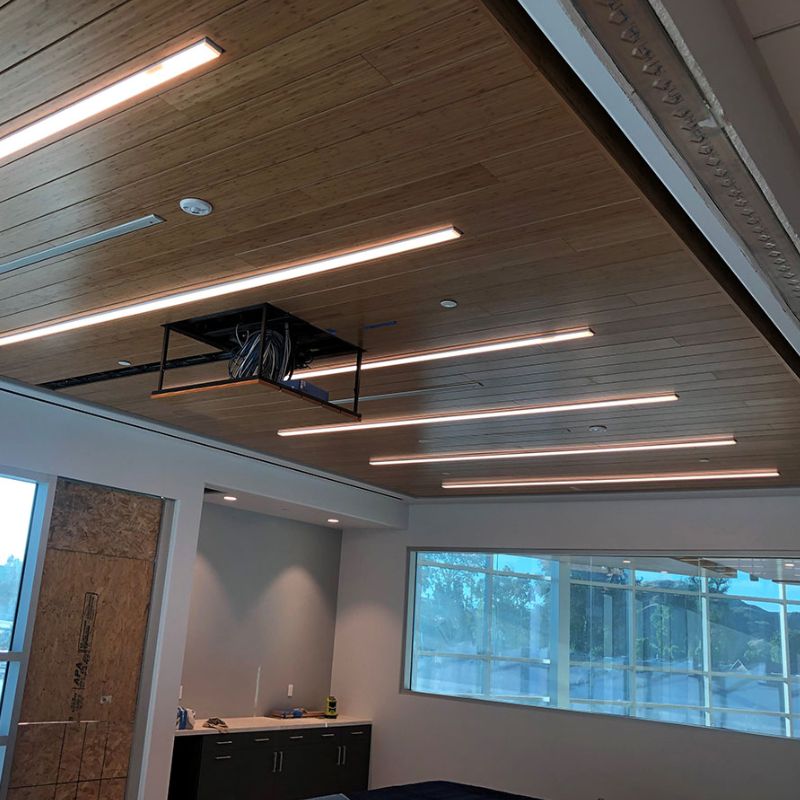
In the modern workplace, lighting directly impacts productivity and focus. We use recessed linear fixtures to create long, continuous runs that eliminate dark spots and significantly reduce screen glare. As a specialized led office lighting supplier, we prioritize high-performance optics that meet strict glare-control standards. For specific layout strategies, you can refer to our false ceiling lights for office buying guide.
Healthcare and Clinical Environments
In hospitals and clinics, lighting must support both staff efficiency and patient recovery.
- Hygienic Design: Flush-mount profiles prevent dust buildup.
- Visual Comfort: Soft, even distribution reduces patient anxiety in corridors.
- High CRI: Essential for accurate color rendering during medical examinations.
Modern Residential and Hospitality Interiors
We help designers achieve a “quiet luxury” aesthetic in high-end homes and hotels. Recessed lines are perfect for:
- Defining Spaces: Framing kitchen islands or open-plan living areas.
- Atmosphere: Utilizing tunable white options to shift from bright morning light to warm evening hues.
- Accentuation: Creating “halos” of light in hotel lobbies and corridors for a premium feel.
Retail and High-End Commercial Showrooms
In the retail sector, lighting is a silent salesman. We use recessed linear systems to guide customer traffic through a store naturally.
- Minimalist Ceiling: Keeps the focus entirely on the merchandise.
- High-Intensity Output: Ensures products look vibrant and high-quality.
- Dynamic Layouts: Using T-shape or L-shape connectors to mirror the brand’s geometric identity.
Selection and Installation Guide
Getting the most out of your recessed linear led light fixture guide 2026 requires a balance between technical specs and practical site conditions. I always recommend planning the layout before the ceiling goes up to avoid costly adjustments later.
Choosing the Right Lumen Output and Wattage
The goal isn’t just “bright”; it’s “right.” For 2026, we focus on delivered lumens—the actual light hitting the floor—rather than just the raw output of the LEDs.
| Application | Recommended Lumens/Foot | Typical Wattage/Foot |
|---|---|---|
| Ambient/General | 400 – 600 lm | 4W – 6W |
| Task/Workstations | 700 – 1000 lm | 8W – 12W |
| Decorative/Accent | 200 – 300 lm | 2W – 3W |
Understanding Driver and Power Supply Requirements
The driver is the heart of your system. Most modern recessed linear fixtures use Universal Voltage (120-277V) drivers. When selecting your power supply, consider these three factors:
- Dimming Compatibility: Standard 0-10V is the industry go-to, but DALI or Ecosystem drivers offer better granular control for smart buildings.
- Remote vs. Integral: Shallow plenums often require remote drivers placed in an accessible junction box.
- Environment: If you’re installing in bathrooms or overhangs, check a contractor’s guide to UL damp vs wet location lighting to ensure the driver enclosure matches the rating.
Installation Best Practices for Drywall and T-Bar
The mounting method defines the final look. For a seamless finish in drywall, trimless (mud-in) profiles are the standard for high-end architecture.
- Drywall: Ensure the framing provides enough clearance for the housing depth. Use fiberglass tape on the flanges to prevent cracking.
- T-Grid: Select fixtures specifically designed for 15/16″ or 9/16″ grids to ensure they sit flush with the acoustic tiles.
- Wiring: Always pull your feed to the start of the run; for continuous rows, we use quick-connect harnesses to speed up the process.
Maintenance and Tool-Less Entry Features
I prioritize fixtures with tool-less entry. In 2026, nobody wants to hunt for a specialized screwdriver to check a connection. Look for:
- Snap-in Lenses: High-quality polycarbonate lenses that can be removed with a simple suction tool or light pressure.
- Plug-and-Play LED Boards: Magnetic or clip-on boards that allow for easy upgrades if lighting technology evolves.
- Accessible Drivers: Designs where the driver is reachable through the fixture aperture, saving you from cutting holes in the ceiling later.
Technical Resources and Compliance
Interpreting Spec Sheets and Photometric (IES) Files
Spec sheets are the blueprints for a successful installation. I provide comprehensive data to ensure your recessed linear LED light fixture guide 2026 planning is accurate and efficient. Beyond basic wattage, pay close attention to the photometric data. IES files allow you to simulate light distribution in software like AGi32 or Dialux, ensuring there are no dark spots in your layout.
| Metric | Importance for Projects |
|---|---|
| Delivered Lumens | The actual light leaving the fixture, not just the LED chip output. |
| Efficacy (LPW) | How many lumens you get per watt; higher is better for energy codes. |
| Beam Angle | Determines the spread; crucial for choosing recessed linear wall wash lighting types versus general ambient runs. |
| L70 Rating | Predicts the lifespan by showing when light output drops to 70%. |
UL-Listed and DLC Certification Importance
Safety and ROI are my top priorities. When I supply fixtures, I ensure they carry the necessary certifications to meet local building codes and financial goals.
- UL/ETL Listing: This is a non-negotiable safety requirement for North American installs. It proves the fixture has been tested for electrical safety and fire risk.
- DLC (DesignLights Consortium): I focus on DLC-certified products because they meet high standards for color quality and efficiency. More importantly, DLC listing is usually a prerequisite for qualifying for lucrative utility rebates.
- IP Ratings: For specialized areas, ensure the fixture is rated for damp or wet locations to prevent moisture ingress.
For projects requiring high-performance architectural integration, our 6-slot recessed panel light offers the certified reliability needed for commercial-grade compliance.
Revit and BIM Files for Architectural Planning
Modern architectural design happens in a 3D digital environment. To support seamless integration, I provide Revit (.RFA) and BIM files for my recessed linear systems. These files are more than just 3D models; they contain the technical metadata needed for a “digital twin” of the building.
- Clash Detection: Identify if your linear run interferes with HVAC ducts or plumbing in the plenum before construction starts.
- Accurate Rendering: High-quality BIM files include light source data for realistic visual walkthroughs.
- Simplified Scheduling: Automatically generate lighting schedules with accurate part numbers and electrical loads for the contractor.
STAY IN THE LOOP
Subscribe to our free newsletter.
Leave A Comment

Explore types of hanging lights including pendant chandeliers and cluster designs to find the perfect style for every room