
Understanding Recessed Office Lighting: Types and Applications
Choosing the right recessed LED office lighting is the foundation of a productive workspace. In my years of supplying the North American market, I have seen how the right fixture selection directly impacts both employee focus and long-term operational costs. We focus on three primary systems that define modern professional environments.
Core Fixture Types and Their Roles
- Commercial Recessed Downlights: Often called “can lights,” these are essential for lobbies, hallways, and targeted task lighting in private offices.
- Office LED Troffers: The traditional 2×2 and 2×4 standard for T-grid ceilings, providing broad, uniform light for high-density work areas.
- Recessed Linear Office Lights: The contemporary gold standard. These systems offer a sleek, architectural look that provides continuous runs of light without the visual breaks of traditional panels.
Application Strategy by Zone
| Office Area | Recommended Fixture | Primary Benefit |
|---|---|---|
| Open-Plan Offices | Recessed Linear / Troffers | Uniformity and glare reduction |
| Conference Rooms | Linear Systems + Perimeter Downlights | Dimmable, professional aesthetic |
| Hallways/Transitions | Commercial Recessed Downlights | Energy efficiency and wayfinding |
| Private Offices | Selectable CCT Troffers | Personalized comfort and task focus |
Why Commercial Grade Matters
I cannot stress enough the importance of choosing commercial-grade over residential-grade fixtures. For North American builds, IC-rated (Insulation Contact) fixtures are a safety necessity, allowing the housing to stay in direct contact with ceiling insulation without fire risks. Commercial units also offer higher lumen packages and superior thermal management, ensuring the electronics don’t degrade under 40+ hours of weekly use.
The Shift to Linear Design
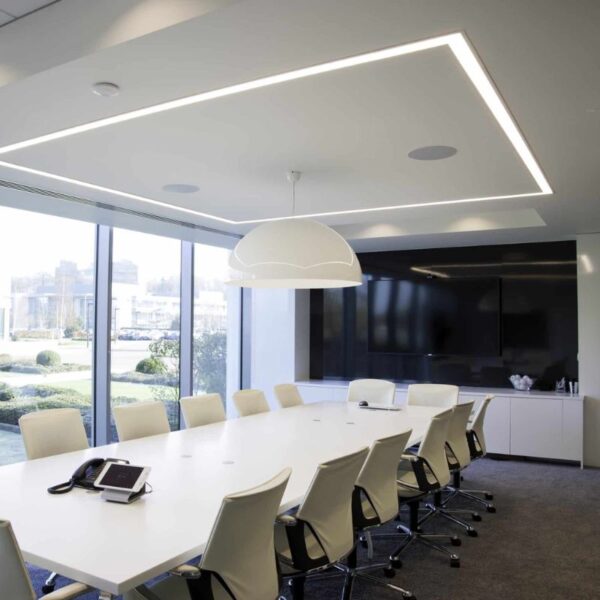
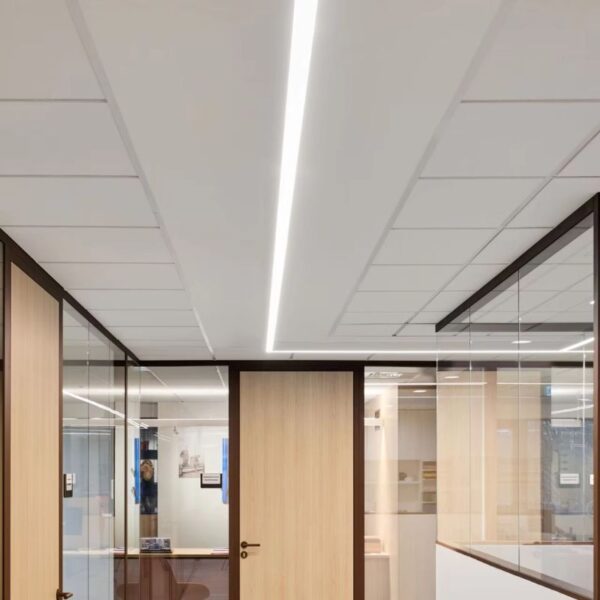
While 2×4 panels remain a budget-friendly staple, the emerging preference in modern North American architecture is recessed linear office lights. These fixtures eliminate the “checkerboard” ceiling look, providing a clean, streamlined aesthetic that makes spaces feel larger and more organized. They offer the same high-performance output as troffers but with a much smaller visual footprint.
Essential North American Regulations and Certifications
Navigating the regulatory landscape in North America isn’t just about red tape; it’s about ensuring your project is legal, safe, and eligible for cash back. Whether you are in California or Ontario, these codes dictate exactly how we deploy recessed LED office lighting.
Energy Codes and Compliance
Most states and provinces follow a strict set of rules to limit energy waste. Ignoring these can lead to “stop-work” orders or failed final inspections.
- Title 24 (California): This is the gold standard for efficiency. It requires high-efficacy fixtures and mandatory controls like occupancy sensors and daylight harvesting.
- ASHRAE 90.1 & IECC: These codes set the baseline for lighting power density (LPD) across the rest of the US and Canada.
- Using Title 24 compliant lighting ensures you are meeting the highest efficiency tiers, regardless of your specific zip code.
Safety and Listing Requirements
In the North American market, safety certifications are non-negotiable. If a fixture isn’t properly listed, it simply shouldn’t be in your ceiling.
- UL/ETL Listing: These marks prove the fixture has been tested for fire and electrical safety. Most building inspectors will flag and reject any UL certified recessed lights that lack these visible labels.
- CSA Certification: The primary safety requirement for Canadian installations, often interchangeable with UL/ETL in many jurisdictions.
Maximizing ROI with Rebates
Utility companies across the US and Canada offer massive incentives to offset your upfront costs. To get that check, your fixtures almost always need to be on a Qualified Products List (QPL).
- DLC Premium/Standard: Most commercial rebates require DesignLights Consortium (DLC) listing. DLC Premium usually triggers higher payouts because the fixtures are more efficient.
- Energy Star: While more common in residential settings, it still applies to certain commercial recessed LED office lighting like smaller downlights.
- I’ve found that importing UL/DLC certified LED office panel lights is the most reliable way to ensure you actually receive those utility incentives, which can often cover 30% or more of your total hardware cost.
The Real Cost of Non-Compliance
Choosing uncertified or non-compliant fixtures is a massive risk. We see it lead to:
- Project Delays: Having to rip out and replace non-certified lights mid-project.
- Insurance Issues: Unlisted electrical components can give insurance companies a reason to deny claims in the event of a fire.
- Lost Savings: Leaving thousands of dollars in “free” utility rebate money on the table by using non-qualified products.
Performance Specs for Recessed Office Lighting
To get the most out of your workspace, we focus on technical specs that balance employee comfort with energy savings. Meeting IESNA office illuminance levels ensures the space is bright enough for productivity without causing eye strain. For most North American offices, we aim for 300–500 lux on the work plane.
Core Lighting Specifications
| Feature | Recommended Standard | Why It Matters |
|---|---|---|
| Color Temp (CCT) | 3500K – 4000K | Balanced, neutral light for alertness. |
| Color Rendering (CRI) | ≥80 (Standard) / ≥90 (High) | Accurate color for design and detail work. |
| Glare Rating (UGR) | <19 | Essential for glare-free recessed fixtures. |
| Luminous Efficacy | 110–130 lm/W | High energy efficient commercial lighting performance. |
Smart Controls and Dimming
In modern office layouts, the fixture is only half the story. To maximize savings and meet local codes, we prioritize:
- 0-10V Dimmable Office Lighting: Provides smooth, flicker-free dimming from 100% down to 1% or 10%.
- Daylight Harvesting: Automatically dims lights near windows to save energy when natural light is available.
- Occupancy Sensors: Ensures lights are only on when people are actually in the room.
When selecting fixtures, we ensure they meet rigorous certifications and North American standards to guarantee long-term reliability and safety. Choosing the right 4000K office lighting paired with high-transmittance diffusers creates an environment that feels natural and keeps the team focused throughout the workday.
Advanced Features in Recessed LED Office Lighting
We focus on engineering fixtures that simplify installation while maximizing long-term ROI. Modern recessed LED office lighting has moved beyond simple “on/off” functionality. To stay competitive in the North American market, we integrate high-end features that reduce SKU complexity and labor costs.
Field-Selectable CCT and Wattage
Inventory management is a headache for large projects. Our selectable CCT wattage fixtures allow contractors to adjust the light color (3500K, 4000K, or 5000K) and power output directly on the driver during installation. This flexibility ensures every zone—from the breakroom to the executive suite—has the perfect atmosphere without ordering different model numbers.
Architectural Precision and Build Quality
- Continuous Run Linear Recessed: We design our linear recessed sections to lock together perfectly. This creates a seamless continuous run with no light leaks or visible joints, providing a high-end architectural look.
- Universal Voltage (120-277V): Standard for all our commercial builds to ensure compatibility with any US or Canadian power grid.
- Heavy-Duty Construction: We use extruded aluminum housings for superior heat dissipation and high-transmittance diffusers to eliminate “hot spots” and pixelation.
Performance Comparison: Linear Recessed Systems
| Fixture Length | Wattage Options | Lumen Output | Efficacy (lm/W) |
|---|---|---|---|
| 2ft Linear | 15W – 25W | 1,950 – 3,250 | 130 lm/W |
| 4ft Linear | 30W – 40W | 3,900 – 5,200 | 130 lm/W |
| 8ft Linear | 60W – 80W | 7,800 – 10,400 | 130 lm/W |
These energy efficient commercial lighting solutions come standard with 0-10V dimmable office lighting protocols, making them fully compatible with daylight harvesting and occupancy sensors to further drive down utility bills.
Planning and Layout for Recessed Office Lighting
When I sit down to plan a layout, I focus on the math of the space to ensure the recessed LED office lighting performs as intended. It isn’t just about brightness; it’s about how that light hits the work surface without creating hotspots or dark corners.
Spacing Guidelines for Even Coverage
The most reliable shortcut I use is the ceiling height ÷ 2 rule. For a standard 10-foot office ceiling, you should space your fixtures roughly 5 feet apart. This ensures the light beams overlap at the right height, providing uniform coverage and maintaining glare-free recessed fixtures across the floor plan.
Zoning by Office Function
I treat every zone differently based on the task at hand. Mixing and matching helps with both energy savings and employee comfort:
- Task Areas: Higher lumen output focused on workstations.
- Ambient Zones: Softer, general lighting for hallways and transition spaces.
- Conference Rooms: Require high-performance dimming and specific zoning to accommodate screen presentations.
- Breakrooms: More relaxed, warmer light to separate the “work” feel from the “rest” feel.
Ceiling Integration and Photometrics
Choosing the right fixture depends heavily on your ceiling type. While T-grid ceiling recessed lights are the standard for most North American “drop” ceilings, drywall installations in high-end suites require specific mounting frames.
- Avoid Shadows: Place fixtures relative to furniture layouts to prevent people from working in their own shadows.
- Wall Washing: I often specify wall-wash trims for vertical surfaces. Lighting the walls makes a room feel more expansive and reduces that “cave” feeling.
- Construction Type: If you are working on a retrofit, look for remodel-specific housings to save on labor. For more technical details on beam angles and spacing for specific projects, our architectural lighting FAQ covers the most common onsite challenges.
Properly planned energy efficient commercial lighting should be invisible in its function—providing perfect visibility without the occupants ever noticing the source.
Installation and Long-Term Maintenance of Recessed Office Lighting
Installing recessed LED office lighting correctly is the first step toward a maintenance-free workspace. In North American offices, we primarily deal with T-grid (drop ceilings) or drywall. While T-grid installations are generally straightforward “lay-in” jobs, drywall requires precision-cut openings and secure mounting to the joists or framing.
When setting up a 4-inch recessed linear fixture or a standard downlight, follow these core steps:
- Power Down: Always cut the breaker before starting any wiring.
- Layout Marking: Use a laser level to ensure perfectly straight runs, especially for linear systems.
- Wiring: Connect the 0-10V dimmable office lighting wires (usually purple and gray/pink) to your compatible dimmer or sensor.
- Mounting: Secure the fixture using the provided T-bar clips for grids or butterfly brackets for hard ceilings.
- Trim & Finish: Snap the magnetic or mechanical trim into place for a flush, professional look.
The LED Maintenance Advantage
One of the biggest wins for any facility manager is the move away from fluorescent tubes. Our commercial-grade fixtures are rated for 50,000+ hours, which translates to over a decade of use in a typical 40-hour work week.
- Minimal Heat: Unlike old halogens or fluorescents, these LEDs run cool, reducing the load on your HVAC system.
- Durability: No glass tubes to break and no mercury to dispose of.
- Consistency: High-quality drivers ensure the light output doesn’t “yellow” or dim significantly over the first few years.
Troubleshooting and Warranty Expectations
Even with the best T-grid ceiling recessed lights, you might run into occasional hiccups. Most issues stem from control compatibility rather than the fixture itself.
| Issue | Common Cause | Fix |
|---|---|---|
| Flickering | Incompatible dimmer or loose neutral wire. | Ensure you are using a dedicated 0-10V LED dimmer. |
| Overheating | Lack of clearance in non-IC rated housings. | Check that insulation is cleared away from non-IC fixtures. |
| Delayed Start | Driver “soft start” feature or poor sensor signal. | Adjust the occupancy sensor sensitivity or check driver specs. |
For any professional project, I recommend never settling for less than a 5-year limited warranty. Commercial-grade UL certified recessed lights should come with dedicated US-based support to handle driver replacements or technical questions quickly, ensuring your office stays bright without unexpected downtime.
Cost Analysis and ROI for Recessed Office Lighting
I view lighting as a strategic investment rather than a simple overhead cost. When you transition to recessed LED office lighting, the financial profile of your building changes immediately. While the initial equipment cost is higher than legacy systems, the 60–75% reduction in energy consumption typically pays for the upgrade in under three years.
Lifecycle Costs and Energy Reduction
Modern energy efficient commercial lighting eliminates the “hidden” costs of traditional fixtures.
- Maintenance Savings: LED systems last 50,000+ hours, removing the labor and material costs associated with frequent ballast and lamp failures.
- HVAC Efficiency: LEDs emit significantly less heat, reducing the load on your cooling system during North American summers.
- Aesthetic Value: High-quality recessed linear LED ceiling lights increase property value and tenant retention by providing a modern, premium workspace.
Maximizing Payback with DLC Rebates
To hit the fastest ROI, I always recommend DLC listed office fixtures. DesignLights Consortium (DLC) qualification is the gold standard that most North American utility companies require to issue rebates.
- Rebate Stacking: By selecting DLC Premium products, you can often “stack” local utility incentives with federal tax deductions, covering up to 40% of the hardware cost upfront.
- Incentive Programs: Utilities like ConEd, PG&E, and Hydro Quebec offer aggressive per-fixture rebates that turn a standard retrofit into a high-yield financial move.
Case Example: 10,000 Sq Ft Open Office Retrofit
This table illustrates the typical shift from old fluorescent troffers to high-performance recessed LED systems in a standard American commercial space.
| Metric | Legacy Fluorescent (2×4) | Modern LED Recessed |
|---|---|---|
| Total Fixture Count | 125 | 100 (Optimized spacing) |
| System Wattage | 11,250W | 3,800W |
| Annual Energy Cost | ~$5,400 | ~$1,820 |
| Maintenance Cost (Yearly) | $1,200 | $0 |
| Estimated Utility Rebate | $0 | $3,500 – $6,000 |
| Simple Payback Period | N/A | 1.8 – 2.2 Years |
By focusing on high-efficacy fixtures and proper zoning, the energy savings alone dictate that staying with old lighting is actually more expensive than upgrading. Utilizing 0-10V dimmable office lighting further extends these savings by allowing for daylight harvesting, which can shave another 10–20% off the monthly utility bill.
Related Sources
STAY IN THE LOOP
Subscribe to our free newsletter.
Leave A Comment
Retrofit LED Lighting Solutions Are soaring energy bills, relentless ballast [...]

Struggling to cut operational costs while upgrading your facility’s lighting [...]
The Financial & Operational Business Case Upgrading to energy efficient [...]
Are you worried about overhead head clearance, or tired of [...]