
The Evolution of Commercial Linear Lighting in 2026
From Basic Illumination to Architectural Storytelling
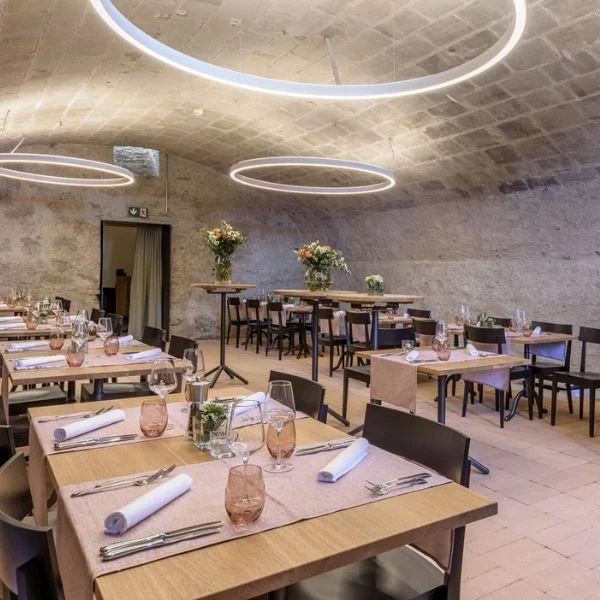
In the modern commercial landscape, lighting has transcended its utilitarian roots to become a primary driver of spatial design. We no longer view fixtures merely as sources of brightness; instead, we utilize architectural linear systems to define the narrative of a workspace. By leveraging modular designs and custom geometric configurations, our lighting solutions guide foot traffic, delineate zones, and emphasize the structural rhythm of a building.
- Continuous Runs: Interlocking connectors allow for seamless, uninterrupted lines of light that visually expand corridors and open offices.
- Geometric Freedom: Beyond straight lines, custom angles and shapes turn ceilings into dynamic canvases.
- Spatial Definition: Strategic placement of linear luminaires creates subconscious boundaries without physical walls.
The Shift Toward “Quiet Luxury” and Minimalist Integration
Current architectural trends prioritize “Quiet Luxury,” where technology blends invisibly with the built environment. The goal is to experience the light, not the fixture. We achieve this sophisticated minimalism through high-grade extruded aluminum housings that offer robust performance with an incredibly low profile.
To meet the demand for clean, uncluttered ceilings, our focus remains on precision engineering:
- Trimless Recessed Profiles: These fixtures mud directly into the drywall, eliminating visible bezels for a flawless “lines of light” effect.
- Seamless Diffusion: High-quality polycarbonate (PC) diffusers ensure a smooth, dot-free glow that enhances visual comfort.
- Compact Form Factors: Slim apertures deliver powerful lumen output while maintaining a discreet architectural presence.
Key Performance Metrics for Modern Workspaces
Understanding UGR < 19: Why Visual Comfort is Non-Negotiable
In the world of commercial linear lighting, raw brightness is no longer the primary goal. The real challenge in modern open-plan offices is managing glare. We prioritize a Unified Glare Rating (UGR) of less than 19 for our workspace solutions. This threshold is critical because it ensures that the light source doesn’t cause eye strain or fatigue for employees working on screens all day.
We achieve this through advanced optical engineering, using deep-recessed light sources and high-quality polycarbonate diffusers. This setup delivers light exactly where it is needed—on the desk—without creating distracting hotspots on the ceiling.
Beyond Lumens: The Importance of High CRI (90+) and R9 Values
Quantity of light is easy to achieve; quality is where we differentiate our products. Standard LEDs often wash out colors, making a space feel sterile. That is why we focus on CRI 90+ as a standard for architectural applications. High Color Rendering Index (CRI) ensures that finishes, fabrics, and branding materials appear vibrant and accurate.
Equally important is the R9 value, which measures how well a light source renders saturated reds. High R9 values are essential for making skin tones look healthy and natural, which is vital for video conferencing and face-to-face collaboration. Our suspended direct-indirect lighting systems are designed to deliver this high-fidelity illumination, ensuring that your environment looks as good as it functions.
Human-Centric Lighting (HCL) and Circadian Rhythm Support
Lighting has a profound impact on biological clocks. We design our linear systems to support Human-Centric Lighting strategies by offering a range of Color Correlated Temperatures (CCT), typically from warm 3000K to cool 4000K and 6500K.
- 3000K: Warm light for hospitality or breakout areas to induce relaxation.
- 4000K: Neutral white for general office tasks to maintain focus.
- Dimming Control: Compatibility with 0-10V and DALI systems allows the light intensity to adjust throughout the day.
By integrating these controls, facility managers can align artificial lighting with natural daylight patterns, promoting alertness in the morning and comfort in the evening.
Mounting Versatility: Choosing the Right Profile for Your Project
In Commercial Linear Lighting, the physical profile of the fixture is just as critical as the light output. The mounting method dictates how the luminaire interacts with the architecture, determining whether the light serves as a bold statement piece or disappears into the structure.
Recessed & Mud-in: Achieving a Seamless “Trimless” Look
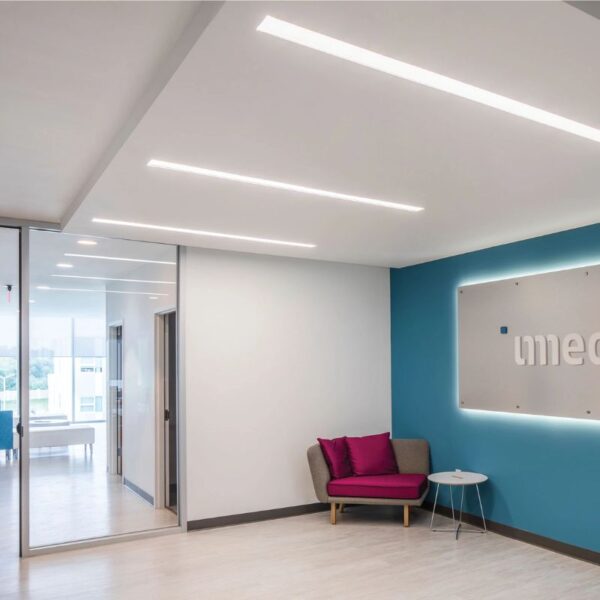
For high-end lobbies and executive corridors, visual clutter is the enemy. We are seeing a massive demand for mud-in flanges that allow the fixture to merge perfectly with the drywall. This “trimless” application creates a clean, uninterrupted line of light that feels like it is part of the building itself rather than an add-on.
- Flangeless Design: Eliminates visible metal edges for a pure architectural look.
- Precision Install: Requires careful coordination with drywall contractors to ensure a crack-free finish.
- Application: Best for low-ceiling conference rooms or minimalist reception areas.
Suspended & Surface Mount: Flexibility for Open-Plenum Designs
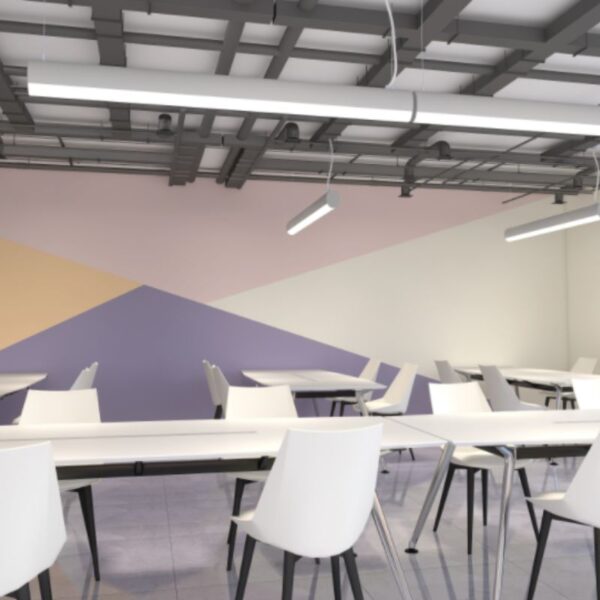
When dealing with exposed concrete ceilings or open-plenum offices, you need fixtures that can bridge the gap between the structure and the workspace. Suspended linear lighting allows us to drop the light source to the optimal height for task illumination while maintaining the industrial aesthetic of the space.
If you are navigating the complexities of open ceilings, sourcing suspended linear fixtures requires paying attention to suspension cabling and power feed aesthetics. For areas requiring reduced glare, using regressed linear hanging lights can help hide the light source from direct view, improving visual comfort for occupants below.
Why choose suspended?
- Height Adjustment: easily bypass HVAC ducts and sprinklers.
- Direct/Indirect Options: Send light up to highlight the ceiling while illuminating desks below.
- Surface Mount: Ideal when ceiling height is limited but recessing isn’t possible (e.g., concrete slabs).
Wall Grazing vs. Wall Washing: Accenting Architectural Textures
Lighting vertical surfaces changes the perceived size of a room, but the technique matters. I often see these two terms used interchangeably, but they achieve very different results.
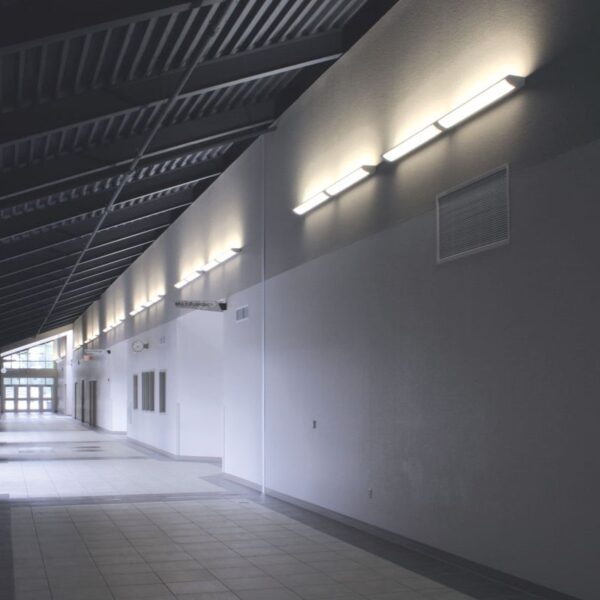
- Wall Grazing: The fixture is mounted tight against the wall (within 12 inches). The narrow beam angle scrapes down the surface, creating dramatic shadows that highlight textures like brick, stone, or wood slats.
- Wall Washing: The fixture is set further back (12+ inches). A wider beam angle bathes the wall in uniform light, flattening out imperfections and making the wall appear smooth and the room larger.
Compliance and Standards in North America
When we supply lighting for commercial projects across the US, adhering to local codes isn’t just about avoiding fines—it’s about safety and performance. Navigating the regulatory landscape ensures that our linear systems deliver long-term value without legal headaches.
Navigating NEC 410.10: Damp vs. Wet Location Ratings
Understanding the National Electrical Code (NEC) 410.10 is critical when specifying linear runs that transition between environments. We see a lot of confusion here, so let’s keep it simple:
- Dry Locations: Standard for most indoor offices and conference rooms.
- Damp Locations: Required for areas subject to moisture but not direct saturation, such as covered canopies or bathrooms.
- Wet Locations: Mandatory for any fixture directly exposed to rain or splashing water.
For most architectural interiors, a Damp Location rating provides enough protection against humidity without the bulk of a fully sealed waterproof housing. Always verify the rating on the spec sheet before installation to prevent premature failure.
DLC 5.1 Premium: Maximizing Energy Rebates and Project ROI
Energy efficiency is the biggest driver for retrofits today. We engineer our fixtures to meet high efficacy standards, often aligning with DesignLights Consortium (DLC) 5.1 Premium requirements. This certification is the gold standard for utility companies offering rebates.
- Higher Efficacy: Delivers more lumens per watt, reducing electricity loads.
- Better Controls: Mandates dimming capabilities (like 0-10V) for deeper energy savings.
- Faster Payback: Rebates can offset a significant portion of the upfront hardware cost.
By selecting high-performance 2″ recessed linear light fixtures, facility managers can drastically improve their Return on Investment (ROI) while complying with strict energy codes like Title 24 in California or IECC elsewhere.
Sustainable Manufacturing: Circular Economy and Recyclable Aluminum
Modern construction demands responsibility. We prioritize the use of high-grade extruded aluminum for our housing profiles. Unlike plastic composites that degrade and end up in landfills, aluminum is infinitely recyclable, supporting the circular economy.
Using aluminum offers two distinct advantages:
- Thermal Management: It acts as a superior heat sink, extending the lifespan of the LED chips.
- Green Building Credits: Recyclable materials contribute points toward LEED and WELL building certifications.
We focus on durability and material recovery, ensuring that the lighting we install today doesn’t become the waste problem of tomorrow.
Smart Controls and IoT Integration
In the world of commercial linear lighting, a fixture is only as good as its control system. We are moving past simple wall switches into an era where lighting acts as the nervous system of a smart building. Integrating intelligent controls isn’t just a “nice-to-have” add-on; it is essential for meeting strict energy codes and operational efficiency goals in the US market.
DALI-2 and 0-10V Dimming: Future-Proofing Your Install
When we supply architectural linear systems, we prioritize driver compatibility. The two heavyweights here are 0-10V dimming and DALI-2.
- 0-10V Dimming: This remains the standard for most commercial retrofits and cost-conscious projects. It provides reliable, smooth dimming down to 1% or 10%, ensuring visual comfort without flicker. It is simple, effective, and universally understood by electrical contractors.
- DALI-2 (Digital Addressable Lighting Interface): For projects requiring granular control, DALI-2 is the superior choice. It allows us to address individual fixtures within a continuous run, meaning you can dim specific sections of a linear profile while keeping others bright.
Choosing the right protocol early prevents costly rewiring later. For those navigating complex specs, understanding these protocols is a critical part of overcoming linear LED procurement challenges to ensure your hardware talks to your building management system (BMS) correctly.
Predictive Maintenance and AI-Driven Energy Monitoring
Modern linear fixtures equipped with smart drivers do more than emit light; they generate data. By integrating IoT-ready sensors into our aluminum profiles, facility managers gain visibility into real-time energy consumption and occupancy patterns.
Key benefits of IoT-ready linear lighting:
- Occupancy Sensing: Lights automatically adjust based on foot traffic, drastically cutting energy waste in corridors and open offices.
- Daylight Harvesting: Sensors detect ambient sunlight and dim the artificial lighting output to maintain a constant light level, optimizing energy usage.
- Maintenance Alerts: Smart drivers can report anomalies or failures before lights go dark, allowing for proactive rather than reactive maintenance.
We design our profiles to be robust enough to house these advanced components while maintaining a sleek, minimalist aesthetic. This ensures that your lighting infrastructure supports the data-driven demands of modern commercial real estate.
STAY IN THE LOOP
Subscribe to our free newsletter.
Leave A Comment
Retrofit LED Lighting Solutions Are soaring energy bills, relentless ballast [...]

Struggling to cut operational costs while upgrading your facility’s lighting [...]
The Financial & Operational Business Case Upgrading to energy efficient [...]
Are you worried about overhead head clearance, or tired of [...]