Why Boutique Lighting Design Drives Sales
Lighting is never just a utility in retail; it is your most powerful silent salesperson. In my work designing high-performing store environments, I see firsthand how strategic illumination transforms casual window shoppers into paying customers. When you elevate your boutique lighting design, you do not just illuminate products—you curate an emotional journey that justifies premium pricing and accelerates purchasing decisions.
Visual Merchandising Psychology and Customer Flow
The human eye instinctively follows light. By leveraging visual merchandising lighting, we can map out a customer’s journey across your floor without adding physical barriers.
- Focal Anchor Points: I direct the eye toward high-margin hero displays using narrow-beam high CRI LED spotlights, creating clear points of interest that pull foot traffic inside.
- Intuitive Navigation: Graduating light levels subtly leads clients through your collections, guiding them naturally from prime display tables toward the fitting rooms.
- Curiosity and Discovery: By balancing brighter focal zones with softer ambient spaces, shoppers feel compelled to explore darker, secondary alcoves.
| Lighting Technique | Psychological Impact | Retail Result |
|---|---|---|
| High Accent Contrast (5:1 Ratio) | Draws immediate focus to hero apparel | Increases grab-and-touch rates |
| Warm Ambient Wash | Triggers relaxation and luxury perception | Reduces customer rush and anxiety |
| Vertical Wall Illumination | Expands visual depth and store boundaries | Guides foot traffic deep into the shop |
The Economics of Atmosphere and Dwell Time
Retail dwell time optimization directly dictates your bottom line. Research consistently confirms that for every additional minute a customer spends browsing, basket size increases proportionately.
- Atmospheric Immersion: Harsh, clinical fixtures cause subconscious visual fatigue. Soft, carefully calibrated architectural lighting calms the nervous system, allowing clients to unwind and engage with your brand.
- Fabric Tactility: Proper retail lighting reveals the true richness, drape, and texture of premium garments. When fabrics look luxurious under the beam, perceived value spikes.
- Extended Browsing: A balanced lighting scheme keeps shoppers comfortable, directly increasing their willingness to explore complementary pieces and try on complete outfits.
How to Avoid Flat and Uninspired Lighting
The quickest way to devalue a luxury clothing boutique is to flood the floor with uniform, uncalibrated downlights. Flat illumination eliminates shadows, erases fabric depth, and renders your space indistinguishable from a generic discount store.
- Stop Over-Lighting the Floor: Light the merchandise, not the empty walkways. I keep floor foot-candles moderate while concentrating punchy, targeted lumens directly on garment racks and display tables.
- Harness Contrast Ratios: Avoid uniform brightness. Aim for a minimum 3:1 to 5:1 contrast ratio between accent spotlights and general ambient lighting to carve out dimension and drama.
- Ditch Wide Flood Beams: Replace wide-angle troffers with directional retail track lighting systems featuring interchangeable beam angles (15 ° to 36 °). This lets you sculpt sharp, crisp shadows that make textures pop.
- Layer with Precision: Combine architectural downlights, concealed millwork LEDs, and decorative identity pendants. Layering prevents visual monotony and gives your boutique a curated, high-end gallery aesthetic.
Technical Standards for Boutique Lighting Design
Getting the technical specs right makes the difference between a high-end space and a bargain bin look. When I plan store layouts, I treat lighting like silent sales architecture. If the numbers behind your light engines fail, your apparel and displays will look flat and cheap under overhead glow.
Color rendering index and why CRI 95+ and R9 matter
Standard retail LEDs usually stop at CRI 80, which completely dulls rich fabrics, jewelry, and human skin tones. In premium boutique lighting design, I never specify anything under CRI 95.
Standard CRI ratings only measure pastel swatches (R1–R8). The real test for fashion retail is the saturated red value, known as R9.
- Why R9 matters: Deep reds, rich browns, warm woods, and healthy human skin tones look gray or sickly under fixtures with low R9 values.
- The baseline: I insist on an accurate color rendering index featuring an R9 score of 80 or higher.
- The payoff: High-end silks pop, leather looks premium, and customers feel radiant looking at themselves in mirrors.
Choosing the right correlated color temperature (CCT)
Your correlated color temperature sets the mood instantly. Choosing the wrong CCT can make warm wools look dirty or cool activewear look faded.
| Target Atmosphere | CCT Range | Best Product Categories |
|---|---|---|
| Intimate & Luxurious | 2700K – 3000K | High-end couture, evening wear, leather goods, fine jewelry |
| Crisp & Contemporary | 3500K | Streetwear, tailored suits, everyday apparel, footwear |
| Clean & Modern | 4000K | Technical activewear, minimalist denim, wellness and beauty |
Keep your CCT consistent across every fixture family. Mixing 3000K track heads with 4000K shelf lighting immediately degrades the architectural quality of your store.
Balancing contrast ratios and glare control (UGR < 19)
Flat, uniform light kills visual interest. Effective retail lighting relies on contrast:
- The 3:1 to 5:1 rule: Set accent spotlighting on feature displays at three to five times the brightness of the ambient walkway light. This naturally pulls eyes straight to high-margin merchandise.
- Taming glare: Raw, exposed light diodes blind shoppers and cause visual fatigue.
- Anti-glare optical design: I always specify optics engineered for a Unified Glare Rating under 19 (UGR < 19). Deep-recessed reflectors, honeycomb louvers, and cross-baffles keep the focus on the product, not the light bulb.
Four Core Layers of Boutique Lighting Design
When I build out a boutique concept, I never rely on a single light source. High-converting retail spaces depend on visual depth and intentional hierarchy. By layering four specific tiers of illumination, I guide the shopper’s eyes across the sales floor, pull focus to high-margin pieces, and create an atmosphere where customers want to linger.
Implementing proven boutique lighting ideas for retail design comes down to balancing these four distinct layers:
| Lighting Layer | Recommended Lux | Primary Optical Choice | Strategic Role |
|---|---|---|---|
| Accent | 800 – 1,500 lux | 15° – 24° Narrow Spot | Grabs immediate attention for hero items |
| Ambient | 200 – 300 lux | Wide flood, diffused panels | Establishes spatial comfort and navigation |
| Task | 400 – 500 lux | 36° – 60° Shielded Downlights | Ensures smooth transactions and POS operations |
| Decorative | Variable (Low glare) | Pendants, sconces, chandeliers | Solidifies brand identity and aesthetic appeal |
Accent lighting to highlight hero products
Accent lighting is your primary visual sales tool. I use high-output, narrow-beam spotlights to create an accent-to-ambient contrast ratio of at least 3:1 (and up to 5:1 for luxury displays).
- Focused beam angles (15° to 24°): Deliver punchy contrast that separates premium mannequins and featured shelving from the rest of the floor.
- Micro-adjustable heads: Allow instant repositioning whenever seasonal visual merchandising layouts shift.
- High-draw presentation: Makes textures, stitching, and rich fabric tones pop instantly under crisp focal beams.
Ambient lighting for baseline spatial comfort
Ambient illumination serves as the backdrop. If it is too bright, your merchandise looks flat; if it is too dim, navigating the store feels unsettling.
- Keeps walking paths and open zones evenly illuminated at a comfortable 200 to 300 lux.
- Softens harsh shadows cast by focused accent spots without washing out contrast.
- Utilizes indirect cove lighting or wide-beam architectural fixtures to make compact boutiques feel open and inviting.
Task lighting for cash wrap and checkout counters
Checkout zones demand functional precision. The cash wrap is where transactions happen, items are packaged, and final brand impressions are made.
- Targeted 400 to 500 lux: Gives staff clear visibility to inspect garments, read tags, and handle POS terminals accurately.
- Anti-glare shielding: Prevents reflections on payment touchscreens and shields cashiers' eyes during long shifts.
- Uniform color matching: Keeps counter downlights at the exact same color temperature as display lighting so clothing doesn't shift color at the register.
Decorative fixtures to reinforce brand identity
Decorative lighting is the visual signature of your retail interior. While functional layers do the heavy optical lifting, selecting the right types of commercial lighting fixtures for retail reinforces your brand's personality the moment a shopper steps inside.
- Statement centerpieces: Sculptural chandeliers or oversized minimalist pendants serve as architectural anchors over feature display tables.
- Photogenic focal points: Provide visually engaging backdrops that encourage organic social shares and user-generated content.
- Warm, low-output glow: Adds warmth and luxury without interfering with the calibrated beam angles of nearby accent fixtures.
Zone-by-Zone Boutique Lighting Design Guide
Every square foot of your shop serves a distinct sales objective. When I lay out a boutique lighting design plan, I treat each zone as its own micro-environment, tailoring the beam spreads, intensities, and fixture placements to guide shopper movement and maximize conversions.
Window displays and storefront illumination
Your window display has less than three seconds to stop foot traffic. Street-facing glass naturally reflects daylight, turning your featured mannequins into dark silhouettes if the fixtures lack sufficient punch.
- Target punchy contrast: Aim for 1,500 to 2,500 lux on featured mannequins, creating at least a 3:1 contrast ratio against the sidewalk ambient light.
- Use narrow-beam track heads: Equip retail track lighting systems with 15° to 24° optics to carve your hero garments out of the background.
- Aim off-axis: Angle high CRI LED spotlights at 30° to 45° from the vertical to eliminate harsh shadows on facial features while keeping light from bouncing directly back into the glass.
Merchandise walls and vertical perimeter lighting
Floor displays catch immediate attention, but brightly illuminated perimeter walls draw customers deep into your store. A dark perimeter makes any boutique feel cramped and cluttered.
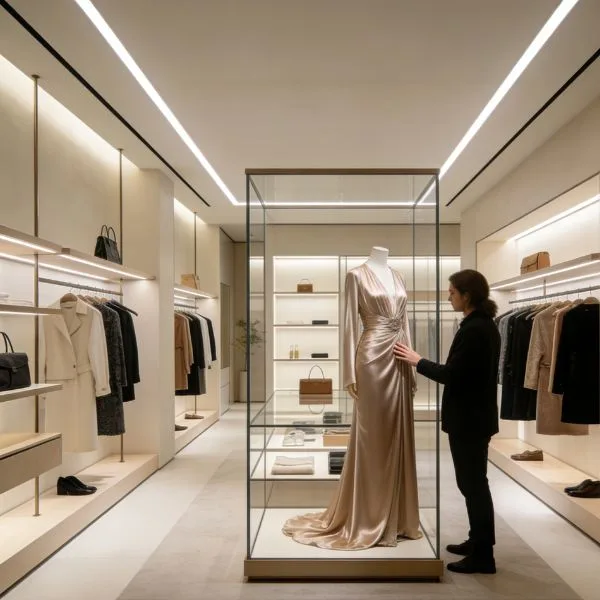
- Vertical wall washing: Standard downlights leave wall-mounted racks dark near the bottom. Specifying proper recessed linear wall wash lighting spreads a smooth curtain of light across the entire vertical plane from ceiling to baseboard.
- Integrated millwork strips: Route miniature architectural linear lighting directly into display shelving. Hiding the light source under each shelf shelf-front illuminates folded denim, handbags, and folded knits without blinding shoppers.
- Contrast balance: Keep your perimeter walls roughly 2 to 3 times brighter than your walkways to establish clear visual wayfinding.
| Store Zone | Target Illuminance (Lux) | Primary Beam Type | Core Objective |
|---|---|---|---|
| Window Display | 1,500 – 2,500 lx | 15° – 24° Spot | Stop foot traffic, pierce glass reflections |
| Perimeter Walls | 700 – 1,000 lx | Asymmetric Wall Wash | Expand spatial depth, showcase garment detail |
| Fitting Rooms | 400 – 600 lx | Diffuse Vertical Linear | Flatter skin tones, boost try-on conversions |
| Wrap Counter / POS | 400 – 500 lx | Medium Flood + Decorative | Glare-free checkout, final impulse visibility |
Fitting room lighting that drives conversions
The fitting room is where buying decisions are made, yet it is routinely neglected. A single overhead downlight casts deep shadows under eyes, accentuates skin blemishes, and pushes customers out of the stall empty-handed.
- Flattering vertical illumination: Flank the mirror with vertical diffuse LED bars mounted at eye level. This fills in shadows across the customer’s face and body with soft, even light.
- Accurate color rendering: Never settle for standard lighting here. Insist on fitting room illumination with a CRI of 95+ and an R9 value above 80 so fabrics, makeup, and skin tones render naturally.
- Warm-neutral color temperature: Keep fitting rooms at 3000K. It delivers a golden, healthy glow without distorting fabric colors.
Point of sale and wrap counter lighting
The cash wrap requires balanced task lighting that handles payments smoothly while driving high-margin impulse sales.
- Glare-free transaction zone: Position downlights directly over the counter surface, slightly forward of the register, to avoid washouts or reflections on digital payment terminals.
- Impulse display accents: Use low-wattage, narrow-beam spotlights over small accessory racks and display trays near the register to keep small items glistening.
- Brand-defining statement pieces: Suspend architectural pendants or decorative fixtures low over the wrap counter. This visually anchors your point of sale and reinforces the aesthetic identity of your clothing boutique lighting.
Fixture Selection for Boutique Lighting Design
Selecting the right hardware is where a boutique lighting design transitions from concept to revenue driver. I treat fixtures as precision tools: they must showcase the merchandise flawlessly while disappearing into the ceiling architecture.
Architectural Track and Magnetic Rail Systems
A modern retail track lighting system forms the backbone of an adaptable sales floor. Merchandising layouts change with every season, and your lighting must move with them.
- Low-voltage magnetic track light systems: Operating on a 48V rail, these let my team click, slide, and swap fixtures in seconds without hiring an electrician.
- Streamlined visual profile: Ultra-slim recessed or surface-mounted tracks keep ceilings uncluttered, focusing eyes entirely on the garments.
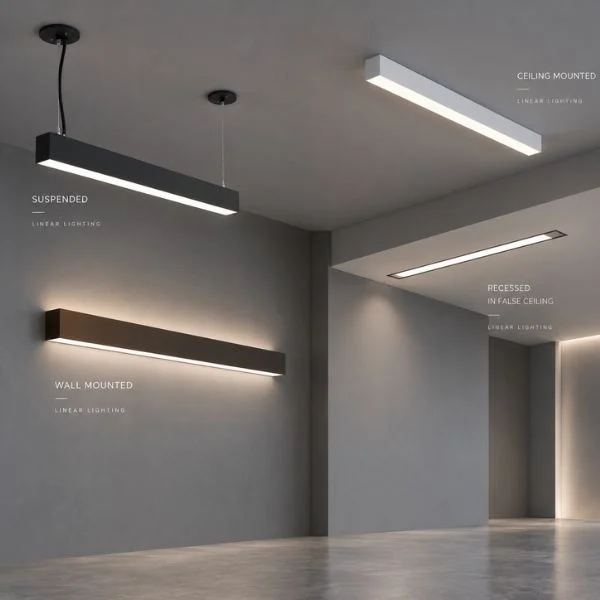
- Interchangeable modules: Combine linear diffusers for ambient base levels with adjustable spots on the exact same run.
| System Type | Best Application | Key Benefit |
|---|---|---|
| Magnetic Track (48V) | High-turnover fashion racks | Tool-free repositioning, minimalist ceiling line |
| Commercial 3-Circuit Track | Large boutique floors & high ceilings | High lumen output, multi-switch circuit control |
| Recessed Downlights | Fixed checkout & transition zones | Clean ceiling aesthetic with deep glare cutoff |
Precision Recessed Spotlights and Downlights
For fixed zones, high CRI LED spotlights deliver deliberate, dramatic punch. I specify fixtures with deep-set secondary reflectors to achieve an anti-glare optical design (UGR < 19).
- Beam angle distribution: Use narrow 15° to 24° spots to create high-contrast highlights on hero displays, and wider 36° floods for general perimeter racks.
- Optical accessories: Honeycomb louvers and snoots eliminate stray spill light, protecting customer sightlines from uncomfortable glare.
- Gimbal flexibility: 360-degree rotation and 30-degree tilt ensure beam centers land squarely on mannequin torsos, not the empty floor.
Linear LED Integration for Millwork and Shelving
Architectural linear lighting integrated directly into cabinetry turns flat shelving into high-end presentation displays. Unlit shelves leave lower garments in dark shadows; integrated lighting balances the display evenly from top to bottom.
- Concealed installation: Rout aluminum extrusions into millwork edges with 45-degree angled profiles to direct illumination backward onto folded items.
- Milky diffusion: High-density LED tape (at least 120 LEDs/meter) paired with frosted diffusers prevents visible diode spotting on glossy accessories and leather goods.
- Heat management: Heavy-gauge aluminum channels pull thermal energy away from the strip, protecting fabric fibers from heat degradation.
Smart Drivers, Dimming Controls, and Flicker-Free Video Performance
Fixtures are only as reliable as the dimmable commercial LED drivers powering them behind the walls. Today’s boutique shoppers constantly share their try-on hauls and store experiences on social media, making flicker-free performance mandatory.
I specify high-frequency drivers (above 3,000 Hz) to eliminate the rolling black shutter bars that ruin smartphone videos. Pair these with smooth 0-10V or DALI dimming curves down to 1% to tune daytime drama and evening intimacy effortlessly. When selecting commercial fixtures, ensuring equipment meets verified standards like UL/ETL compliance for commercial lighting installations keeps your electrical systems safe, code-compliant, and built for continuous commercial run times.
Common Boutique Lighting Design Mistakes to Avoid
Even a beautifully curated boutique will struggle with conversions if the illumination works against the inventory. When auditing retail spaces, I routinely spot the same recurring missteps that degrade perceived value and distract shoppers. Fixing these operational blind spots immediately upgrades your store experience.
Washing Out the Floor Instead of Merchandise
One of the quickest ways to ruin an intimate shopping vibe is flooding the circulation paths while leaving display fixtures underlit.
- The Problem: Broad, symmetrical downlights pointing straight into open walkways waste energy and make a showroom feel like a supermarket.
- The Fix: Shift luminous flux toward vertical display planes and display tables. Using purpose-built commercial retail lighting fixtures allows you to maintain an intentional 3:1 or 5:1 contrast ratio between your products and the floor aisles.
- The Rule: Light the merchandise, not the tiles. Keep walkways soft and guide the shopper's eye straight to key garments and displays.
Mismatching Color Temperatures Across Fixtures
Nothing screams amateur store planning faster than an erratic mix of warm and cool white tones in the same sightline.
- Inconsistent Kelvin ratings: Mixing a 3000K track head with a 4000K recessed downlight creates visual chaos and distorts product hues.
- Perceived quality drop: Disjointed correlated color temperatures (CCT) make high-end apparel look faded, muddy, or cheap.
- Standardize your spec: Lock in one core CCT across your ceiling plan—typically 3000K for warm lifestyle brands or 3500K for crisp contemporary fashion—and stick to it across all ambient and accent layers.
Overheating Sensitive Retail Products
Thermal management is a critical yet frequently ignored facet of boutique lighting.
- Old lamp tech hazards: Halogen and metal halide spotlights emit intense infrared heat, which dries out leather goods, fades dyed silks, and melts cosmetics.
- Thermal build-up: Trapped heat inside display cases or low-ceiling alcoves raises overall cooling costs and makes browsing uncomfortable.
- The modern solution: Deploying properly heatsunk commercial indoor LED lighting fixtures keeps the beam cold, protecting sensitive fabrics while lowering ambient HVAC load.
Relying on Static Non-Adjustable Layouts
Retail floor plans change constantly, yet many owners still install fixed, non-directional luminaires.
| Layout Type | Flexibility | Merchandising Impact |
|---|---|---|
| Fixed Downlights | Rigid / Non-adjustable | Creates dead zones whenever racks or display tables shift |
| Track & Rail Systems | Fully modular | Easily re-aimed, swapped, or expanded for seasonal drops |
Rigid grids force you to merchandise around the ceiling rather than designing lighting around the product. A winning boutique lighting design relies on adjustable track spots and movable magnetic heads so your lighting adapts instantly to every floor reset.
Frequently Asked Questions About Boutique Lighting Design
When clients approach me to upgrade their retail spaces, they usually have the same practical questions about balancing aesthetics, output, and sales performance. Here are straightforward answers to the most common challenges in boutique lighting design.
How Many Lux Does a Fashion Boutique Need?
Lighting levels depend on the zone, but a boutique should never rely on flat, uniform brightness. Instead, aim for layered illumination using a 3:1 to 5:1 contrast ratio:
- Ambient Circulation Areas: 300 to 500 lux for comfortable walking paths and spatial ease.
- Merchandise Racks and Wall Shelving: 800 to 1,200 lux to make textures and colors pop.
- Feature Displays and Focal Points: 1,500 to 2,500 lux using high CRI LED spotlights to pull eyes toward high-margin items.
- Cash Wrap and POS Counters: 400 to 600 lux for functional, glare-free transactions.
For a deeper dive into zoning setups, explore our guide to premium lighting for clothing stores to see exact beam layouts in action.
What Color Temperature Works Best for Luxury Retail?
For high-end boutiques, I consistently recommend 2700K to 3000K (Warm White).
Warm light creates an inviting, residential-level ambiance that encourages shoppers to slow down and stay longer. It flatters skin tones, complements rich materials like brass, wood, and leather, and builds an upscale mood.
If your inventory leans heavily toward street fashion, stark white minimalism, or cool athletic apparel, shift to 3500K. Avoid 4000K or higher in luxury environments—it feels sterile and clinical rather than exclusive.
Why Is the R9 Color Rendering Value Critical for Clothing Stores?
Standard Color Rendering Index (CRI Ra) only measures pastels and neutral tones from R1 to R8. It completely ignores R9, which measures saturated red.
| Metric | Standard Retail Target | Why It Matters for Boutiques |
|---|---|---|
| General CRI (Ra) | 90+ | Ensures base fabrics look accurate without muddy shifts. |
| R9 Value | 50+ (Ideally 80+) | Reproduces deep reds, corals, warm undertones, and natural skin tones. |
Without a high R9 score: Warm-colored apparel looks dull, brownish, and cheap. Customers look washed out and tired in the mirrors, directly hurting fitting room conversion rates.
Always specify fixtures with CRI 95+ and an R9 value above 80 to ensure your merchandise appears exactly as the designers intended.
How Do You Prevent Reflections on Storefront Glass?
Storefront glass reflections happen when outdoor daylight is brighter than the interior window display, turning the window into a giant mirror. To defeat this effect:
- Punch Up Display Lux Levels: Push accent track heads to 2,000–3,500 lux directly onto mannequins and key merchandise to compete with bright exterior daylight.
- Position Spotlights at a 45-Degree Angle: Aim narrow-beam fixtures down and slightly toward the sides of the display rather than straight at the glass.
- Use Deep Matte Backdrops: Darker, non-reflective backdrop panels absorb daylight and stop bounce-back reflections.
- Integrate Low-Glare Optics: Mount anti-glare snoots and honeycomb louvers on your LED lighting for retail stores to focus light strictly on the product, leaving passing shoppers with a clean, transparent view into your store.
STAY IN THE LOOP
Subscribe to our free newsletter.
Leave A Comment

Explore types of hanging lights including pendant chandeliers and cluster designs to find the perfect style for every room