Core Photometric Standards for Library Lighting Design
Engineering an effective educational lighting environment requires balancing visual comfort, task clarity, and regulatory compliance. We design our commercial optical systems around strict photometric benchmarks to eliminate eye strain and ensure optimal readability across varied physical tasks.
Target Illuminance Levels for Study and Stack Areas
Proper lux levels for study areas vary significantly based on visual task intensity and plane orientation. While horizontal surfaces demand uniform light distributions, vertical bookstacks require specialized asymmetric distributions to avoid shadow drop-off on lower shelving tiers.
| Library Application Zone | Target Illuminance (Lux) | Illuminance (Foot-Candles) | Plane / Measurement Focus |
|---|---|---|---|
| Quiet Study & Reading Desks | 500 Lux | ~46–50 fc | Horizontal Workplane (0.75m AFF) |
| High-Density Bookstacks (Top to Bottom) | 200–300 Lux | ~20–30 fc | Vertical Plane (0.15m to 2.0m AFF) |
| Computer Labs & Digital Stations | 300–400 Lux | ~28–37 fc | Screen-Adjacent Workplane |
| Circulation & General Wayfinding | 150–200 Lux | ~14–19 fc | Floor Level |
| Archive & Rare Book Collections | 100–150 Lux | ~10–14 fc | Horizontal / Low UV & IR Protection |
Unified Glare Rating (UGR < 19) to Eliminate Visual Fatigue
Direct and reflected glare are the primary contributors to visual fatigue in long-duration study environments. Educational lighting standards mandate low UGR reading light systems across all primary work zones.
- Micro-Prismatic Diffusers: Structured lenses shield the light source at critical viewing angles, cutting direct luminance above 65 degrees.
- Deep Recessed Optics: Darklight reflectors and secondary baffle geometry suppress high-angle beam intensity.
- Direct/Indirect Distribution: Bi-directional architectural fixtures bounce 20% to 40% of the light off ceilings to soften ceiling-to-fixture contrast and achieve UGR < 19 consistently.
Correlated Color Temperature (CCT) and Circadian Support
Lighting affects cognitive performance and alertness. We utilize tunable white human centric lighting systems ranging between 2700K and 5000K to support biological rhythms throughout extended operating hours:
- 4000K (Neutral White): Ideal default CCT for general reading rooms and collaborative study zones to boost concentration.
- 3000K–3500K (Warm White): Best suited for casual lounges, perimeter seating, and heritage archive collections.
- Dynamic Circadian Scheduling: Automated DALI-enabled transitions supply crisp 5000K morning-to-midday light to stimulate focus, gradually warming to 3000K in evening sessions.
High Color Rendering Index (CRI > 90) for Visual Clarity
Standard commercial lighting (CRI 80) distorts colored maps, photographic archives, and fine book print. We mandate a minimum CRI > 90 with high saturated color fidelity:
- R9 Value ≥ 50: Critical for high-red color rendering, vital for accurately viewing historical texts, bindings, and multi-color charts.
- Spectral Uniformity: High Fidelity ($R_f \ge 90$) and Gamut ($R_g \ge 100$) metrics ensure true-to-life clarity for both digital displays and printed materials without chromatic distortion.
Zone-by-Zone Library Lighting Design Strategies
Every modern library combines quiet individual research, active digital labs, high-density storage, and open social hubs under one roof. When we develop a comprehensive library lighting design, we break the facility into dedicated functional zones to balance optical performance, visual comfort, and power consumption.
+———————————————————————————–+
| ZONE-BY-ZONE LIGHTING MATRIX |
+———————-+——————–+——————-+——————-+
| Zone / Area | Target Illuminance | Optical Strategy | Visual Goal |
+———————-+——————–+——————-+——————-+
| High-Density Stacks | 150-200 lx (Vert.) | Asymmetric Linear | Spine Legibility |
| Quiet Study Desks | 500 lx (Horiz.) | Direct / Indirect | UGR < 19, No Eye |
| | | Low-Glare Diffuser| Fatigue |
| Digital Workstations | 300-400 lx | Micro-Prismatic | 3:1 Luminance |
| | | Wide Beam (80-90°)| Contrast Ratio |
| Collaborative Hubs | 350-450 lx | Acoustic Pendants | Noise Reduction & |
| | | (NRC ≥ 0.75) | Dynamic Dimming |
| Atriums & Corridors | 100-150 lx | Continuous Linear | Visual Guidance & |
| | | Recessed Downlight| Wayfinding |
+———————-+——————–+——————-+——————-+
High-Density Bookstacks and Vertical Illuminance Solutions
Standard downward-facing troffers leave bottom shelves dark while overexposing top tiers. Bookstack aisles require dedicated vertical illuminance on bookstacks rather than high horizontal foot-candles on the floor.
- Target Metrics: 150–200 lux along vertical shelf faces from the top shelf down to the floor level (minimum 100 lux on the lowest shelf).
- Optics: Asymmetric optic linear lighting or double-asymmetric batwing lenses positioned directly over aisle centerlines.
- Fixture Layout: Continuous linear LED runs mounted parallel to stack aisles, preventing harsh shadows cast by patrons browsing adjacent bays.
Quiet Study Areas and Glare-Free Reading Desk Illumination
Deep concentration requires balanced ambient light paired with high-performance task illumination. In reading zones, we prioritize micro-louvers and wide-distribution diffusers that mitigate harsh reflections on matte paper and electronic tablets. Implementing specialized direct and indirect glare control keeps ambient luminance uniform across expansive desk surfaces.
- Illuminance Target: 500 lux maintained across the horizontal reading surface.
- Glare Threshold: Unified Glare Rating (UGR) strictly below 19.
- Fixture Selection: Direct indirect suspended lighting throwing 60–70% downward light for task focus and 30–40% upward light to eliminate ceiling cavity shadows.
Computer Labs and Digital Workstations with Balanced Contrast Ratios
Modern digital research spaces require controlled contrast ratios to prevent screen washout and eye strain caused by high luminance disparities.
- Illuminance Target: 300–400 lux maintained horizontal light (lower than pure paper reading zones to optimize monitor legibility).
- Luminance Ratios: Maintain a 3:1 maximum contrast ratio between the active monitor screen and the immediate desk background.
- Beam Control: Low-profile recessed or pendant luminaires with micro-prismatic shielding to block high-angle stray light (cutoff angle > 60°).
Collaborative Learning Spaces and Acoustic Lighting Integration
Multi-use group study zones require flexible illumination paired with acoustic management to mitigate reverberation from open architecture and hard surfaces.
- Integrated Acoustic Fixtures: Acoustic pendant light fixtures built with high-density PET felt baffles (Noise Reduction Coefficient NRC ≥ 0.75) integrated with dimmable LED arrays.
- Lighting Control: Independent multi-scene dimming (0–10V or smart DALI dimming control) configured for presentation, group discussion, and video-conferencing modes.
- Color Temperature: Tunable white human centric lighting shifting from 4000K for active midday work sessions down to a warm 3000K for relaxed evening discussions.
Atriums, Circulation Paths, and Intuitive Wayfinding Illumination
Open entrance atriums and main corridors guide traffic, connect distinct library wings, and set the architectural tone of the facility.
- Illuminance Target: 100–150 lux for safe passage and clear perimeter orientation.
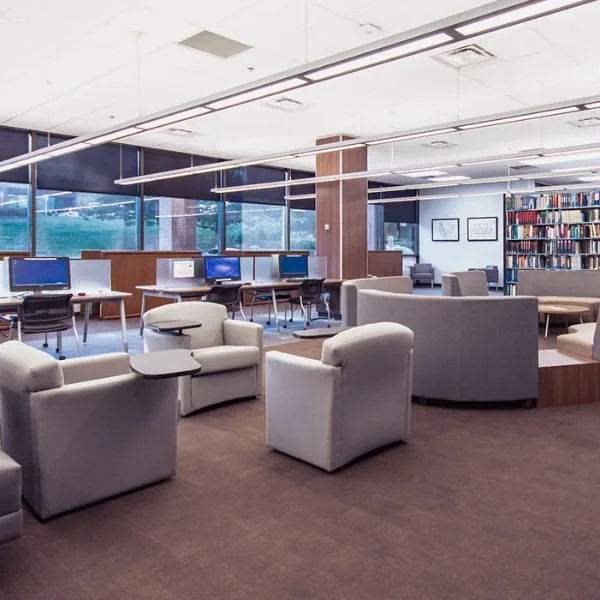
- Linear Library Lighting: Continuous recessed or suspended architectural linear LED lighting arrays that delineate major pathways and draw the eye naturally toward reception and checkout desks.
- Perimeter Accent: Wall-washers paired with narrow-beam spotlights (CRI > 90) to highlight directory kiosks, curated rare-book vitrines, and wall graphics.
Best Commercial Library Lighting Fixture Types
Selecting the right fixtures for a library requires balancing optical precision, visual comfort, and architectural integration. We configure commercial luminaires to deliver high performance across diverse zones while maintaining clean, modern aesthetics.
+—————————————————————————————————+
| Fixture Type | Recommended Zones | Key Photometric / Functional Specs |
+—————————————————————————————————+
| Architectural Linear | Reading halls, open | Direct/indirect distribution (70/30), |
| LED Systems | bookstacks, corridors | UGR < 19, continuous run trunking |
+—————————————————————————————————+
| Acoustic LED Pendants | Collaborative spaces, | Sound absorption NRC ≥ 0.85, micro-prismatic |
| | high-ceiling study zones | optics, high-efficacy glare control |
+—————————————————————————————————+
| Low-UGR Recessed | Circulation paths, | Deep-regressed baffle, UGR < 16, |
| Downlights | lounges, restrooms | beam angles 30°–60°, CRI 90+ |
+—————————————————————————————————+
| Precision Track | Art galleries, special | 90° tilt / 355° rotation, zoomable optics, |
| Spotlights | collections, displays | CCT tuning, high color fidelity |
+—————————————————————————————————+
Architectural Linear LED Lighting Systems for Continuous Runs
For main reading rooms and open-plan book halls, continuous-run linear fixtures deliver seamless illumination without visual clutter. We configure these systems with direct/indirect light distributions—typically 70% downward light for task performance and 30% upward light to brighten the ceiling plane and eliminate cave effects.
- Optical Control: Equipped with micro-prismatic diffusers or batwing lenses to eliminate harsh glare on computer screens and printed materials.
- Continuous Trunking: Seamless mechanical and electrical connections allow uninterrupted runs exceeding 50 meters from a single power feed.
- Compliance & Selection: For complex multi-tier layouts, consult our linear LED lighting guide for commercial spaces to determine optimal driver configurations and lens options.
Acoustic LED Pendant Fixtures for Multi-Use Noise and Light Management
Modern library architecture embraces high ceilings and hard surfaces, which frequently leads to acoustic reverberation issues in shared zones. We integrate sound-dampening PET felt acoustic materials directly into architectural pendant luminaires.
- Dual-Function Performance: Provides Class-A sound absorption (NRC ≥ 0.85 to 1.0) while delivering precision study room lighting.
- glare-Free Visual Field: Recessed optical modules maintain a strict UGR < 19 threshold, keeping collaborative areas quiet both acoustically and visually.
- Design Flexibility: Available in geometric forms—rings, panels, and linear baffles—to serve as striking architectural focal points.
Recessed Low-UGR Downlights for Circulation and Lounges
Circulation pathways, lounge seating, and perimeter zones require discreet fixtures that blend cleanly into ceiling grids without casting distracting hotspots.
- Deep-Regressed Optics: Deep reflectors and anti-glare honeycomb louvers hide the light source from direct sightlines, achieving UGR < 16 ratings.
- Uniform Ambient Wash: Wide, soft beam distributions provide comfortable transitional lux levels (150–200 Lux) that guide visitors naturally through the facility.
- Compact Integration: Shallow housing depths fit tight plenum spaces in retrofit or low-clearance building designs.
Precision Track Lighting and Adjustable Spotlights for Exhibitions
Libraries routinely host specialized rare book exhibits, local history displays, and art installations that require dynamic, directional lighting.
- Precision Beam Tuning: Adjustable beam angles (15° to 60°) and interchangeable snoots or barn doors direct light strictly onto displays without causing glare in adjacent study bays.
- Preservation Standards: High-fidelity LEDs with zero UV/IR emissions and CRI 95+ / R9 > 80 protect fragile archival materials and paper from photo-degradation while rendering fine bindings and graphics with pristine color accuracy.
Smart Lighting Controls and Energy Optimization
Smart controls transform commercial library lighting design from a static utility into a dynamic, energy-efficient infrastructure. By pairing automated sensing with addressable drivers, we cut facility energy use by 35% to 60% while extending LED fixture lifespans across large academic and public footprints.
+————————–+———————–+—————————–+
| Control Strategy | Typical Target Area | Energy Reduction Impact |
+————————–+———————–+—————————–+
| Daylight Harvesting | Window Perimeters | 30% – 45% |
| Aisle-Specific Sensors | High-Density Stacks | 40% – 60% |
| Centralized Network DALI | Reading Halls & Hubs | 20% – 35% (via scheduling) |
+————————–+———————–+—————————–+
Automated Daylight Harvesting Systems Along Perimeters
Large perimeter glazing brings abundant natural light into reading perimeters, but without intelligent dimming, it leads to over-illumination and wasted wattage.
Continuous Closed-Loop Photosensors: We integrate optical sensors within 15 to 20 feet of exterior windows to dynamically adjust architectural linear LED output.
Smooth Lux Compensation: Fixtures dim smoothly down to 1% to maintain a steady 400–500 lux target at desk surfaces without abrupt, distracting steps in brightness.
Aisle-Specific Occupancy and Vacancy Sensors
Bookstack corridors experience intermittent, unpredictable foot traffic throughout the day. Running 100% full output across dozens of vacant book aisles inflates operating costs unnecessarily.
Integrated PIR & High-Frequency Sensors: Micro-sensors embedded directly into each linear run detect patron presence instantly.
Bi-Level Standby Dimming: Aisles drop to a 10%–20% background safety level (50 lux) when vacant, ramping up to the full 200–300 vertical lux standard within milliseconds of motion detection.
DALI-2 and 0-10V Centralized Network Control Protocols
A robust control architecture allows facility operators to rezone spaces effortlessly without rewiring fixtures.
DALI-2 Open Standards: Provides bidirectional feedback per fixture, enabling automated fault reporting, runtime logging, and granular addressability down to individual luminaires.
0-10V & PWM Systems: Ideal for straightforward, continuous group dimming in quiet study halls and multi-purpose computer labs.
Tunable White Integration: Central schedules automate circadian color temperature transitions from 4000K daytime alertness to 3000K evening focus.
Meeting ASHRAE 90.1, Title 24, and LEED/WELL Green Standards
Compliance with stringent energy codes requires strict adherence to Lighting Power Density (LPD) limits.
Target LPD Thresholds: Modern library lighting layouts must achieve an LPD well below 0.60 W/sq.ft. to satisfy ASHRAE 90.1 and California Title 24 mandates.
Building Certification Credits: Full addressability and automated daylight controls directly contribute to LEED v4.1 Energy & Atmosphere credits and WELL v2 Light features (circadian lighting design, glare avoidance, and visual balance).
Certified Hardware: We build and test our luminaires to align with rigorous safety and performance guidelines, ensuring seamless compliance with required certifications and North American standards for commercial projects.
Common Library Lighting Mistakes to Avoid
In our engineering and photometric design work, we regularly audit spaces where well-intentioned installations fall short of practical needs. Successful library lighting design requires balancing visual comfort, strict energy metrics, and practical maintenance. Below are the most frequent mistakes we encounter and the straightforward fixes we implement to resolve them.
Ignoring Vertical Illuminance on Lower Book Shelves
The most widespread error in bookstack aisles is designing exclusively for horizontal foot-candles at floor level. Standard downward-firing fixtures leave titles on lower shelves cast in deep shadow.
- The Issue: Light levels drop below 80 lux on the bottom two tiers, forcing patrons to stoop and strain to read spines.
- The Fix: Deploy linear luminaires equipped with asymmetric or batwing optical distributions. This technique directs punchy, wide-angle illumination down the stack face, maintaining a balanced vertical illuminance on bookstacks of at least 150 to 200 lux from top to bottom.
Over-Illuminating General Spaces with High-Glare Fixtures
Flooding open circulation or reading zones with excess lumen packages wastes power and triggers persistent eye strain.
- The Issue: High-output, wide-beam troffers push general ambient levels beyond 600 lux while causing specular reflections on laptop monitors and polished desk surfaces.
- The Fix: Lower ambient targets to a comfortable 200 to 300 lux and enforce a strict Unified Glare Rating under 19 (UGR < 19). Micro-prismatic diffusers, deep-recessed baffles, and direct/indirect suspended fixtures keep glare off digital displays.
Creating Monotonous Flat Lighting Without Depth
Treating an entire library floor plate as a uniform, homogeneous plane turns architectural spaces into sterile environments.
- The Issue: Equal illumination across study tables, walkways, and lounge zones eliminates visual interest and makes large halls disorienting.
- The Fix: Layer the lighting plan into distinct tiers—ambient, task, and accent. Contrast ambient paths with focused desk lighting and warm perimeter accents. Integrating high-performance commercial indoor LED lighting fixtures enables precise zoning, establishing clear visual boundaries between quiet study pods and active collaborative lounges.
Neglecting LED Driver Accessibility and Long-Term Maintenance
Specifiers frequently focus on aesthetic profiles while overlooking the physical logistics of servicing power supplies over a ten-year operational lifecycle.
- The Issue: Burying drivers above inaccessible hard ceilings or inside sealed extrusions turns standard driver replacements into disruptive, multi-trade repairs.
- The Fix: Standardize on quick-disconnect internal wiring, toolless luminaire housing releases, or centralized remote driver enclosures situated in accessible electrical closets.
| Common Mistake | Direct Consequence | Corrective Optical / Engineering Approach |
|---|---|---|
| Horizontal-only stack calculations | Dark bottom shelves (< 80 lux) | Asymmetric lens optics targeting 150–200 vertical lux |
| Excessive ambient brightness | Screen reflections, visual fatigue (UGR > 22) | Low-glare optics, UGR < 19 diffusers, calibrated dimming |
| Uniform, flat foot-candle spread | Sterile space lacking depth and visual cues | Layered lighting: 200 lux ambient + 500 lux local task |
| Inaccessible driver placement | Costly ceiling damage during service calls | Remote driver racks or toolless modular gear trays |
Frequently Asked Questions About Library Lighting Design
What is the ideal lux level for library reading desks?
For dedicated reading and study desks, we target 500 lux maintained illuminance directly on the task surface, paired with a unified glare rating of UGR < 19. If the desk layout includes digital screens alongside paper textbooks, dropping ambient light to 300–400 lux while using localized task fixtures prevents screen washout and visual fatigue. Maintaining a 3:1 contrast ratio between the reading material and the surrounding desk surface ensures comfortable focus during extended study sessions. Implementing principles from our architectural lighting design guide for modern spaces helps balance this direct task delivery with indirect ambient ceiling light.
How do you achieve proper vertical illuminance on library bookstacks?
Standard downlights fail in book aisles because they cast deep shadows across lower shelves. To deliver uniform vertical illuminance on bookstacks, we rely on dedicated asymmetric optic linear lighting centered over each aisle.
Key targets for stack illumination include:
Vertical Illuminance: Minimum 150 to 200 lux measured vertically at 0.2 meters above the finished floor on the lowest shelf spine.
Uniformity Ratio: A vertical uniformity of 1:3 (minimum to average) from the top shelf to the bottom shelf.
Optical Distribution: Continuous asymmetric or batwing beam spreads (typically 30° x 60° or asymmetric wall-wash lenses) that punch light directly down the face of both shelf fronts rather than pooling light on the aisle floor.
| Shelf Position | Target Vertical Lux | Optical Approach |
|---|---|---|
| Top Shelf (1.8m–2.1m) | 250–300 Lux | Diffuse lateral batwing cutoff |
| Middle Shelves (0.9m–1.5m) | 200–250 Lux | Direct beam intensity peak |
| Bottom Shelf (0.1m–0.3m) | 150+ Lux | Precision asymmetric tilt lens |
What color temperature works best in educational study environments?
We specify 3500K to 4000K CCT with CRI > 90 for general study halls and research areas. Neutral-cool spectrums enhance visual acuity, keep students alert, and make fine print easier to read over long periods.
In modern campus projects, we frequently deploy tunable white systems (2700K to 5000K). This allows facilities to align lighting with natural circadian rhythms:
Morning to Early Afternoon: 4000K–5000K promotes focus and alertness.
Late Afternoon & Evening: 3000K–3500K softens visual stress for night study sessions.
Special Collections & Archives: Fixed 3000K with zero UV/IR emissions prevents photochemical degradation of rare bindings and historical papers.
How does acoustic lighting improve modern collaborative library spaces?
Modern libraries function as community hubs, blending active group work with digital collaboration. High ceilings and hard surfaces amplify chatter, foot traffic, and keyboard clicks.
We resolve this by integrating acoustic pendant light fixtures directly over open study tables. These multi-functional luminaires pair high-performance LED optics with high-density recycled PET sound-absorbing felt:
Sound Absorption: Delivers a Noise Reduction Coefficient (NRC) between 0.75 and 0.85, dampening mid-to-high human speech frequencies.
Visual Performance: Delivers 400–500 lux with direct/indirect optical distributions, providing low-UGR downward task light and upward ceiling wash to eliminate the “cave effect.”
Ceiling Decluttering: Combining acoustic management and illumination into a single suspended fixture cuts down on structural hang points, reducing both MEP coordination issues and installation labor costs.
Commercial Sourcing and Optical Engineering Support
Executing a high-performance library lighting design requires more than standard off-the-shelf fixtures. As a dedicated commercial education lighting supplier, we engineer tailored optical solutions and precision fixtures that resolve complex lighting challenges across academic, public, and research institutions.
Custom Optical Distribution and Low-Glare Lens Capabilities
Standard diffusers often fail to deliver balanced light across deep bookstacks and study desks. We manufacture specialized lens options to meet exacting architectural and photometric requirements:
- Asymmetric and Double-Asymmetric Optics: Direct peak candela output toward vertical shelf faces, achieving balanced 200+ lux from top to bottom shelves without wasting energy on center aisles.
- Micro-Prismatic and Louvered Optics: Deliver UGR < 19 glare control on reading area lighting and continuous architectural linear LED runs.
- Batwing and Direct/Indirect Distributions: Ensure wide, uniform horizontal desk illuminance while softening ceiling contrasts to prevent dark cave effects.
| Optical Type | Primary Application | Target Photometric Metric |
|---|---|---|
| Asymmetric Linear Lens | High-density bookstacks | Vertical Uniformity ratio $\ge$ 1:3 |
| Micro-Prismatic (PMMA) | Open quiet study areas | UGR < 19, Direct visual comfort |
| Direct/Indirect (70/30 split) | Collaborative study halls | Balanced ceiling contrast & task lux |
Dialux Photometric Layout Simulations and Lighting Planning
We eliminate guesswork during the specification phase by generating full Dialux evo photometric models for your space. Our lighting engineers map out:
- Point-by-point horizontal illuminance for reading tables and carrels (300–500 lux target).
- Vertical plane calculations on stack faces to verify compliance with IES and CIBSE educational standards.
- True UGR mapping from multiple viewer angles to eliminate visual fatigue.
- Integrated emergency lighting pathways and daylight-harvesting zones.
Turnkey OEM/ODM Commercial Manufacturing with Prillumenlight
From custom profile extrusions to bespoke acoustic integrations, we handle the complete development pipeline for educational projects. Whether your project involves sourcing bulk LED up and down lights or implementing versatile commercial modular LED lighting systems, our team provides:
- Custom Housing & Finishes: Extruded aluminum channels, acoustic PET felt integration, and bespoke RAL powder coating to match library interior palettes.
- Driver & Control Customization: Pre-integrated 0-10V, DALI-2, wireless Casambi, and dual-channel tunable white (2700K–6500K) circadian engines.
- Full Certification Compliance: Complete safety and performance testing, including UL, ETL, DLC Premium, and Title 24 compliance for seamless project sign-off.
STAY IN THE LOOP
Subscribe to our free newsletter.
Leave A Comment
Why high ceilings are challenging Tall architectural volumes—such as multi-story [...]
Main Types of Commercial Lighting Commercial spaces require distinct lighting [...]