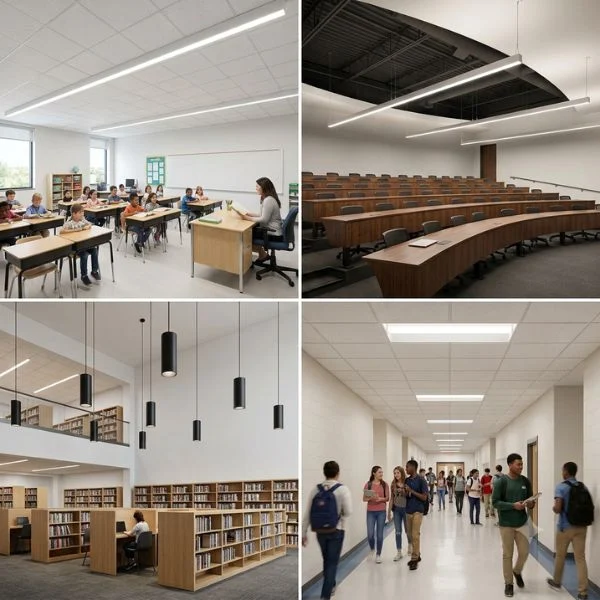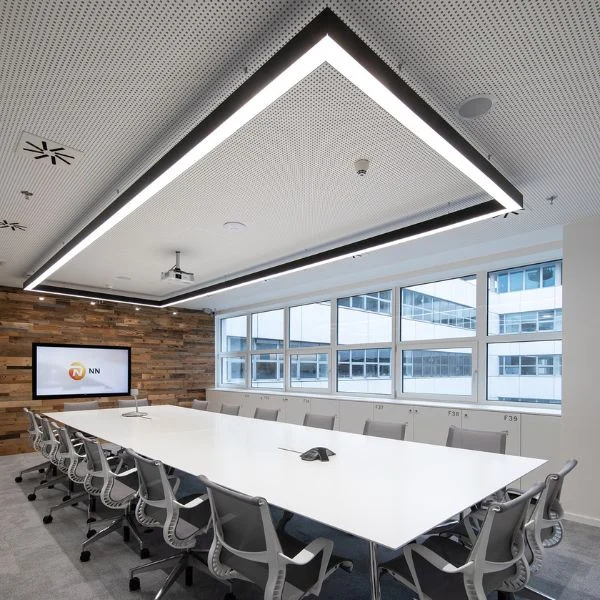
What is direct lighting?
Direct lighting distributes all or most of its luminous output downward toward a specific task surface or focal zone without initial reflection from ceilings or walls. In architectural commercial environments, this configuration delivers precise, unobstructed illumination to work planes, conference tables, and presentation zones.
Core Mechanics of Direct Illumination
Direct downlight fixtures focus luminous flux directly onto the horizontal plane. When engineered for professional spaces, these fixtures utilize specialized optical engines to balance high visual clarity with strict glare control:
-
- Targeted Beam Distribution: Concentrates illumination specifically where high-focus tasks occur, minimizing wasted spill light.
- Optical Glare Mitigation: Incorporates micro-prismatic diffusers, low-UGR louvered baffles, or frosted opal lenses to shield the light source from direct sightlines.
- Mounting Versatility: Available in continuous recessed channels, surface-mount profiles, and suspended linear systems aligned directly over conference tables.
Strategic Role in Office and Conference Spaces
-
- High-Contrast Task Lighting: Delivers focused foot-candles directly to document review areas, note-taking stations, and conference desks.
- Enhanced Visual Acuity: Prevents dull, washed-out visibility by defining crisp details and clean boundaries across work surfaces.
- Energy Efficiency: Maximizes usable lumens on the target surface, reducing the overall fixture density required to meet standard commercial lux targets.
What is indirect lighting?
Indirect lighting directs light upward toward the ceiling or surrounding walls rather than beaming it straight down onto work surfaces. By using the ceiling plane as a broad secondary reflector, it bounces illumination evenly across the room to create a soft, balanced ambient layer.
In collaborative workspaces and boardrooms, we utilize indirect office lighting fixtures to eliminate hot spots, reduce reflections on laptop screens, and soften harsh downward facial shadows during hybrid video calls.
Key Characteristics of Indirect Illumination
-
- Diffused ambient glow: Distributes light smoothly across the upper room volume, eliminating dark ceilings and the “cave effect.”
- Zero direct glare: Hides the primary LED source from the direct line of sight, keeping visual fatigue to an absolute minimum.
- Balanced contrast: Bridges the brightness gap between task surfaces and the surrounding architectural envelope.
What is direct/indirect lighting?
Direct/indirect lighting is a dual-emission illumination system that combines downward task lighting with upward ambient lighting within a single fixture. In high-performance office environments, we use suspended architectural fixtures that simultaneously cast light downward onto work surfaces and upward toward the ceiling plane.
This dual distribution delivers balanced illumination, preventing the harsh contrasts and “cave effect” often caused by standard downlight-only fixtures.
The mechanics of balanced uplight and downlight
By dividing light output into two distinct optical components, direct/indirect luminaires create a complete, multi-layered visual environment:
-
- Downlight component (Direct): Delivers focused, functional footcandles directly onto conference tables and work planes for reading, writing, and clear task visibility.
- Uplight component (Indirect): Distributes light across the ceiling surface, bouncing soft, diffuse illumination back into the room to wash out shadows and brighten the overall volume of the space.
- Configurable distribution ratios: Depending on ceiling reflectivity and room geometry, fixtures are typically configured with standard optical splits—such as 60/40 or 70/30 downlight-to-uplight ratios—to balance task demands with ceiling brightness.
Why direct/indirect systems excel in conference rooms
Meeting spaces require lighting that supports physical collaboration, digital screens, and video conferencing simultaneously. Installing direct/indirect LED linear pendants resolves multiple spatial challenges at once:
-
- Eliminates harsh facial shadows: Uplight bounces smoothly across the room, filling in under-eye and overhead shadows on participants’ faces—a critical requirement for clear video conferencing.
- Minimizes screen and tabletop glare: Precision downward optics, such as micro-prismatic diffusers, control beam angles to keep direct glare away from laptops, presentation displays, and polished conference tables.
- Enhances spatial aesthetics: Suspended continuous runs create clean, architectural sightlines while making ceilings appear taller and more open.
Integrating high-performance direct/indirect linear fixtures ensures your conference room achieves optimal visual comfort, uniform coverage, and a clean architectural finish.
Direct vs indirect: key differences
When we plan a conference room layout, understanding how light travels through the space is the difference between visual comfort and distracting glare. Direct lighting sends focused downlight straight to the work surface, while indirect lighting bounces uplight off the ceiling to create soft ambient lighting.
Pairing them together into direct indirect lighting delivers the ideal balance: functional illumination for taking notes and comfortable, diffused light that keeps video calls free from harsh facial shadows.
Core Performance Comparison
| Feature | Direct Lighting | Indirect Lighting | Direct/Indirect Lighting |
|---|---|---|---|
| Light Direction | 100% Downward (Downlight) | 90%–100% Upward (Uplight) | Split distribution (e.g., 60% down / 40% up) |
| Visual Effect | Crisp task focus; sharp contrast | Soft, shadow-free ceiling illumination | Balanced luminance with zero cave effect |
| Glare Risk | Higher risk on screens and glossy tables | Very low direct glare | Minimal glare with micro-prismatic optics |
| Best Meeting Zone | Focused presentation counters | Perimeter walls and high ceilings | Conference tables and collaborative zones |
| Fixture Styles | Recessed downlights, linear slots | Cove fixtures, wall sconces | Direct indirect ring pendant light systems, linear pendants |
Key Takeaways for Meeting Spaces
-
- Beam control: Direct fixtures pinpoint light exactly where it is needed on meeting tables, but they can trigger reflections on laptops and monitors if unshielded.
- Spatial perception: Indirect fixtures illuminate the ceiling plane, making low or compact conference rooms feel open, airy, and spacious.
- Visual comfort: Direct/indirect suspended lighting balances ambient illumination with targeted task lighting, keeping Unified Glare Rating (UGR) values low and attendees comfortable during long presentations.
Advantages and disadvantages
When we design spaces for collaboration, evaluating the trade-offs of each optical strategy is critical for a balanced conference room lighting design: layout, glare and fixture selection.
Direct lighting pros and cons
-
- Advantages: Delivers maximum task illumination directly to conference tables with minimal energy waste. High beam control makes it simple to highlight note-taking zones and key focal points.
- Disadvantages: Can create harsh shadows on faces during video calls and causes reflective glare on laptops and glossy screens if high-output diffusers lack proper louvered or micro-prismatic optics.
Indirect lighting pros and cons
-
- Advantages: Bounces light off the ceiling to produce soft, shadow-free ambient lighting. It eliminates hot spots on display monitors and keeps visual comfort high.
- Disadvantages: Requires higher overall lumens and energy consumption to achieve target work-surface lux levels. It is also unsuitable for low ceilings or dark, non-reflective ceiling finishes.
Direct/indirect lighting pros and cons
-
- Advantages: Combines the best of both worlds by pairing targeted task lighting with balanced ceiling illumination. The uplight downlight balance eliminates the dark “cave effect,” flatters faces on camera, and supports low Unified Glare Rating (UGR) targets. Choosing the proper output and color spectrum—such as comparing 4000K vs 5000K linear lights for offices and warehouses—further refines visual clarity.
- Disadvantages: Typically requires suspended lighting hardware and sufficient vertical clearance to allow the uplight component to spread evenly.
| Lighting System | Glare Control | Energy Efficiency | Video Call Performance | Visual Balance |
|---|---|---|---|---|
| Direct Only | Moderate to Low | High | Moderate (Harsh facial shadows) | High contrast |
| Indirect Only | Excellent | Lower | Good (Very soft) | Low contrast |
| Direct/Indirect | Superior (Low UGR) | High | Excellent (Even facial fill) | Optimal balance |
Best applications for each type
Every commercial space has distinct visual demands. Selecting the right distribution style—whether focused downlight, soft uplight, or a balanced hybrid—ensures proper visibility, low glare, and visual comfort across different room layouts.
Direct lighting: focused task zones
Direct lighting sends illumination straight down to the working plane. We recommend this approach for spaces that require intense focus and high lux levels on specific surfaces:
-
- Dedicated Task Tables: Provides crisp, shadow-defined light for reading, writing, and detailed physical work.
- Circulation Paths & Corridors: Guides movement clearly through hallways using recessed or surface architectural linear profiles.
- Huddle Booths: Delivers high lumen output to compact spaces without requiring high-output ambient ceiling wash.
Indirect lighting: low-glare presentation spaces
Indirect fixtures cast light upward, using the ceiling as a broad reflector to bounce soft, diffused illumination back down. This setup is ideal for:
-
- Media & AV Rooms: Prevents screen reflections on monitors and digital displays during slide decks or video screenings.
- Executive Lounges & Breakout Spaces: Creates a relaxed, low-contrast atmosphere that eliminates harsh overhead glare.
- Architectural Ceiling Features: Highlights textured, vaulted, or exposed concrete ceilings while delivering gentle ambient lighting.
Direct/indirect lighting: collaborative conference rooms
Combining direct downlight with uplight downlight distribution provides the most versatile performance for modern workspaces. When planning your conference room lighting design: layout, glare and fixture selection, direct/indirect linear systems stand out as the primary choice for:
-
- Primary Conference Rooms: Balances functional tabletop illumination with ambient ceiling brightness to eliminate dark shadows on faces during discussions.
- Video Conferencing Suites: Softens harsh eye-socket shadows on camera while maintaining adequate light on conference tables.
- Open-Plan Team Tables: Keeps overall room contrast low and visual comfort high, which is essential when selecting the best LED lights for office environments with heavy screen usage.
| Lighting Type | Primary Beam Direction | Best Application | Main Benefit |
|---|---|---|---|
| Direct | 100% Downward | Huddle tables, corridors, task desks | Maximum work-surface brightness |
| Indirect | 100% Upward | Screen-heavy rooms, quiet lounges | Zero monitor glare, soft ceiling wash |
| Direct/Indirect | Split (e.g., 70/30 or 60/40) | Boardrooms, hybrid meeting spaces | Balanced facial lighting & low UGR |
Office and commercial examples
Applying the right luminaire setup across real-world commercial zones requires matching fixture optics to the visual tasks performed in each space. Modern workplaces rely on tailored commercial office lighting to keep teams productive, comfortable, and focused throughout the day.
Conference and Boardroom Layouts
In high-stakes meeting rooms, the lighting must balance screen visibility, facial clarity on video calls, and clean aesthetics. For a successful conference room lighting design: layout, glare and fixture selection strategy, suspended continuous linear profiles deliver the best results.
-
- Setup: Suspended direct/indirect linear fixtures aligned directly above the conference table.
- Optics: Micro-prismatic or louvered diffusers ensuring low Unified Glare Rating (UGR < 19).
- Effect: Downlight provides uniform task illumination across the tabletop, while uplight bounces off the ceiling to soften shadows on faces during video conferences.
Open-Plan Office Workstations
Open workspaces demand balanced ambient illumination that eliminates monitor reflections while maintaining visual interest across large ceiling planes. Implementing purpose-built commercial LED office lighting solutions keeps energy use low and visual comfort high.
-
- Setup: Long continuous runs of suspended direct/indirect linear luminaires running parallel to desk pods.
- Light Distribution: A balanced 60/40 or 70/30 split between downward task light and upward ceiling bounce.
- Effect: Removes harsh overhead hotspots, brightens the ceiling plane to eliminate the “cave effect,” and prevents glare on laptop screens.
Executive Offices and Huddle Spaces
Smaller meeting rooms and private offices benefit from compact, multi-functional fixture configurations that offer flexible control.
-
- Setup: Recessed or surface-mounted linear fixtures combined with perimeter wall-washing.
- Controls: 0–10V continuous dimming to instantly transition between focus work and digital presentations.
- Effect: Clean, uncluttered ceilings with precise beam delivery tailored to smaller footprints.
How ceiling height affects the choice
Ceiling height is one of the most critical factors in conference room lighting design: layout, glare and fixture selection. The vertical clearance of your meeting space dictates whether direct downlight, pure uplight, or a balanced direct/indirect profile will deliver optimal visual comfort.
Low Ceilings (8 to 9 Feet)
In standard or low-clearance conference rooms, suspended fixtures risk crowding the line of sight and creating hot spots on the ceiling plane.
Fixture Typology: Recessed linear profiles, flush surface-mount linear fixtures, or integrated ceiling lights in office setups.
Distribution Strategy: Focus on direct task illumination with micro-prismatic optics or louvered diffusers. Keeping the fixture flush prevents glare in presentations and ensures full headroom over conference tables.
Alternative: If grid integration is required, precision 4ft recessed LED lights for ceiling systems provide seamless continuous runs that preserve ceiling clearance while keeping the Unified Glare Rating (UGR) well under control.
Medium Ceilings (9 to 12 Feet)
This height range provides the ideal canvas for balanced direct/indirect linear architectural fixtures.
Fixture Typology: Suspended linear profiles hung 12 to 24 inches below the ceiling plane.
Distribution Strategy: A balanced split (such as 60% downlight / 40% uplight or 70/30) eliminates the dark “cave effect” on the ceiling while casting uniform, glare-free light onto meeting tables and video participants.
High or Open Ceilings (12+ Feet)
High ceilings require robust fixture output and controlled optics to maintain targeted lux levels on the workplane without causing stray light spill.
Fixture Typology: Cable-suspended continuous linear fixtures positioned at an effective working suspension height (typically 8 to 9 feet from the finished floor).
Distribution Strategy: High-output direct lighting downward, combined with wide-batwing indirect uplight to bounce ambient illumination off exposed structures or tall ceiling decks.
| Ceiling Height | Primary Recommended Mounting | Optimal Light Distribution | Glare Control Focus |
|---|---|---|---|
| 8 – 9 ft | Recessed / Surface Mount | 100% Direct | Micro-prismatic or frosted diffusers |
| 9 – 12 ft | Suspended Linear | Direct / Indirect (60/40 or 70/30) | Low-UGR optics + balanced uplight |
| 12+ ft | Suspended at Fixed Height | Direct / Indirect with high output | Precision optical distribution & downlight control |
FAQs
What is the recommended light level for conference room tables?
For balanced visual tasks and video conferencing, we target between 300 and 500 lux (30 to 50 foot-candles) directly on the conference table. This range provides ample task illumination for taking notes and using laptops without washing out presentation displays or overpowering cameras.
How do we eliminate glare on screens and presentation boards?
Controlling glare requires a combination of fixture optics and layout geometry:
Micro-prismatic diffusers & baffles: Direct the downward beam cleanly while maintaining a Unified Glare Rating (UGR) below 19.
Balanced ceiling illumination: Uplight downlight distributions soften contrast against the ceiling plane to prevent eye fatigue.
Dedicated perimeter runs: Adding perimeter wall-washers or clean 2-inch recessed linear lighting illuminates dry-erase boards and accent walls without reflecting off center monitors.
What color temperature (CCT) works best for meeting rooms?
A neutral white CCT between 3500K and 4000K with a high color rendering index (CRI ≥ 90) delivers the most consistent results. This setup keeps the team alert, renders accurate skin tones on video calls, and avoids the unnatural yellow or blue casts common in low-grade commercial spaces.
Should we specify direct or direct/indirect linear fixtures?
For open ceilings or standard ceiling heights above 9 feet, we always favor suspended direct/indirect linear profiles. Distributing 60% to 70% light downward and 30% to 40% upward eliminates harsh shadows and creates an open, modern aesthetic. For lower ceilings, direct-only recessed or surface-mounted linear channels with low-glare lenses deliver optimal clearance and performance.
STAY IN THE LOOP
Subscribe to our free newsletter.
Leave A Comment
5CCT Round Flush Mount Lights for Apartment Renovation Apartment renovation [...]
The Architecture of Retail Ambience: Why Boutique Lighting Matters Walk [...]
-
Why Standard Office Lighting Dictates Workspace Productivity Office lighting is [...]