Energy Efficient Lighting for Commercial Buildings
A practical guide to specifying efficient LED luminaires, designing better lighting layouts, integrating controls and evaluating the real cost of a commercial lighting upgrade.
Lower Energy Use Starts with a Better Lighting System—not Just a Lower-Wattage Lamp
Energy efficient lighting for commercial buildings combines appropriately selected LED fixtures, optical distribution, operating schedules and controls. A successful specification reduces unnecessary electricity use while maintaining the illuminance, uniformity, glare control and color quality the space actually needs.
Replacing older fluorescent or HID equipment may create substantial savings, but results vary with the original installation, selected replacement, operating hours and control strategy. The most reliable approach is to measure the existing system, establish lighting requirements, model the proposed layout and compare whole-system energy consumption.
Core Technologies Behind Efficient Commercial LED Lighting
Luminaire Efficacy (lm/W)
Lumens per watt compares the useful light output of a complete luminaire with its electrical input. Compare tested fixture-level efficacy, not LED-chip claims alone. Also consider how effectively the distribution illuminates the intended task area.
Optics and Visual Comfort
Appropriate beam distribution, shielding, diffuser design and spacing can reduce wasted light and excessive brightness. Efficacy alone does not determine color quality, glare or a successful lighting design.
Thermal and Driver Design
Heat management and suitable drivers affect reliability and lumen maintenance. Review product-specific lifetime reports, ambient-temperature ratings, power factor, dimming compatibility and surge requirements.
Understanding L70 and L90
L70 and L90 describe the time at which a light source or luminaire is projected to maintain 70% or 90% of its initial light output under the applicable reporting method. They are not promises that every component—including the driver—will operate without failure for that duration. Request supporting test and projection information for the exact model being specified.
Choose the Right LED Fixture for Each Commercial Space
Different zones need different mounting formats, light distributions and environmental protection. The following is a selection framework, not a universal specification for every model.
| Fixture family | Typical formats | Suitable commercial areas | Key selection checks |
|---|---|---|---|
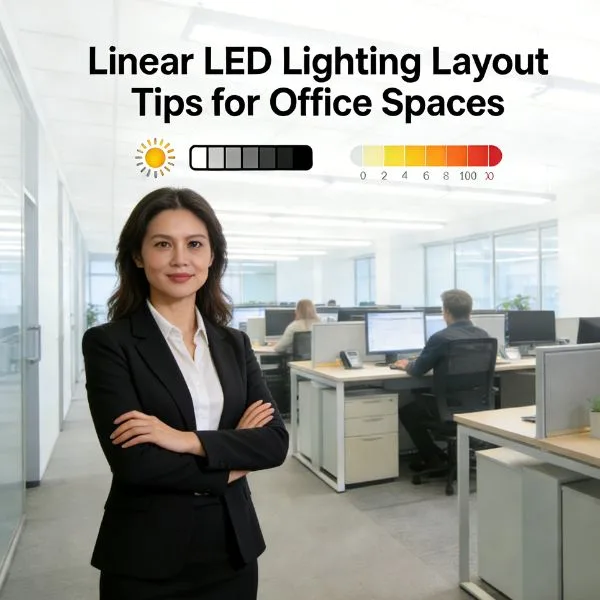
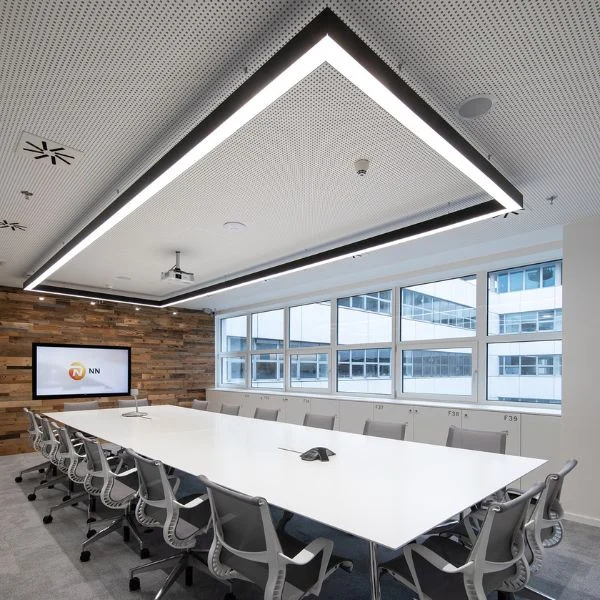
| Architectural linear | Suspended, surface, recessed; direct or direct/indirect by series | Offices, circulation, reception, retail | Distribution, glare, continuous-run configuration, dimming |
| Troffers and LED panels | 2×2, 2×4 and other ceiling-grid formats | Open offices, classrooms, meeting areas | Ceiling compatibility, optical comfort, lumen package |
| LED strip / wraparound | Linear surface or suspended fixtures | Back-of-house, utility and general commercial areas | Coverage, installation height, maintenance access |
| Vapor-tight linear | Enclosed 4 ft and 8 ft models | Parking, damp service areas, selected industrial spaces | Actual IP/wet-location listing, chemical exposure, temperature |
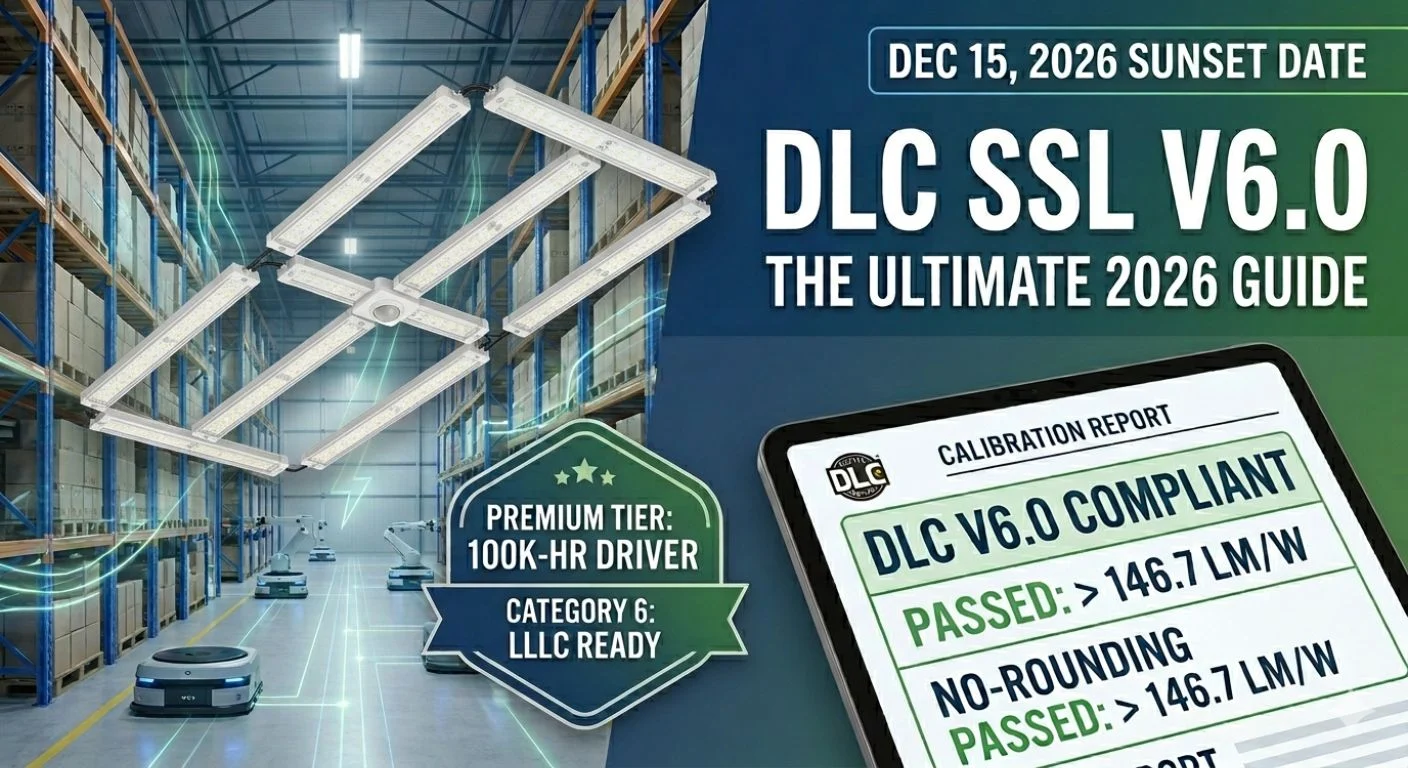
| High bay | Linear or round, model-dependent | Warehouses, logistics, high-ceiling facilities | Mounting height, aisle optics, vertical illumination, controls |
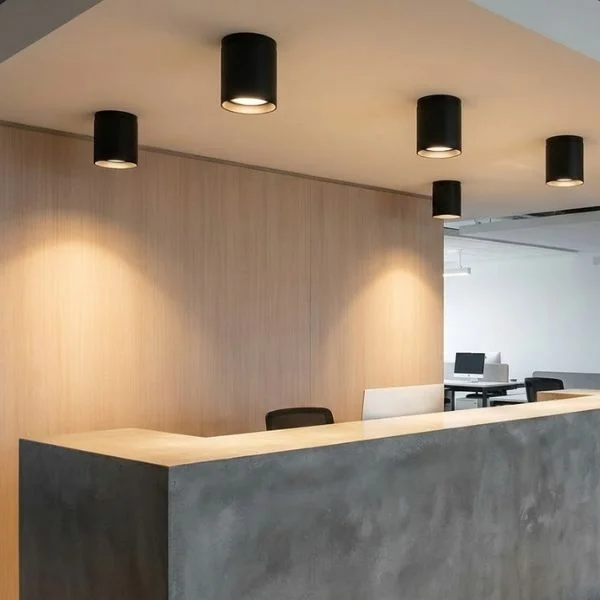
| Accent / perimeter lighting | Recessed slots, cylinders, wall washers | Lobbies, hospitality, retail displays | Beam angle, CRI, visual hierarchy, scene setting |
How to Compare Candidate Luminaires
- Check complete-luminaire input watts and delivered lumens using the same test basis.
- Request photometric files and review the working-plane illuminance and uniformity.
- Assess color rendering, CCT, flicker characteristics and glare in the actual application.
- Confirm voltage, mounting, ambient-temperature range and the correct safety/environmental listing.
- Confirm the specified control interface and compatibility with sensors or a building control system.
Smart Lighting Controls: Save Energy When Full Output Is Not Needed
Efficient hardware sets the connected-load baseline. Controls then reduce operating time or output based on occupancy, daylight and the actual schedule. Savings are site-specific and should not be added together as independent percentages.
Occupancy and Vacancy Sensors
Occupancy sensing automatically responds to presence; vacancy sensing generally requires manual-on and provides automatic-off. Select detection technology and timeout settings for the space. Private offices, restrooms, storage and intermittent warehouse aisles are common candidates.
Daylight Harvesting
Photosensors can dim electric lighting in perimeter and skylit zones when daylight contributes sufficient illumination. Commission sensor placement and dimming levels to avoid unstable or visually distracting behavior.
High-End Trim and Task Tuning
Commission a suitable maximum output for each zone instead of running every luminaire at full capacity. Verify the final maintained light level against the tasks performed there.
Scheduling and Zoning
Separate operating schedules for office floors, meeting rooms, cleaning shifts and security lighting. Wireless grouping may simplify changes where compatible equipment is used.
0–10V, DALI and Networked Controls
These are different control approaches—not interchangeable features. Check driver compatibility, dimming range, wiring and system commissioning requirements before ordering.
BMS and Demand Response
Where supported, a lighting control network may connect to a building management system through appropriate gateways, enabling coordinated scheduling, energy monitoring and non-critical load management.
Energy-Efficient Lighting Strategies by Facility Type
| Facility | Potential fixture approach | Useful controls | Design priorities |
|---|---|---|---|
| Corporate offices | Architectural linear, troffers, panels | Daylight dimming, occupancy, task tuning | Screen comfort, appropriate glare control, uniformity |
| Warehouse and logistics | High bay, vapor-tight in suitable zones | Aisle sensing, scheduling | Mounting height, rack-face illumination, safety |
| Retail and hospitality | Architectural linear, accents, cylinders | Scene control, zoning, scheduling | Merchandise color, ambience, layered light |
| Healthcare and laboratory | Application-specific panels or enclosed luminaires | Carefully specified zone and operating controls | Applicable hygiene, clinical and safety requirements |
| Parking and service areas | Appropriately rated vapor-tight or strip fixtures | Occupancy-based bi-level output where suitable | Environmental listing, visibility and coverage |
Corporate Offices: Efficiency with Visual Comfort
Use low-glare distribution and well-planned direct/indirect lighting where appropriate. Compare the task plane and screen reflections, not just average lumens. Window-side zones are candidates for daylight dimming. For meeting spaces, see our conference room glare design guide.
Warehouses: Deliver Light Where It Is Needed
Model floor and vertical rack-face illumination using suitable high-bay optics. Zone intermittently occupied aisles and verify sensor coverage. Select ingress protection only when the environmental conditions require it.
Retail and Hospitality: Balance Layers
Combine efficient ambient lighting with targeted accents. CRI, color consistency and scene settings can be as important as connected watts. Reduce unnecessary full-output operation outside customer-facing hours.
Healthcare: Specify by Room Function
Patient rooms, corridors, examination rooms and controlled environments have different requirements. Confirm application-specific cleaning, emergency, flicker, controls and certification needs rather than assuming a general commercial panel is suitable for clinical use.
Calculate Lighting Energy Savings and Realistic Project ROI
An auditable estimate starts with measured fixture power, quantity, annual operating hours and the applicable electricity tariff. Add installation, maintenance, control-system and incentive assumptions separately.
Basic calculation
Annual energy (kWh) = Fixture quantity × Input watts ÷ 1,000 × Annual operating hours.
Annual electricity savings = (Existing annual kWh − Proposed annual kWh) × Electricity rate.
Simple payback = Net project investment ÷ Estimated annual financial savings.
For controls, use measured or modeled equivalent full-load operating hours. Do not count the same reduction twice.
200 existing fixtures at 100 W each, replaced with 40 W fixtures; 3,000 annual hours; electricity at $0.15/kWh.
60,000 → 24,000 kWh/yearExisting versus proposed lighting electricity, before any additional control savings.
36,000 kWh/yearCalculated reduction: 60% in fixture-related electricity for these stated assumptions.
$5,400/yearIllustrative direct electricity-cost difference, excluding demand charges, installation and maintenance.
Other Factors in the Business Case
| Financial factor | How to evaluate it | Important qualification |
|---|---|---|
| Energy reduction | Baseline and proposed watts × verified operating hours | Actual operating patterns may change |
| Maintenance | Expected labor, access equipment and replacement components | Use product-specific service assumptions |
| HVAC interaction | Whole-building energy model where relevant | Cooling benefits and heating penalties vary by climate and season |
| Utility rebates | Current local program and exact qualifying model | Eligibility, funds and amounts vary |
| Tax treatment | Current law and qualified professional assessment | Do not treat an incentive as automatically available |
Compliance, DLC Qualification and Commercial Procurement
Lighting Power Density and Local Energy Codes
Lighting Power Density (LPD) expresses installed lighting power relative to floor area, commonly in W/ft². Requirements depend on jurisdiction, building type, applicable code edition and compliance method. Review the relevant version of ASHRAE 90.1, IECC or California Title 24 with the project designer or authority having jurisdiction. There is no single LPD table that applies to every US commercial building.
UL / ETL, DLC and ENERGY STAR: Different Roles
- Safety listing: Verify the appropriate UL/ETL or other accepted listing for the actual model and installation environment.
- DLC: Check the current Qualified Products List and the exact product identifier if a utility incentive requires DLC qualification. Standard and Premium criteria vary by category and technical-requirement version.
- ENERGY STAR: Check whether the specific product category and applicable program cover the item being purchased; it is not interchangeable with DLC or a safety listing.
- Procurement documents: Request the datasheet, photometric file, installation instructions, warranty terms and model-specific certificates.
For more detail, read our UL and ETL compliance guide for imported office lighting.
Rebates and Section 179D
Some commercial lighting projects may qualify for utility incentives or tax-related benefits, but programs change. Confirm rebate requirements with the serving utility before purchase. For Section 179D, consult current IRS guidance and a qualified tax professional regarding project dates, eligibility, certification and any legislative changes. A reduction in fixture wattage alone does not establish tax eligibility.
A Five-Step Commercial LED Retrofit Process
Audit the Existing Installation
Record fixture counts, lamp/ballast system watts, condition, mounting and hours by zone. Document the current controls, task needs and electricity costs.
Compare Retrofit Kits with Complete Fixture Replacement
Retrofit kits may reuse serviceable housings; complete luminaires can offer different optics, aesthetics and mounting arrangements. Compare installed cost, compatibility, listing and photometric performance—not only product price.
Prepare Photometric Layouts
Use model-specific IES files to check maintained foot-candles/lux, distribution, spacing and power density. Account for ceiling height, reflectance, furniture and application-specific standards.
Install and Commission in Phases
Coordinate installation around building operations. Configure occupancy zones, photocells, dimming ranges and schedules; arrange proper handling of removed lamps and electrical equipment.
Measure and Verify
Compare post-upgrade consumption with a normalized baseline, document commissioning settings, and collect the paperwork needed for any applicable incentive program.
Retrofit Kit vs. New Luminaire
| Decision point | Retrofit kit / lamp solution | Full luminaire replacement |
|---|---|---|
| Existing housing | Retained where compatible and permitted | Replaced |
| Optical result | May depend on existing reflector/diffuser | Designed as a complete system |
| Installation | May reduce physical ceiling work | May require additional mounting/electrical work |
| Controls | Check kit and driver compatibility | Choose required interface at specification |
| Safety / rebate | Verify exact kit, installation and program | Verify exact luminaire and program |
Frequently Asked Questions
How much electricity can commercial LED lighting save?
It depends on the old system, the proposed fixture wattage and actual hours. Calculate both scenarios from complete-system input watts and operating hours. Occupancy sensing and daylight dimming may add savings where the building conditions support them; model their interaction rather than adding percentage claims together.
What is a typical payback period for a lighting retrofit?
There is no dependable universal period. Divide net installed project cost by realistic annual savings, including electricity and defensible maintenance estimates. Electricity price, operating hours, labor and available incentives have a major effect.
Is DLC Premium always necessary for a utility rebate?
No. Requirements vary by utility, measure category, date and model. Search the relevant qualified-product list and confirm program rules before purchasing.
Do LEDs reduce commercial cooling loads?
Lower lighting input power can reduce internal heat gains and therefore cooling demand in some conditions. Heating-season effects and the actual HVAC response can offset part of that benefit. Use a building energy model for a credible estimate.
What foot-candle levels and LPD limits should I use?
Task illuminance should follow the applicable project criteria and current professional guidance; LPD limits depend on the adopted local energy code and compliance method. A universal fixed table is not appropriate for all building types and jurisdictions.
Should I choose the fixture with the highest lumens per watt?
Not automatically. Compare delivered light at the work plane, glare, color quality, optical distribution, reliability, dimming and installation constraints alongside efficacy.
Can architectural linear lighting be part of an efficient office design?
Yes. Appropriate direct/indirect distribution, task-based layout and dimming can combine visual comfort with energy-conscious design. Verify the exact fixture configuration and photometric results.
What should a manufacturer provide for a commercial project?
Request model-specific specifications, input watts, lumen output, IES files, certification documents, controls compatibility, warranty information and installation instructions. Discuss finish, dimensions, mounting and private-label requirements before finalizing a bulk order.
Planning Energy-Efficient Lighting for a Commercial Project?
Share your building type, fixture schedule, target quantities and control requirements. We can discuss suitable architectural and commercial LED product families, customization and manufacturing support.
Model-specific performance, listings, lead times and options are subject to final quotation and technical confirmation.
STAY IN THE LOOP
Subscribe to our free newsletter.
Leave A Comment
Office Lighting Design Guide for Modern Workplaces with lux UGR and LED fixture tips for comfort productivity and energy efficiency
Ever wonder why an outfit looks vibrant in natural sunlight, [...]
What is Tunable White Lighting? As the industry standard evolves, [...]