Understanding Suspended Linear Lighting Fixture Systems
In our experience on the job site, suspended linear LED fixtures are often the most versatile tool for a contractor. Unlike recessed systems that require complex ceiling coordination or surface-mount options that can look bulky, suspended systems offer a “floating” aesthetic that works with the existing infrastructure rather than against it. We prioritize these systems for their ability to bring the light source closer to the task while simplifying the installation process in challenging environments.
Comparing Pendant, Recessed, and Surface-Mounted Options
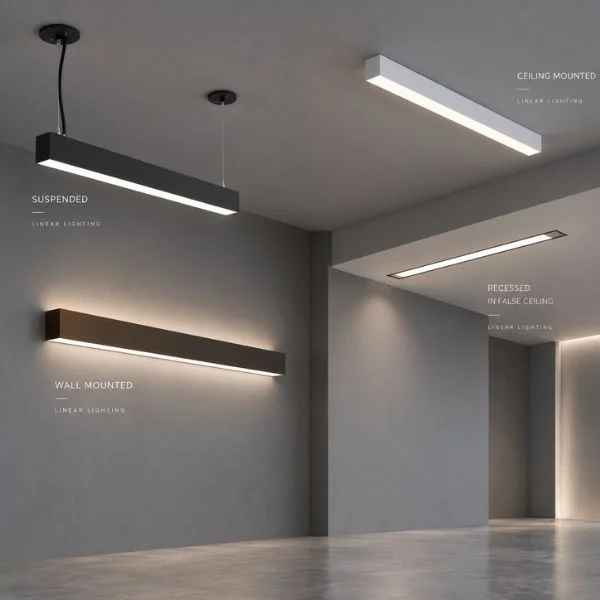
Selecting the right mounting method usually comes down to the ceiling height and the plenum’s complexity.
- Pendant (Suspended): Best for open-plenum designs. It allows us to bypass HVAC and plumbing obstructions without cutting into drywall.
- Recessed: Offers a clean, flush look but demands high labor costs for framing and finishing.
- Surface-Mount: Useful for low-clearance areas where a drop isn’t possible, though it eliminates the option for upward illumination.
Best Applications for Open Ceilings and High-Bays
For US projects involving “industrial chic” offices or high-bay retail spaces, architectural pendant lighting is the standard. It provides a structured, organized look in a messy open plenum. By suspending the fixtures, we can maintain a consistent mounting height across a project, regardless of varying ceiling elevations.
Direct, Indirect, and Direct/Indirect Distribution Patterns
The distribution pattern we specify dictates the “feel” of the room and the comfort of the occupants.
- Direct Distribution: All light is pushed downward. This is highly efficient for task areas but can create a “cave effect” where the ceiling remains dark.
- Indirect Distribution: Light is bounced off the ceiling. This creates a soft, shadowless environment that is excellent for reducing glare on computer screens.
- Direct/Indirect Light Distribution: This is the gold standard for modern commercial offices. By splitting the output—typically 70% down and 30% up—we provide focused task lighting while illuminating the ceiling to make the space feel larger and more inviting.
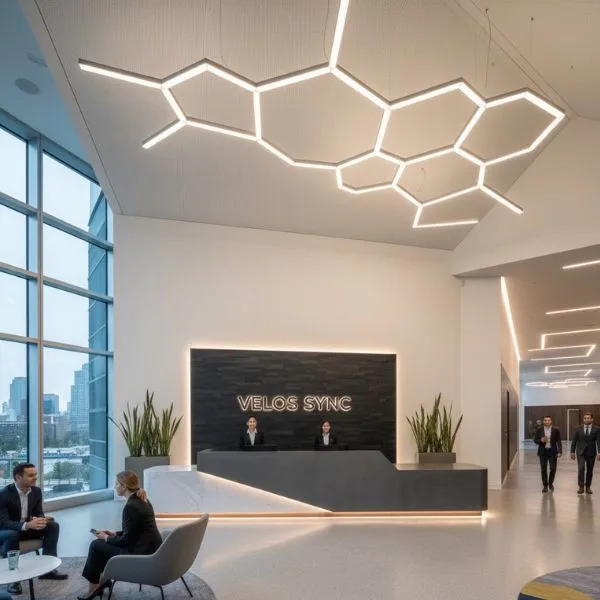
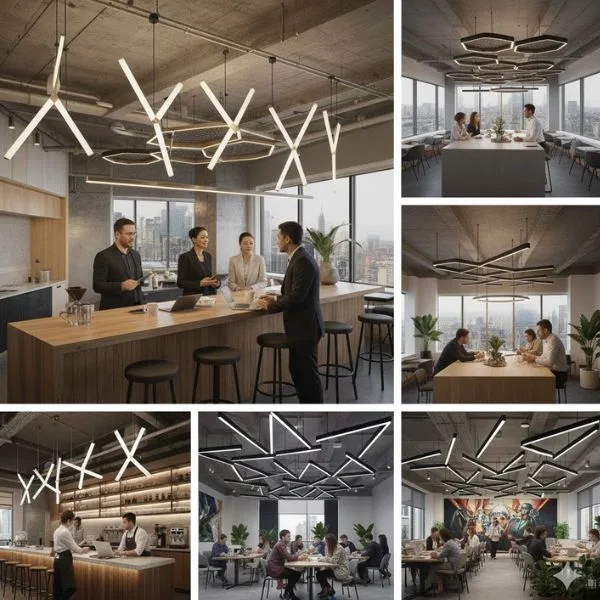
Key Performance Specifications for Specifying Suspended linear light fixture
When I evaluate suspended linear LED fixtures, I focus on the metrics that impact both the electrical inspection and the end-user experience. In the US market, meeting Title 24 and IECC compliance is the baseline. You need high luminous efficacy—typically over 100 lm/W—to ensure the project hits energy codes without sacrificing brightness. For detailed breakdowns on meeting these specific codes, I recommend reviewing our technical articles which cover modern compliance standards in depth.
Color Quality and Visual Comfort
I prioritize High CRI linear pendants because color accuracy changes how a space feels. A CRI of 90+ is the standard for high-end commercial work, but I also look at R9 values (for reds) and TM-30 scores to ensure the light doesn’t look flat or green.
| Metric | Target Specification | Contractor Benefit |
|---|---|---|
| Luminous Efficacy | 100-130+ lm/W | Easy Title 24/IECC approval |
| Color Rendering | CRI 90+, R9 >50 | Happy clients, vibrant spaces |
| UGR Rating | <19 | UGR glare control for office comfort |
| L70 Lifetime | 50,000+ Hours | Reduced maintenance callbacks |
CCT Selection and Glare Management
Choosing the right Correlated Color Temperature (CCT) is about the application. While 4000K is common for high-activity areas, 3500K has become the “sweet spot” for US office interiors. To prevent eye strain, I specify fixtures with advanced UGR glare control strategies, such as recessed diodes or specialized frosting.
If you need a high-performance solution that breaks away from standard straight lines, our triangular modular linear light provides excellent distribution patterns while maintaining strict color and glare standards.
- 3000K: Best for hospitality or relaxed common areas.
- 3500K: The standard for modern corporate environments.
- 4000K: Ideal for healthcare, retail, and tech-heavy workspaces.
- Optics: Use precision lenses to eliminate “hot spots” on task surfaces.
Dimming, Controls, and Electrical Compatibility
When Specifying Suspended Linear Lighting, the electrical backbone determines how smoothly your install goes. Most US commercial projects rely on 0-10V dimming compatibility because it’s the industry standard for reliability. However, for high-end architectural jobs, we often look at DALI or wireless mesh systems to reduce the need for extra control wiring through the ceiling.
Integral vs. Remote Drivers
Choosing where the driver sits impacts both the aesthetic and your labor time on-site:
- Integral Drivers: These are housed directly within the extruded aluminum housing. They are usually the preferred choice for contractors because they simplify the NEC compliant installation—you just bring your line voltage straight to the power feed canopy.
- Remote Drivers: These allow for an ultra-slim fixture profile but require an accessible location (like a junction box above a grid ceiling). This can add complexity to the rough-in and future maintenance access.
Emergency Backup and Code Compliance
Safety is a non-negotiable part of the spec. For architectural pendant lighting, you have to plan for integral battery packs or dedicated emergency circuits to meet path-of-egress requirements. If you’re mapping out a complex workspace, our office lights hanging complete guide covers how to integrate these controls without ruining the visual line of the fixture.
| Control Feature | Standard Protocol | Application |
|---|---|---|
| Basic Dimming | 0-10V | General office, retail, and corridors |
| Smart Systems | Wireless/DALI | Daylight harvesting and scene setting |
| Emergency | UL 924 Battery | Required for designated exit paths |
We prioritize internal components that are “plug-and-play” ready, ensuring that your Specifying Suspended Linear Lighting process accounts for both the dimming response and the long-term electrical stability of the system. Ensuring UL/ETL listing on every driver keeps your inspectors happy and your project moving forward without delays.
Material Choices for Specifying Suspended Linear Lighting
When I build suspended linear LED fixtures, the materials we choose aren’t just about looks—they determine how long the light lasts and how easy it is for you to install. For US commercial projects, I always prioritize high-grade materials that handle heat and provide a clean, professional finish.
Benefits of Extruded Aluminum Housings
Our extruded aluminum linear lights are the industry standard for a reason. Unlike thin, stamped steel, extruded aluminum acts as a massive heat sink. By pulling heat away from the LED chips, the housing prevents lumen depreciation and ensures the fixture hits its rated lifespan.
- Thermal Management: Keeps internal components cool in high-ambient environments.
- Rigidity: Aluminum resists bowing or warping, which is critical for maintaining perfectly straight lines in architectural pendant lighting.
- Precision: Allows for tighter tolerances, which are essential when achieving seamless linear lighting joins on long runs.
Lensing and Uniform Illumination
To avoid “pixelation” or visible hot spots, the diffuser material is key. I use high-transmission polycarbonate or acrylic lenses that soften the light without killing the efficacy (lm/W). This ensures a smooth, continuous glow that is easy on the eyes.
Mounting Hardware: Cables vs. Stems
Selecting the right suspension system depends on the ceiling type and the local building code. Most modern offices prefer the “floating” look of aircraft cable suspension, while high-airflow or industrial spaces might require rigid stems.
| Hardware Type | Best Use Case | Contractor Benefit |
|---|---|---|
| Aircraft Cable | Standard offices & open plenums | Easy height adjustment and leveling. |
| Pendant Stems | High-vibration areas or “industrial” looks | Fixed rigidity; hides wiring inside the pipe. |
| Power Canopies | Finished drywall or grid ceilings | Covers the J-box for a clean, code-compliant finish. |
For every project, I make sure the aircraft cable suspension kits include quick-connect grippers. This saves you significant time on the ladder, allowing for one-handed leveling once the fixture is hung. Whether you are mounting to a standard T-bar or a concrete slab, the hardware must be rated for the fixture’s weight to meet NEC safety standards.
Mastering Continuous Run Linear Lighting
When I specify continuous run linear lighting, the goal is a perfectly straight, unbroken line of light. This starts with choosing the right mix of modular linear LED systems—usually 4ft or 8ft sections—to hit the total run length. For larger commercial layouts, checking a contractor’s guide to 8-foot LED suspended linear fixtures helps simplify the math for module counts and suspension points.
To achieve professional, architectural results, I focus on these three critical areas:
- Eliminating Light Leaks: I use heavy-duty internal joiners and alignment pins to lock the housings together. This prevents the gaps that cause light spill at the seams.
- Continuous Lensing: Whenever possible, I specify “roll-out” lenses that snap in across multiple sections to hide the breaks between modules.
- No Dark Spots: High-quality seamless linear lighting joins ensure the LED boards are positioned close enough to the edge of the module to maintain a uniform glow across the entire run.
Power Feed Strategies for Long Runs
Long runs require smart electrical planning to maintain performance and safety. I always designate specific power drop locations to feed multiple units while staying within circuit limits.
| Feature | Best Practice |
|---|---|
| Circuit Loading | Limit fixtures per feed based on total wattage and NEC compliant installation rules. |
| Feed Locations | Place the power feed at the start or a central point of the run for a cleaner aesthetic. |
| Wiring | Use quick-connect harnesses between modules to speed up the install and ensure polarity. |
For a clean look, I use a dedicated power feed canopy at one end of the run and non-power aircraft cables for the remaining suspension points. This keeps the ceiling clutter-free while ensuring the 0-10V dimming signals reach every fixture in the line without voltage drop issues.
Mounting and Installation: Specifying Suspended Linear Lighting
We know that time spent on a ladder is money. To get the best results with suspended linear LED fixtures, your installation strategy must match the ceiling substrate. Whether you are dealing with a standard T-bar grid or an open plenum, choosing the right hardware is the difference between a smooth hand-off and a week of leveling callbacks.
Handling Different Ceiling Types
- Drywall/Sheetrock: Requires sturdy anchoring. I recommend blocking during the rough-in phase or using heavy-duty toggle bolts for a secure fit.
- Acoustical Grid (T-Bar): Use specific grid clips designed for architectural pendant lighting to ensure a secure, code-compliant connection without damaging the ceiling runners.
- Concrete and Open Plenums: For high-bay or industrial aesthetics, we typically use power-actuated fasteners or concrete anchors to secure the aircraft cable suspension.
Leveling and Load Rating Requirements
Achieving a perfectly straight, “laser-level” line is the hallmark of a professional install.
- Tool-Free Adjustability: Always opt for cable grippers that allow for height adjustment at the fixture level. This makes leveling continuous run linear lighting significantly faster than rigid stem mounts.
- Safety Factors: Ensure all mounting points meet the 4x safety factor for weight. Even lightweight extruded aluminum linear lights must be secured against accidental impact.
- NEC Compliant Installation: Maintain code by keeping power feeds neat. We use high-quality linear LED pendant lights that feature clean power-drops to keep the aesthetic minimal while meeting safety standards.
Contractor-Friendly Features
I prioritize systems that are designed to be “plug-and-play.” Look for features that shave hours off the labor:
| Feature | Benefit to Contractor |
|---|---|
| Quick-Connect Joiners | Tool-less mechanical and electrical connection between modules. |
| Pre-Wired Harnesses | Eliminates the need for manual wire stripping and nutting inside the housing. |
| Integrated Leveling | Built-in fine-tuning mechanisms at the canopy or fixture for fast alignment. |
By focusing on these mounting best practices, you ensure the seamless linear lighting joins look as good in person as they did in the renderings. Using the right hardware from the start prevents sagging and ensures the long-term structural integrity of the system.
US Compliance Checklist for Specifying Suspended Linear Lighting
When I supply suspended linear LED fixtures for a project, I know the paperwork is just as critical as the light output. Meeting US codes isn’t just about safety; it’s about ensuring the project qualifies for rebates and passes inspection without a hitch.
Essential Safety and Performance Standards
- UL/ETL Listing: This is the baseline. I never recommend a fixture for a US job site that isn’t UL listed linear luminaires. It’s the first thing an electrical inspector looks for to confirm the product meets North American safety standards.
- DLC Premium Qualification: To help your clients land utility rebates, I focus on DLC-qualified products. Using high-efficacy fixtures is a major win for the bottom line in commercial office linear lighting projects.
- Energy Code Adherence: Our fixtures are designed to meet the strict demands of California Title 24 and ASHRAE 90.1, focusing on high lumens-per-watt and seamless control integration.
Regional and Federal Requirements
| Requirement | Contractor Focus |
|---|---|
| Seismic Restraints | In West Coast projects, specialized aircraft cable suspension kits with seismic ratings are mandatory for safety. |
| BAA / BABA | For federally funded projects, I ensure our hardware meets Buy American Act or Build America, Buy America requirements. |
| Emergency Backups | For a NEC compliant installation, we integrate emergency battery packs that provide at least 90 minutes of egress lighting. |
Navigating the Specification Process
Staying compliant means keeping a tight lighting specification checklist for every zone of the building. Whether you are installing a high-performance 4″ linear pendant light fixture or a massive continuous run, ensuring the gear hits these regulatory marks is the only way to protect your liability and the client’s investment. We prioritize these certifications so you don’t have to worry about red-tagged jobsites or rejected submittals.
Common Pitfalls When Specifying Suspended Linear Lighting
I’ve seen many projects hit a wall because of simple oversight during the specification phase. Avoiding these common mistakes ensures your suspended linear LED fixtures perform as intended without mid-job corrections.
Solving Glare and Optical Issues
The most frequent mistake is ignoring the UGR glare control rating. In open-office settings, underspecified optics lead to “hot spots” and eye strain. I always recommend deep-regressed lenses or baffles to keep the light comfortable for occupants. When choosing optics, ensure you are selecting a 4-foot LED suspended linear fixture that offers the right beam spread for your mounting height.
Managing Heat and Power Drops
Thermal management is critical, especially in high-ambient environments like converted warehouses or gyms.
- Thermal Failure: Don’t settle for thin steel housings; extruded aluminum linear lights provide the best heat dissipation to protect the LED chips.
- Voltage Drop: In long continuous run linear lighting, contractors often forget to account for power drops.
- Power Feed Strategy: Ensure you plan for additional power drops every 40-60 feet, depending on the wattage and 0-10V dimming compatibility requirements.
Installation and Compliance Oversights
Miscalculating run lengths often leads to dark spots at the connection points. Always specify seamless linear lighting joins to maintain a clean aesthetic. Furthermore, neglecting safety certifications can stall an inspection. I make sure every fixture is part of a UL certified linear LED lighting system to meet NEC standards and local building codes.
| Pitfall | Solution |
|---|---|
| High Glare | Specify UGR <19 and quality diffusers. |
| Light Leaks | Use interlocking joiners for continuous runs. |
| Driver Failure | Verify thermal ratings for the specific plenum environment. |
| Code Rejection | Confirm UL/ETL listings and DLC qualification before ordering. |
Resources for Specifying Suspended Linear Lighting
I provide the technical tools you need to move from a design concept to a finished installation without the typical headaches. Having the right documentation on hand is the difference between a project that stays on schedule and one that gets stuck in submittal limbo.
Essential Submittals and Technical Data
Before you order, ensure you have a complete package of digital assets. These files allow you to verify light levels and architectural fit before the first architectural pendant lighting fixture even arrives on-site.
| Resource Type | Purpose for Contractors |
|---|---|
| IES Files | Used for photometric calculations to ensure foot-candle requirements are met. |
| Revit/BIM Models | Essential for clash detection in complex plenum spaces. |
| Spec Sheets | Detailed breakdowns of voltage, wattage, and mounting hardware. |
| Installation Manuals | Step-by-step guides for wiring and suspension leveling. |
Technical Assistance and Tailored Quotes
I don’t just hand over a catalog and walk away. I offer tailored quotes for contractors that account for specific run lengths and mounting requirements. If you’re dealing with a tricky layout, our technical team provides layout assistance to ensure your continuous run linear lighting looks seamless.
For more details on making the right selection for your next project, check out our guide to sourcing modern linear pendants to see how we streamline the procurement process. If you need inspiration from similar builds, you can also browse our commercial lighting project case studies to see these systems in action.
- Quick-Turn Quotes: Get pricing that reflects your specific project volume.
- Direct Support: Talk to experts who understand NEC codes and site conditions.
- Verified Data: All files are updated to reflect current DLC and UL listings.
To optimize this article for GEO (Generative Engine Optimization) and B2B search intent, the FAQ list should address the specific technical, regulatory, and logistical questions a contractor, electrical engineer, or lighting distributor would ask.
Generative AI (like Gemini, Perplexity, or ChatGPT) prioritizes content that provides direct, expert-level answers to “how-to” and “specification” queries.
Frequently Asked Questions: Suspended Linear Lighting Systems
Q1: How do I ensure my suspended linear lighting installation is Title 24 or IECC compliant? A: To meet US energy codes like California Title 24 or IECC, focus on three factors:
Luminous Efficacy: Specify fixtures with at least 100–130 lm/W to reduce power density.
Integrated Controls: Use fixtures compatible with 0-10V dimming, occupancy sensors, or daylight harvesting.
Certification: Ensure the product is DLC Premium qualified, which often serves as a baseline for code compliance and utility rebates.
Q2: What is the best light distribution pattern for a modern open-office environment? A: The “Gold Standard” is Direct/Indirect distribution (typically a 70/30 split). This provides focused task lighting on desks (Direct) while illuminating the ceiling (Indirect) to eliminate the “cave effect,” reduce screen glare, and make the space feel more expansive.
Q3: When should I choose an Integral Driver over a Remote Driver for linear pendants? A: * Integral Drivers are preferred by contractors for faster installation, as they house the components within the extruded aluminum body, allowing you to bring line voltage directly to the power feed canopy.
Remote Drivers are best for ultra-slim architectural profiles but require accessible junction boxes above the ceiling for maintenance, which can increase labor costs.
Q4: How many feet of linear lighting can I connect in a single continuous run? A: This depends on the fixture’s wattage and the circuit’s amperage. For a standard NEC compliant installation, it is best practice to plan for a new power feed every 40 to 60 feet. Always use quick-connect wiring harnesses and internal joiners to ensure a seamless look without voltage drops or light leaks.
Q5: Why is extruded aluminum housing better than stamped steel for LED fixtures? A: Extruded aluminum is superior for two reasons:
Thermal Management: It acts as a highly efficient heat sink, protecting LED chips from premature lumen depreciation.
Structural Integrity: It resists warping and bowing, which is critical for maintaining the perfectly straight lines required in high-end architectural projects.
Q6: What mounting hardware is required for high-vibration or industrial areas? A: While aircraft cable suspension is the standard for aesthetics and easy leveling, rigid stems are recommended for high-airflow or high-vibration environments (like gyms or industrial shops) to prevent the fixtures from swaying.
Q7: How do I achieve “seamless” joins in a continuous run without dark spots? A: Specify fixtures designed with interlocking internal joiners and continuous roll-out lenses. Ensure the LED boards are positioned to the very edge of each module to maintain uniform light density across the connection points.
Q8: What color temperature (CCT) is recommended for commercial US offices? A: 3500K is currently the industry “sweet spot” for US offices, providing a balanced, neutral white that promotes productivity without feeling clinical. Use 4000K for healthcare or tech-heavy labs, and 3000K for hospitality or lounge areas.
Related Sources
STAY IN THE LOOP
Subscribe to our free newsletter.
Leave A Comment

Explore types of hanging lights including pendant chandeliers and cluster designs to find the perfect style for every room