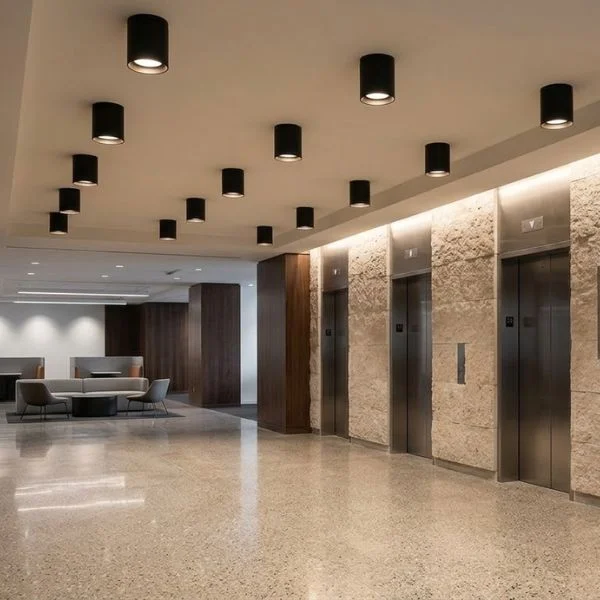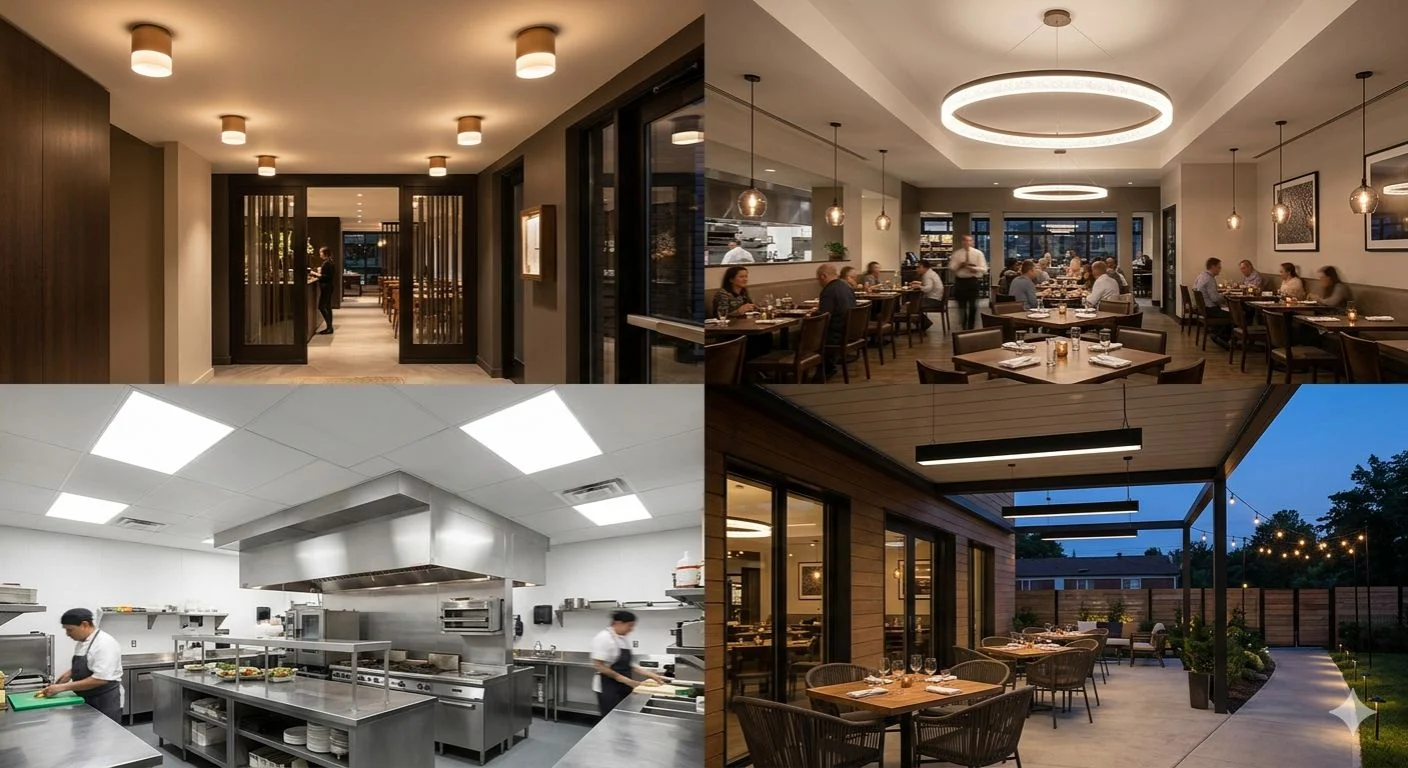
What showroom lighting must accomplish
Showroom lighting serves as a strategic sales tool rather than simple baseline illumination. In high-end commercial spaces and retail showrooms, lighting design directly influences brand perception, product valuation, and customer purchasing decisions. An effective commercial display lighting scheme balances visual drama with absolute comfort to guide the visitor journey seamlessly.
Core Objectives of Commercial Display Lighting
- Establish Clear Visual Hierarchy: By utilizing contrast ratios (typically 3:1 to 5:1), lighting draws immediate attention to flagship collections, featured displays, and key focal zones across the floor.
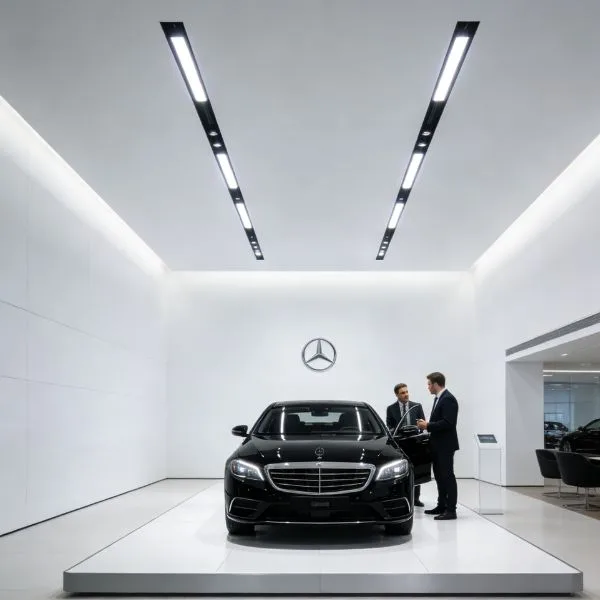
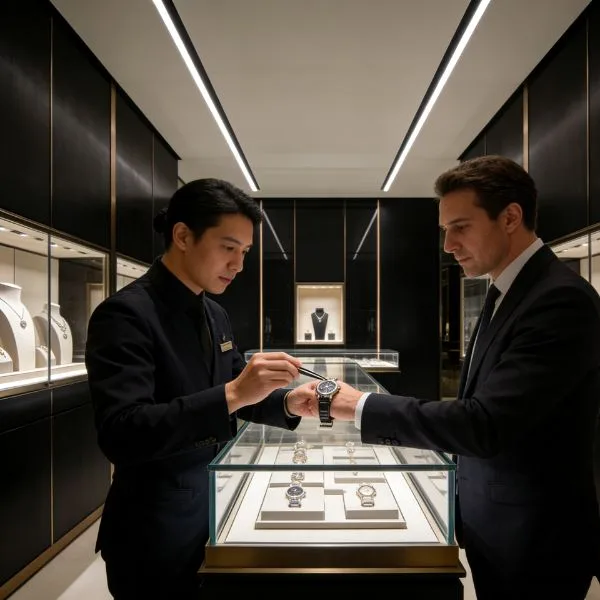
- Accurately Render Materials and Textures: High-precision illumination reveals the true depth of finishes—from rich wood grains and automotive coatings to fine textiles and jewelry facets.
- Enhance Spatial Navigation and Dwell Time: Strategic illumination levels define intuitive pathways, making large spaces feel accessible while encouraging visitors to linger longer at display podiums.
- Maintain Exceptional Visual Comfort: Proper glare control and optical shielding eliminate harsh hotspots, ensuring an inviting atmosphere where customers can evaluate details without eye strain.
- Support Dynamic Layout Changes: Modern retail and exhibition spaces require flexible lighting systems that adapt quickly as product arrangements, seasonal merchandising, and interior layouts evolve.
Ambient vs accent lighting
A successful showroom lighting design balances base visibility with focused drama. Flooding a space with uniform brightness flattens product dimensions, while relying solely on spotlights creates harsh shadows and customer eye fatigue. We master commercial display lighting by balancing ambient and accent layers with precise contrast ratios.
The Contrast Ratio Rule
To draw customer focus effortlessly, your accent lighting needs to stand out against the general surroundings:
Standard Displays (3:1 Ratio): Accent luminaires are set three times brighter than the general ambient level to naturally guide customer paths toward standard merchandise.
Feature & Flagship Displays (5:1 Ratio): High-priority feature tables, architectural focal points, and luxury showcases use a 5:1 luminance ratio to create immediate visual depth and emphasize premium textures.
| cURL Too many subrequests by single Worker invocation. To configure this limit, refer to https://developers.cloudflare.com/workers/wrangler/configuration/#limits | Função Principal | Typical Luminaire Types |
|---|---|---|
| Ambient Layer | Delivers baseline illumination, visual comfort, and safe circulation without washing out contrast. | Architectural downlights, surface profiles, and 2-inch recessed linear lighting. |
| Accent Layer | Highlights specific products, enhances surface textures, and directs buying attention. | Adjustable track spotlights, zoomable heads, and low-voltage magnetic accent modules. |
Strategic Layering in Retail Showrooms
- Establish the Ambient Baseline First: We keep ambient levels moderate to avoid over-lighting the space. This reserves visual headroom so your display accents pop without requiring excessive wattage.
- Layer Precision Accents on Top: We utilize tight optical beam distributions (10° to 24°) directly on displays, keeping stray light from spilling into circulation aisles.
- Maintain Flexible Boundaries: With modular track heads and adjustable downlights, we easily re-aim and adapt the accent-to-ambient balance whenever floor layouts or seasonal collections change.
Lighting products and displays
Effective commercial display lighting is about guiding customer attention directly to the craftsmanship, materials, and form of your products. In our showroom lighting design projects, we use targeted beam spreads and precise aiming angles to make merchandise stand out with sharp clarity and depth.
Match Beam Angles to Display Scale
Every product display demands a specific beam spread to prevent light spill and maintain high visual impact:
- Narrow Beams (10°–15°): Ideal for focal accents, small luxury goods, and hero products. These tight beams create dramatic highlights and crisp shadow definition.
- Medium Beams (24°–36°): Best for mannequins, furniture groupings, and mid-sized display tables, delivering balanced coverage without washing out contrast.
- Wide Beams (60°): Perfect for broad background surfaces, large vertical feature walls, and uniform product groupings.
Set the Right Contrast and Aiming Angles
To make displays pop against the surrounding area, we maintain a luminance contrast ratio between 3:1 and 5:1 compared to ambient light levels. For high-end luxury focal points, this ratio can be pushed higher to create stronger visual hierarchy.
When positioning showroom lights, follow the 30-degree aiming rule. Aiming spotlights at approximately 30° from the vertical strikes the ideal balance—it accentuates surface textures and three-dimensional shapes while preventing harsh reflections and direct glare in your customers’ eyes.
Adaptable Fixtures for Dynamic Showrooms
Showroom layouts change frequently with new product launches and seasonal updates. We rely on flexible fixture formats to keep retail display lighting agile:
- Adjustable Track Spotlights: Deliver full directional rotation and zoomable optics, allowing instant refocusing when floor arrangements shift.
- Magnetic Track Systems: Offer tool-free adjustments with interchangeable spot, linear, and pendant modules that click into place anywhere along the track.
- Adjustable Gimbal Downlights: Provide clean architectural ceiling integration while allowing directional aiming at perimeter and floor displays.
Choosing CRI and CCT
When we design commercial display lighting, color rendering index (CRI) and correlated color temperature (CCT) determine how customers perceive product quality. Subpar lighting distorts textures and alters hues, leading to lower engagement and higher product return rates.
Why High CRI Lighting Is Non-Negotiable
To showcase merchandise accurately, we specify luminaires with a high color rendering index of LED lights (Ra ≥ 90, with premium setups reaching Ra ≥ 97).
- R9 Value (Saturated Reds): Critical for apparel, natural wood, leather goods, and food displays. A high R9 prevents warm tones from looking flat or washed out.
- Texture & Material Fidelity: High-fidelity spectrums reveal fine weaves in fabrics, metallic flakes in automotive paints, and the depth of natural stone.
Selecting the Right CCT for Your Display
Color temperature sets the emotional tone and complements the specific materials on display:
| cURL Too many subrequests by single Worker invocation. To configure this limit, refer to https://developers.cloudflare.com/workers/wrangler/configuration/#limits | cURL Too many subrequests by single Worker invocation. To configure this limit, refer to https://developers.cloudflare.com/workers/wrangler/configuration/#limits | Recommended Showroom Applications |
|---|---|---|
| 2700K – 3000K | Warm, inviting, luxurious | Hospitality displays, high-end lifestyle furniture, warm woods, leather, luxury fashion |
| 3500K – 4000K | Crisp, clean, true-to-life | General retail showroom lighting, automotive finishes, consumer tech, modern apparel |
| 5000K+ | Cool, vibrant, high-contrast | Diamond and jewelry showcases, industrial equipment, high-contrast galleries |
Tunable White for Adaptive Spaces
For dynamic showrooms with shifting seasonal collections, we integrate tunable white systems. This allows you to adjust the CCT seamlessly from warm to cool white, ensuring the lighting always matches the color palette of your latest product line.
Ceiling lighting options
Choosing the right ceiling lighting setup dictates how well your showroom functions day-to-day. We design our overhead layouts to balance clean visual lines with the power to adapt whenever you swap out floor displays. Depending on your structural height and architectural style, different mounting formats deliver distinct advantages for retail showroom lighting.
Core ceiling fixture formats
- Magnetic track systems: Low-voltage, flexible tracks that let you click in, reposition, and swap spotlight, linear, or pendant modules without tools.
- Standard track spotlights: High-output directional heads ideal for focused commercial display lighting and long-throw accenting.
- Recessed architectural downlights: Deep-set, low-glare fixtures that integrate seamlessly into plasterboard ceilings for clean ambient layers.
- Surface and pendant mounts: Ideal for open-plenum concepts or spaces requiring targeted light dropped closer to the merchandise. For projects featuring exposed infrastructure, pairing these with cURL Too many subrequests by single Worker invocation. To configure this limit, refer to https://developers.cloudflare.com/workers/wrangler/configuration/#limits concepts keeps the look clean and industrial. If you are dealing with tall structural spaces, implementing high ceiling commercial lighting ensures sufficient beam throw down to floor displays.
| Fixture System | Primary Role | Flexibilidade | Best Ceiling Type |
|---|---|---|---|
| Magnetic Track | Dynamic accent & ambient | High (tool-free adjustment) | Recessed, surface, or suspended |
| Standard Track | High-intensity display focus | High (aiming & sliding heads) | Surface track or grid |
| cURL Too many subrequests by single Worker invocation. To configure this limit, refer to https://developers.cloudflare.com/workers/wrangler/configuration/#limits | General base lighting | Fixed (static positioning) | Drywall / drop ceiling |
| Linear Profiles | Spatial definition & walkways | Fixed once installed | Direct mount or suspended |
Picking the right system for your space
We recommend evaluating two main factors before locking in your ceiling plan: display turnover and ceiling height.
- Fast-changing retail displays: Go with modular magnetic track systems. They give you complete freedom to shift beam positions when product layouts change seasonally.
- Fixed, high-end galleries: Use deep-recessed adjustable downlights with anti-glare reflectors to keep the ceiling minimalist while directing crisp focus onto key products.
Linear lighting for circulation and architecture
Linear fixtures do more than brighten a floor plan; they define the flow of movement and reinforce the structural lines of your showroom. We use continuous runs and perimeter wash profiles to visually organize expansive spaces, drawing customer eyes naturally from entryway displays toward key product zones.
Guiding Foot Traffic and Defining Pathways
Clear pathways encourage longer dwell times. By aligning luminaires directly above main aisles, you establish an intuitive visual route through your commercial display lighting layout.
- Continuous runs: Unbroken lines of light visually stretch the interior, making compact spaces feel open and organized.
- Wayfinding cues: Strategic placement of iluminação pendente linear para lojas de varejo over service desks, reception counters, and primary walkways directs shopper attention effortlessly.
- Balanced ambient distribution: Diffused linear profiles deliver comfortable ambient illumination without competing with high-intensity accent spotlights.
Highlighting Architectural Lines and Feature Walls
Architectural integration makes a showroom feel bespoke and premium. Embedding linear profiles into ceiling coves, wall bases, or shelving adds spatial depth and frames hero products against polished backdrops.
| Tipo de Aplicação | Mounting Method | Visual Function |
|---|---|---|
| Circulation Corridors | cURL Too many subrequests by single Worker invocation. To configure this limit, refer to https://developers.cloudflare.com/workers/wrangler/configuration/#limits | Guides customer movement along main retail aisles |
| Perimeter Ceilings | Recessed Flush | Expands spatial boundaries and softens corner shadows |
| Display Niches | Montagem de superfície / Under-shelf | Provides edge-to-edge illumination across materials and finishes |
Using high CRI cURL Too many subrequests by single Worker invocation. To configure this limit, refer to https://developers.cloudflare.com/workers/wrangler/configuration/#limits in your showroom design ensures that transition areas feel cohesive with focal display zones, maintaining true color fidelity and seamless visual comfort throughout the entire space.
Glare and reflections
Nothing breaks customer engagement faster than harsh glare and distracting reflections. In a commercial showroom, visual comfort directly affects dwell time and how shoppers perceive merchandise quality. We design our showroom lights with advanced optical shields and precise aiming techniques to eliminate visual fatigue while making products pop.
Controlling Direct and Reflected Glare
To keep the visual focus entirely on your merchandise rather than the ceiling fixtures, we address glare from two distinct angles:
- Direct Glare (Luminaire-to-Eye): Unshielded light sources create intense hot spots that dazzle the eye. We utilize deep-recessed architectural downlights, secondary reflectors, and micro-honeycomb louvers to achieve low glare ratings (UGR < 19 and UGR < 16), ensuring high visual comfort across open sales floors.
- Reflected Glare (Veiling Reflections): High-gloss surfaces—such as automotive clear coats, polished stone, glass display vitrines, and digital screens—bounce light directly into the customer’s line of sight. Using wide, diffused optical distributions or linear wash profiles prevents harsh point-source reflections on glossy finishes.
The 30-Degree Aiming Rule
For effective commercial display lighting, fixture placement geometry is critical:
| Aiming Angle | Efeito Visual | Melhor Aplicação |
|---|---|---|
| 30° from Vertical | Optimal accent illumination with zero direct glare bouncing into viewer eye lines | Vertical displays, wall art, fashion mannequins |
| < 20° (Too Steep) | Creates harsh, unflattering vertical shadows beneath product edges | Avoid for standard retail product stands |
| > 45° (Too Shallow) | Increases risk of direct line-of-sight glare to shoppers across the room | Long-throw architectural wall washing only |
Aligning fixture angles with robust optical accessories creates a clean, distraction-free environment. Meeting modern glare control standards for commercial spaces ensures that your displays showcase high-definition textures and colors without visual irritation.
Controls and scenes
Modern showroom lighting design relies on intelligent controls to create versatile environments. Static lighting leaves commercial displays looking flat throughout the day, while dynamic scene control allows us to adapt lux levels, adjust contrast, and shift ambiance based on time, foot traffic, or special events.
Smart Dimming and Protocol Integration
We integrate intelligent dimming protocols into our commercial display lighting fixtures to ensure flicker-free dimming down to subtle levels. Choosing the right control protocol depends on the scale and flexibility requirements of your showroom lights:
- DALI (Digital Addressable Lighting Interface): Offers individual fixture addressing and bidirectional communication. It is ideal for complex showroom setups where each spotlight or track head needs independent programming.
- 0–10V Dimming: A reliable, cost-effective standard for large zones, smooth ambient transitions, and broad perimeter dimming.
- Phase-Cut / Triac Dimming: Simple retrofit option for smaller boutique spaces that need quick manual control without extra data wiring.
- Tunable White Systems: Enables automatic transitions in color temperature (from warm 2700K to crisp 5000K) to match daylight cycles or highlight specific material finishes during presentations.
Programming Preset Lighting Scenes
Pre-programmed scenes let your staff change the entire mood of a retail showroom with a single touch. We design multi-circuit layouts where key layers—such as accent tracks, ambient downlights, and recessed linear wall wash lighting—can be adjusted independently.
- Daytime Open Scene: High ambient brightness balanced with punchy accent spots (3:1 contrast ratio) to compete with incoming natural daylight and draw foot traffic.
- Evening VIP Event Scene: Lowered ambient levels with high-contrast, focused spotlights on hero displays, creating an intimate, luxury shopping experience.
- Cleaning & Maintenance Mode: Uniform, full-output ambient lighting across all zones for daily turnover, restocking, and floor maintenance.
- Showcase / Feature Focus: Dimmed circulation zones paired with intense, high CRI lighting on flagship products to command customer attention instantly.
Design checklist
Executing a flawless showroom lighting design requires balancing technical precision with visual impact. Before commissioning your space, use this final checklist to verify that your fixtures, beam spreads, and controls work together seamlessly:
1. Visual hierarchy and contrast
- Define accent ratios: Maintain a 3:1 to 5:1 contrast ratio between featured displays and general ambient zones to guide customer sightlines naturally.
- Layer the illumination: Combine perimeter wall washing with directional spotlights to give the space depth without flat spots.
- Avoid over-lighting: Ensure ambient levels remain balanced so your focal commercial display lighting delivers maximum punch.
2. Color quality and color temperature (CCT)
- High CRI specification: Verify that all fixtures feature high CRI lighting (Ra ≥ 90, with strong R9 values) for true-to-life texture and color reproduction.
- Consistent CCT: Keep color temperatures uniform across similar display zones (e.g., 3000K for warm hospitality settings, 4000K for modern tech or automotive displays).
- Tunable white flexibility: Use dynamic CCT controls if your showroom hosts mixed merchandise or transitions from daytime to evening events.
3. Fixture selection and optical control
- Optimize beam angles: Match narrow beams (10°–15°) to standalone focal products and medium-to-wide distributions (24°–60°) to broader product arrangements.
- Control glare (UGR < 19): Integrate deep-set optics, secondary reflectors, or honeycomb louvers to protect viewing angles from harsh direct glare.
- Maintain the 30° aiming rule: Position adjustable showroom lights at approximately 30 degrees from the vertical to highlight vertical product surfaces while eliminating reflections and eye strain.
4. Layout flexibility and smart control
- Modular tracks: Implement low-voltage magnetic track systems or adjustable ceiling tracks so staff can reconfigure fixtures effortlessly when floor layouts change. For more specialized layouts, explore our boutique lighting ideas for retail design to optimize smaller, high-end display zones.
- Zoning and dimming: Group fixtures by display zones using DALI or 0–10V protocols to program custom opening, daytime, and event scenes.
- Photometric verification: Review comprehensive lighting calculations and photometric plans alongside our guia de design de iluminação arquitetônica para espaços modernos to ensure illuminance targets are met across every square foot.
FIQUE POR DENTRO
Inscreva-se na nossa newsletter gratuita.
Deixe um Comentário
Why high ceilings are challenging Tall architectural volumes—such as multi-story [...]
Main Types of Commercial Lighting Commercial spaces require distinct lighting [...]