Understanding the Technical Essentials of Office Downlighting
When we design workspaces, lighting is the first thing we look at. Getting your recessed office lighting right isn’t just about illuminating a room—it directly impacts focus, energy levels, and daily productivity. To get the most out of your ceiling setup, you need to understand three core technical elements: color temperature, color rendering, and energy efficiency.
Color Temperature (CCT): Finding the Sweet Spot
Choosing the right Correlated Color Temperature (CCT) changes how a workspace feels. We recommend balancing focus and comfort depending on how you use the space.
- 4000K Cool White LED: This is the industry standard for open offices, conference rooms, and task areas. It mimics natural daylight, keeping employees alert and focused.
- 3000K Warm White: Best for breakrooms, lounges, or relaxed home offices where you want a welcoming, low-stress vibe.
Color Rendering Index (CRI): Why High-CRI Workspace Lighting Matters
A high Color Rendering Index (CRI) is non-negotiable for reducing eye strain at work. Light sources with low color rendering make spaces look dull and force your eyes to work harder to distinguish shapes and text.
The Gold Standard: We use a CRI of 90 or higher in our commercial LED downlights. This ensures colors look vivid and true to life, which drastically lowers visual fatigue during long shifts.
Lumens vs. Wattage: Optimizing Commercial Energy Efficiency
Stop looking at wattage to judge brightness. In modern LED setups, wattage only tells you how much power the fixture draws. Instead, focus on lumens (brightness) and lumens per watt (efficiency).
| Metric | What It Means | Why It Matters for Your Business |
|---|---|---|
| Lumens (lm) | Total light output | Determines the actual brightness of the room. |
| Wattage (W) | Energy consumed | Lower wattage means lower monthly utility bills. |
| Luminous Efficacy (lm/W) | Lumens divided by watts | Measures how efficiently the fixture converts power to light. |
By choosing high-efficiency commercial LED downlights, you maximize your light output while keeping your energy footprint as small as possible.
Solving the Office Workspace Enemy: Glare and Eye Strain
Ever find yourself squinting at your monitor by 2 PM, fighting off a headache? You aren’t alone. Bad recessed office lighting is usually the culprit. Direct glare and harsh reflections don’t just hurt productivity—they cause severe eye fatigue. To build a truly comfortable workplace, we need to focus on smart optics and anti-glare office fixtures that keep the light on the desk, not in your eyes.
What is Unified Glare Rating (UGR)?
Unified Glare Rating (UGR) is a psychological measure of discomfort caused by lighting fixtures in an indoor environment. For businesses, this metric is a big deal.
- UGR < 19: The gold standard for offices. It ensures the light is comfortable for long-term screen work.
- Why it matters: Investing in low-UGR fixtures directly cuts down on employee eye strain and headaches, keeping everyone sharp and focused.
If you are designing a high-efficiency workplace, choosing the right fixtures is critical. Check out our comprehensive LED lights for office buildings guide to see how proper brightness levels and UGR ratings work together to boost daily productivity.
Baffle Trims vs. Reflector Trims: Choosing Your Optics
The trim you choose dictates how light behaves when it leaves the ceiling. Here is how they stack up for screen visibility:
| Trim Type | Light Distribution | Best Used For | Screen Glare Risk |
|---|---|---|---|
| Deep Baffle Trim | Absorbs stray light, softens the beam | General workstations, desks | Very Low |
| Reflector Trim | Maximizes lumen output, amplifies brightness | Hallways, breakout zones | High (if placed over desks) |
For primary work areas, we always recommend a deep baffle recessed trim. The grooved ridges trap excess light, stopping harsh reflections from bouncing off computer screens.
The Power of Deep-Regressed LEDs and COB Technology
To truly eliminate glare, you need to hide the light source itself. This is where modern fixture design comes in:
- Deep-Regressed LEDs: These fixtures position the light source higher up inside the ceiling housing. Because the bulb is recessed deeply, you can’t see the blinding source of light unless you are standing directly underneath it.
- Chip-on-Board (COB) Tech: Instead of a cluster of individual, pixelated LED dots that create multi-shadow illusions, COB technology uses a single, concentrated light engine. This delivers a smooth, clean beam of light that mimics natural illumination.
Types of Recessed Office Lighting Fixtures
Choosing the right recessed office lighting fixtures depends heavily on your ceiling type, architectural constraints, and daily workflow. We engineer a variety of commercial-grade options to fit every specific workspace need.
Canless LED Downlights and Ultra-Slim Wafers
- Best For: Low-clearance ceilings with limited plenum space.
- Why They Work: These ultra-slim profiles eliminate the need for traditional bulky cans. They slide effortlessly into tight ceiling spaces, providing a clean look for both modern corporate hubs and compact home offices.
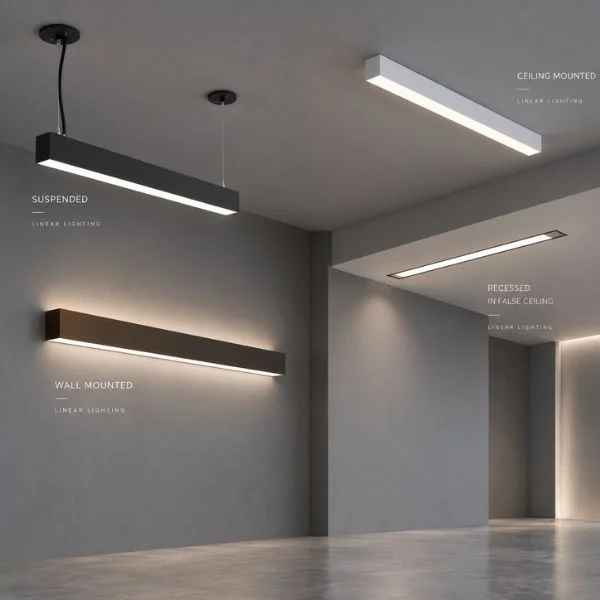
Recessed Linear Slots
- Best For: Creating sleek, continuous lines of light that elongate architectural spaces.
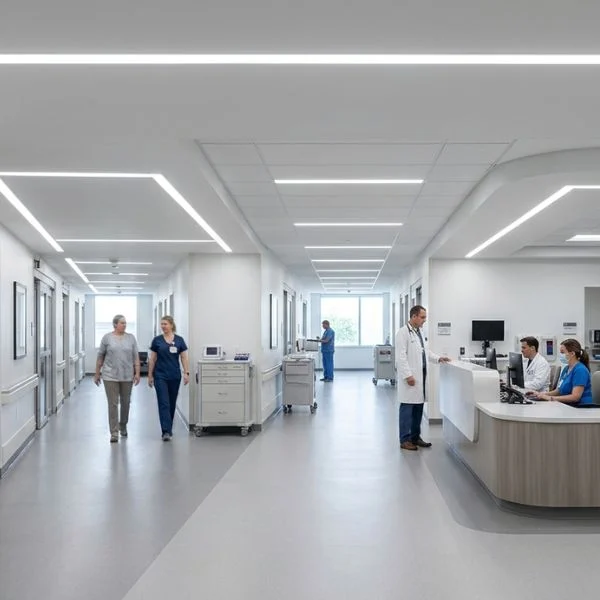
- Why They Work: They offer an upscale, minimalist aesthetic while ensuring uniform light distribution across open desks and conference rooms. If you are mapping out a high-end corporate layout, take a look at our recessed linear wall wash lighting types and guide to optimize your wall-to-floor illumination. You can also view our comparison on 4000k vs 5000k linear lights for offices to select the perfect balance of focus and clarity for your team.
Architectural LED Troffers and Center Baskets
- Best For: Standard T-grid drop ceilings.
- Why They Work: These integrated LED troffers provide volumetric, indirect lighting that fills the workspace without creating harsh hot spots. They are the go-to standard for bulk commercial upgrades, offering premium energy savings and a complete departure from old fluorescent flickering.

Gimbal and Adjustable Downlights
- Best For: Feature walls, reception desks, and targeted task lighting.
- Why They Work: These fixtures feature a swiveling mechanism that lets you direct light exactly where it is needed most, making them perfect for highlighting office signage or adding focused illumination over individual work surfaces.
Layout Planning and Spacing Strategies for Corporate & Home Offices
The Golden Rules of Spacing: Ceiling Height vs. Ambient Footcandles
Getting your office ceiling light layout right depends entirely on your ceiling height. As a general rule, we space recessed office lighting fixtures at a distance equal to half the ceiling height to achieve an optimal 30 to 50 footcandles of ambient light across the workspace.
| Ceiling Height | Fixture Spacing | Target Ambient Light |
|---|---|---|
| 8 Feet | 4 Feet Apart | 30 – 40 Footcandles |
| 10 Feet | 5 Feet Apart | 40 – 50 Footcandles |
| 12+ Feet | 6 – 8 Feet Apart | 50+ Footcandles |
Prevent Shadows: Where to Position Fixtures Relative to Desks and Monitors
Poorly placed commercial LED downlights create annoying shadows right over your paperwork or cause blinding screen glare. We use strategic positioning to eliminate these workplace distractions:
Avoid direct overhead placement: Never place a downlight directly over a worker’s head or right behind their chair to avoid casting harsh shadows on the desk surface.
The desk alignment rule: Position fixtures slightly to the side and in front of the desk setup to illuminate the workspace without bouncing harsh light off computer monitors.
Wall wash techniques: Space fixtures 2 to 3 feet away from walls to bounce ambient light into the room, which expands the space visually and reduces the “cave effect.”
Creating a Layered Lighting Scheme: Ambient, Task, and Accent Integration
We never rely on a single light source to do all the heavy lifting in a modern workspace. A truly productive environment integrates a layered lighting strategy to maintain balance. Understanding the different types of commercial lighting fixtures and their benefits allows us to mix general ambient downlights with dedicated desk lamps for task lighting, and adjustable gimbals for accenting architectural features. This intentional balance keeps the energy high and eye strain low.
Smart Controls, Commercial Dimming, and Energy Compliance
Upgrading your recessed office lighting isn’t just about choosing sleek fixtures; it is about how you control them to maximize efficiency and comfort. Modern corporate environments demand intelligent control systems that adapt to daily workflows while keeping operational costs low.
0–10V Dimming vs. Phase Dimming: Choosing Your Control Protocol
Selecting the right dimming infrastructure ensures your commercial LED downlights perform smoothly without flickering.
- 0–10V Dimming: This is the gold standard for commercial builds. It uses a dedicated low-voltage signal to scale light output from 100% down to 1% or lower. It is highly reliable, scales easily across massive open-plan offices, and handles large lighting loads effortlessly.
- Phase Dimming: More common in smaller retrofits or home office setups. It utilizes existing electrical wiring by cutting off parts of the AC voltage wave. While cheaper upfront, it lacks the precise control needed for large-scale commercial networks.
Daylight Harvesting and Motion Sensors: Meeting Title 24 and Energy Star Standards
Energy regulations are tightening globally. Incorporating advanced sensors into your layout helps you effortlessly meet strict building codes and secure crucial certifications and North American standards like Energy Star and Title 24.
- Daylight Harvesting: These systems use photosensors to detect natural light coming through windows. They automatically dim your overhead recessed office lighting when the sun is bright, saving massive amounts of energy throughout the day.
- Occupancy & Vacancy Sensors: No more wasting money on lighting empty conference rooms. Motion sensors ensure lights are only active when someone is actually using the space.
Future-Proofing with Tunable White and Smart Office Automation
The future of workspace design is centered around human-centric lighting. Integrating tunable white CCT allows your team to shift the color temperature from a crisp, productive cool white during peak morning hours to a warmer, relaxing tone in the late afternoon. By pairing your fixtures with smart office automation platforms, you can program schedules, track energy metrics, and adapt your workspace to changing needs with a single tap on a centralized dashboard.
Installation Considerations for Recessed Office Lighting
Whether we are managing a major corporate renovation or upgrading a compact home workspace, the physical environment dictates how we approach the installation of recessed office lighting. Commercial properties and residential spaces have vastly different structural realities that impact fixture selection.
IC-Rated vs. Non-IC Rated Housings
Navigating insulation safely is the first technical hurdle. We must choose the right housing type based on ceiling contact:
- IC-Rated (Insulation Contact): Mandatory if the fixture will directly touch attic or ceiling insulation. These units are engineered to keep external temperatures low, preventing fire hazards in tight home office setups.
- Non-IC Rated: Designed for open plenums common in corporate buildings with drop ceilings, where insulation is absent. They require at least a 3-inch clearance from any combustible materials.
Retrofitting Legacy Fluorescent Cans to Integrated LEDs
Upgrading inefficient, legacy fluorescent commercial fixtures to modern systems radically lowers energy costs and improves visual clarity. For an in-depth breakdown of fixture metrics and requirements before purchasing, review our technical buying guide for recessed architectural luminaires.
Here is our quick step-by-step process for retrofitting older commercial cans to our high-efficiency integrated LEDs:
- Power Down: Turn off the breaker to ensure complete electrical safety.
- Remove Old Components: Extract the existing fluorescent bulb, trim, and ballast if converting to a direct-wire system.
- Check Dimensions: Verify that the existing housing diameter matches the new LED retrofit kit.
- Connect the Wiring: Plug the quick-connect adapter or wire the fixture directly to the junction box.
- Secure the New Fixture: Push the integrated LED module into the existing housing until the torsion springs snap securely into place.
Frequently Asked Questions (FAQs) About Recessed Office Lighting
How many recessed lights do I need for a standard office room?
The number of fixtures depends on your room square footage and ceiling height. For standard commercial LED downlights, a common rule of thumb is to divide the ceiling height by two to determine fixture spacing. For a typical 10 × 12 foot office, you will generally need 4 to 6 well-placed fixtures to achieve the recommended 40 to 50 footcandles of ambient light on desk surfaces.
What is the best color temperature for productive office work?
A 4000K cool white LED color temperature strikes the perfect balance for corporate environments. It mimics natural daylight, keeping employees alert, focused, and productive without causing the sterile feel of higher kelvin ratings. For hybrid or home offices, you might consider tunable white CCT fixtures that allow you to shift from a crisp 4000K during the day to a warmer 3000K in the evening.
Can I install canless LED wafer lights in a drop ceiling?
Yes, you can install canless LED wafer lights in a suspended ceiling, but they require proper support. Because acoustic tiles can sag over time under the weight of the fixture and driver, you must use a dedicated t-grid mounting plate or rough-in bracket. For a seamless look across a standard grid layout, many businesses prefer utilizing dedicated 2×2 LED lights for suspended ceilings alongside traditional downlights.
How do I reduce screen glare from overhead recessed lights?
To eliminate annoying reflections on monitors, choose anti-glare office fixtures featuring a deep baffle recessed trim or a low Unified Glare Rating (UGR < 19). Additionally, position your recessed office lighting so the fixtures are placed to the sides of the workspace rather than directly directly over a computer screen or directly behind the worker’s chair.
Related Sources
STAY IN THE LOOP
Subscribe to our free newsletter.
Leave A Comment

Explore types of hanging lights including pendant chandeliers and cluster designs to find the perfect style for every room