School Lighting Solutions: A Complete Guide for Educational Facility Projects
Educational facilities represent one of the most demanding segments in commercial lighting design, requiring a balance between energy efficiency, visual comfort, regulatory compliance, and long-term lifecycle cost control. Unlike standard commercial environments, school lighting must support diverse functional spaces—including classrooms, libraries, corridors, gymnasiums, administrative offices, and outdoor campus areas—each with distinct lighting requirements.
Lighting typically accounts for 20–30% of total electricity consumption in educational buildings. As a result, lighting upgrades represent one of the highest-impact opportunities for energy reduction. The transition from fluorescent to LED technology has enabled 40–70% energy savings, while also improving lighting quality, controllability, and maintenance efficiency.
Modern educational projects increasingly rely on LED systems combined with intelligent controls, allowing facilities to reduce operational costs while maintaining compliance with energy codes such as ASHRAE 90.1, IECC, and California Title 24.
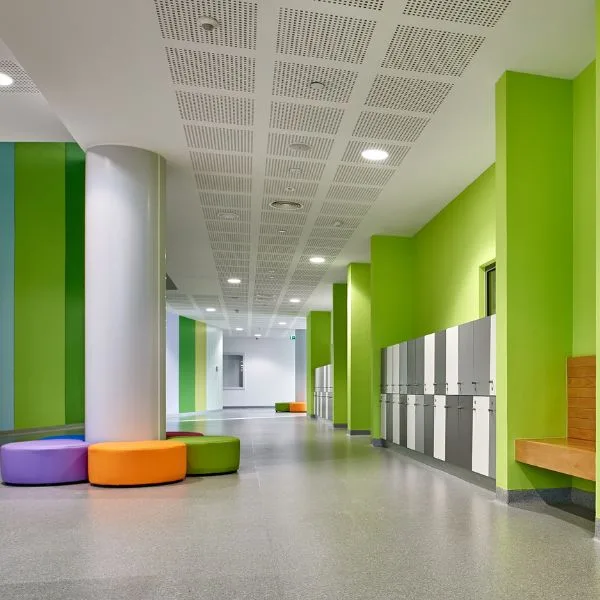
Key Design Requirements in Educational Lighting Projects
Successful educational lighting design is defined not only by achieving target illuminance levels, but also by meeting performance, compliance, and lifecycle requirements.
1. Energy Code Compliance & Efficiency Targets
Most educational lighting projects must comply with:
- ASHRAE 90.1 energy standards
- IECC lighting power density (LPD) limits
- California Title 24 (where applicable)
- DLC qualification for rebate eligibility
Typical LPD targets:
| Space Type | LPD Target (W/sq ft) |
|---|---|
| Classrooms | 0.7 – 0.9 |
| Offices | 0.6 – 0.8 |
| Corridors | 0.4 – 0.6 |
| Gymnasiums | 0.8 – 1.2 |
LED efficacy for modern educational fixtures typically ranges from:
- Standard systems: 120–140 lm/W
- High-performance DLC Premium systems: 140–160+ lm/W
2. Lighting Quality & Visual Comfort
Educational environments require consistent and comfortable illumination to support learning performance and reduce eye strain.
Typical design benchmarks include:
| Parameter | Typical Requirement |
|---|---|
| Classroom illuminance | 300–500 lux (30–50 fc) |
| Library / study areas | 400–750 lux |
| CRI | ≥80 (≥90 for art/design spaces) |
| CCT | 3500K–5000K |
| Glare (UGR) | <19 (classrooms), <16 (libraries) |
| Flicker | Low flicker (<10%, ideally <5%) |
High uniformity and low glare performance are especially important in classrooms and learning environments where visual fatigue directly impacts performance.
3. Lifecycle Cost & Maintenance Strategy
Lifecycle cost is often more important than initial fixture cost in educational projects.
LED systems typically provide:
- 50,000–100,000 hour rated life
- No ballast replacement cycles
- Significantly reduced relamping frequency
- Lower maintenance labor requirements
Compared to fluorescent systems, LED lighting can reduce total lifecycle cost by 35–55% over 10 years, especially in large campus environments where maintenance access is costly.
Why Educational Facilities Are Transitioning to LED
The shift to LED lighting in education is driven by measurable operational advantages:
Energy Reduction
LED systems reduce lighting energy use by 40–70%, depending on control integration and space type.
Maintenance Reduction
Elimination of lamp and ballast replacements significantly reduces maintenance frequency, particularly in high-ceiling or large-scale facilities.
Improved Lighting Performance
Modern LED systems provide:
- Better optical control and uniformity
- Lower glare and flicker
- Stable color temperature
- Improved CRI consistency
Sustainability Benefits
LED lighting supports sustainability goals through:
- Mercury-free construction
- Lower carbon emissions
- Reduced energy demand
- Longer product lifecycle
Fixture Selection by Application
LED Troffers (Classrooms & Offices)
LED troffers remain the most widely specified solution for educational interiors due to compatibility with standard T-grid ceilings and balanced performance.
Typical specifications:
- Output: 3,000–6,000 lumens
- Wattage: 20W–50W selectable
- Efficacy: 130–160 lm/W
- Controls: 0–10V dimming, occupancy sensor ready
Applications:
- Classrooms
- Administrative offices
- Conference rooms
Installation guideline:
- Spacing ratio: 1.0–1.2 × mounting height
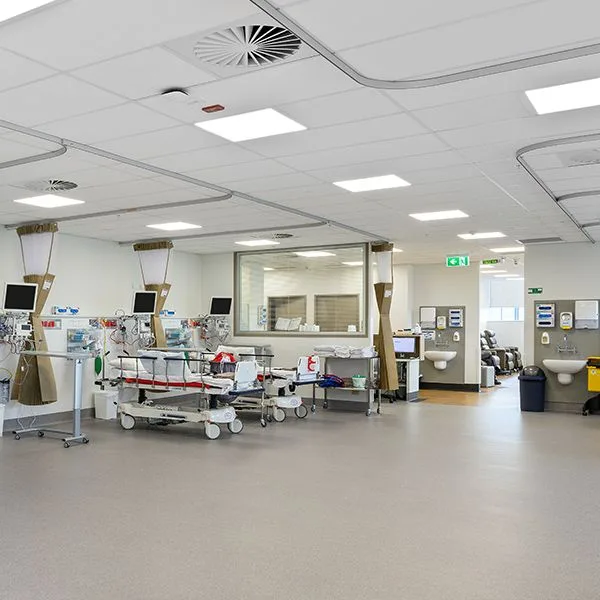
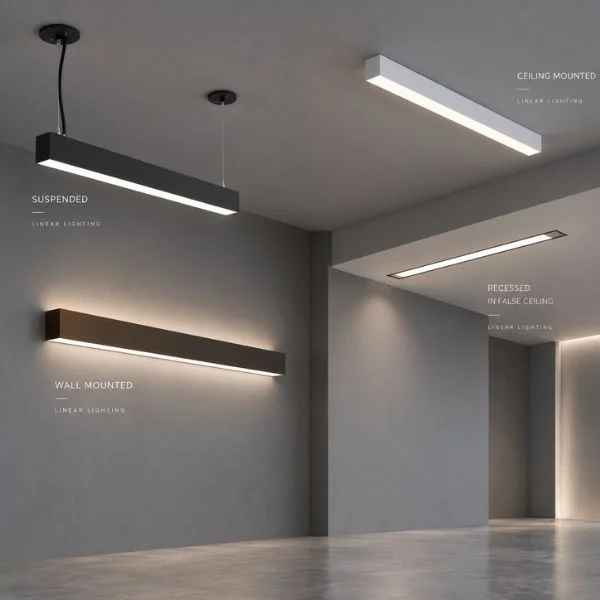
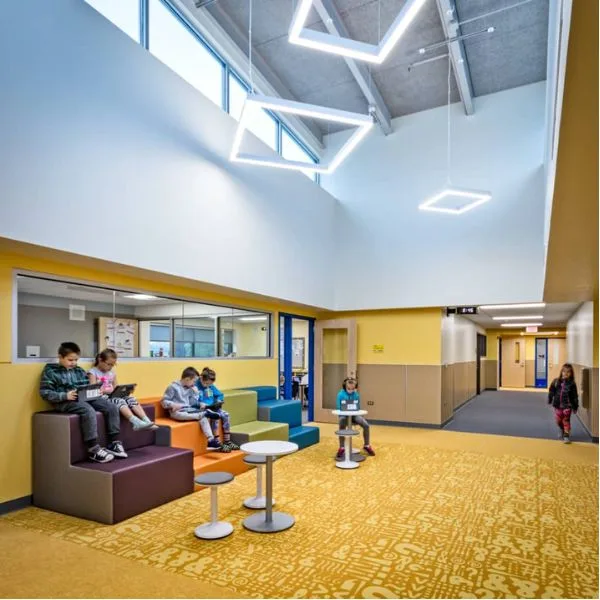
Architectural Linear Fixtures
Used increasingly in modern educational architecture where visual design and lighting quality are both priorities.
Typical specifications:
- Output: 2,000–8,000 lumens per section
- High uniformity continuous-row design
- Optional direct/indirect distribution (70/30 or 50/50)
Applications:
- Libraries
- Learning commons
- Corridors
- Collaboration spaces
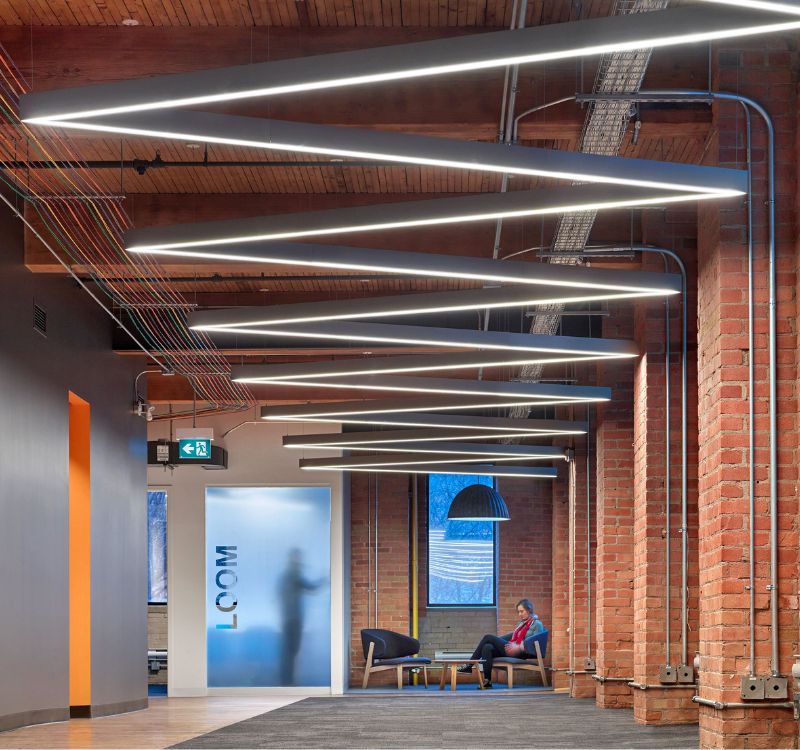
LED Wraparound Fixtures
Cost-effective solution for utility and circulation areas.
Applications:
- Hallways
- Storage rooms
- Maintenance areas
Benefits:
- Fast installation
- Durable housing
- Low maintenance cost
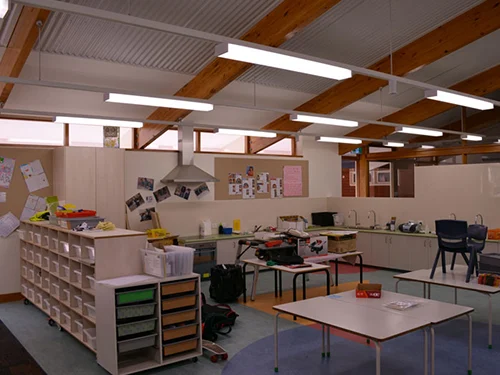
High Bay Fixtures (Gymnasiums & Large Spaces)
Designed for high-ceiling applications (20–40 ft).
Typical specifications:
- Output: 15,000–60,000 lumens
- Wattage: 100W–400W
- Distribution: Type V wide beam
Illuminance target:
- Gymnasiums: 300–500 lux with ≥0.5 uniformity
Lighting Controls & Smart Integration
Lighting controls are now standard in educational specifications and are essential for achieving code compliance and energy savings.
Core Control Strategies
- Occupancy sensors: 20–40% energy savings
- Daylight harvesting: 10–30% savings
- Dimming systems: 5–15% savings
- Networked lighting controls: additional optimization
Combined Impact
Integrated control systems typically deliver:
👉 35–65% total lighting energy reduction
Advanced Capabilities
- Campus-wide scheduling
- Energy monitoring
- Remote diagnostics
- BMS integration
- Demand response readiness
Retrofit vs New Construction Projects
Retrofit Projects
Best for existing schools seeking energy upgrades.
Advantages:
- Lower upfront cost
- Minimal disruption
- Fast ROI (typically 2–5 years)
- Easy fixture replacement
New Construction Projects
Best for full design integration.
Advantages:
- Optimized lighting layout
- Full control integration
- Architectural lighting design flexibility
- Higher long-term efficiency
Key Industry Trends
- Selectable wattage and CCT fixtures reducing SKU complexity
- Tunable white systems for multipurpose learning environments
- Networked lighting systems for smart campus management
- Increased emphasis on sustainability and carbon reduction
- Lighting integrated as architectural design element
Conclusion
Educational lighting design requires a balance of performance, efficiency, compliance, and lifecycle economics. With LED technology, modern facilities can achieve:
- 40–70% energy savings
- 35–55% lifecycle cost reduction
- Improved visual comfort and learning environments
- Full compliance with ASHRAE / IECC / Title 24
- Scalable smart control integration across campuses
By combining high-efficiency LED fixtures with intelligent controls and application-specific design strategies, educational institutions can significantly improve operational performance while reducing long-term costs.
STAY IN THE LOOP
Subscribe to our free newsletter.
Leave A Comment

Explore types of hanging lights including pendant chandeliers and cluster designs to find the perfect style for every room