Understanding the Importance of Data Center Office Lighting
Data center environments demand a precise balance between technological efficiency and human comfort. While server halls require strict environmental controls, the surrounding office spaces, control rooms, and tech bays rely heavily on specialized Data Center Office Lighting to maintain operational excellence. Proper illumination is no longer an afterthought; it is a core infrastructure component that directly influences human performance, regulatory compliance, and facility efficiency.
Enhancing Employee Well-being and Productivity
Data center operators and technicians often work long shifts in environments devoid of natural light. Implementing high-quality Data Center Office Lighting is essential to sustain focus, minimize eye strain, and prevent fatigue during critical monitoring tasks.
- Visual Comfort: Optimized luminance reduces the harsh contrast between bright monitor screens and dark surroundings.
- Error Reduction: High-clarity lighting allows technicians to accurately identify color-coded cabling and micro-components.
- Circadian Support: Advanced lighting setups mimic natural daylight patterns, keeping 24/7 shift workers alert and healthy.
| Lighting Attribute | Benefit to Personnel |
|---|---|
| High Color Rendering (CRI ≥ 80) | Accurate cable identification and reduced visual fatigue |
| Flicker-Free Driver Tech | Elimination of headaches and migraines during long shifts |
| Unified Glare Rating (UGR) < 19 | Comfortable screen monitoring without distracting reflections |
Meeting Data Center Compliance and Lighting Standards
Operating a global data center requires strict adherence to international safety and workplace standards. Regulatory bodies define specific illumination metrics to ensure both occupant safety and operational accuracy.
- ANSI/ASHRAE/IES Standard 90.1: Governs energy-efficient lighting design and power density limits.
- OSHA Requirements: Mandates minimum light levels across workspaces to guarantee safe egress and accident prevention.
- EN 12464-1: Specifies indoor workplace lighting requirements, targeting optimal lux levels for technical office tasks.
Failure to meet these compliance benchmarks risks layout re-engineering, financial penalties, and compromised worker safety during emergency scenarios.
Impact of Lighting on Power Usage Effectiveness (PUE)
Every watt consumed in a facility impacts its Power Usage Effectiveness (PUE). Legacy lighting systems generate excessive heat, placing a dual burden on the facility: direct energy consumption and increased demands on the precision cooling infrastructure.
The PUE Equation: > $$text{PUE} = frac{text{Total Facility Energy}}{text{IT Equipment Energy}}$$
Choosing energy-efficient, low-heat lighting fixtures directly optimizes this ratio.
- Lower Direct Draw: Upgrading to advanced solid-state systems slashes lighting electricity consumption by up to 70%.
- Reduced Thermal Load: Less heat dissipation from the fixtures means the HVAC system expends less energy cooling the facility.
- Smart Integration: Tying office lighting into the overall Data Center Infrastructure Management (DCIM) software allows for real-time tracking and automated energy savings.
Key Challenges in Data Center Lighting Design
Designing an efficient data center office lighting system comes with a unique set of obstacles. Balancing the visibility needs of technicians with the strict environmental controls of a server room requires overcoming several critical engineering challenges.
Managing Thermal Stress and Heat Dispersion
Every watt of electricity consumed by traditional lighting fixtures generates unwanted heat. In a data center, this adds thermal stress to sensitive IT equipment and forces cooling systems to work harder.
- The Heat Load Problem: Legacy fluorescent or incandescent bulbs act as miniature heaters, directly impacting cooling efficiency.
- The LED Solution: Upgrading to advanced solid-state fixtures minimizes heat emission, reducing the load on your HVAC infrastructure and protecting server lifespans.
Navigating Narrow Aisles and High-Density Rack Zones
Server rooms are packed with tall, high-density racks separated by narrow aisles. Standard overhead lighting often fails here, casting deep shadows exactly where technicians need to read small labels or trace cables.
- Shadow Reduction: Fixtures must deliver precise, vertical illumination to light up the entire face of a rack from top to bottom.
- Space Optimization: Specialized recessed architectural lighting and continuous linear systems help maintain a clean ceiling profile while directing light exactly into tight corridors without creating physical obstructions.
Ensuring Safe 24/7 Continuous Operation
Data centers never sleep, meaning the lighting infrastructure must be built for absolute reliability and zero downtime.
| Operational Challenge | Direct Impact | Required Solution |
|---|---|---|
| Constant Runtime | Accelerated fixture burnout | Industrial-grade drivers and premium thermal management. |
| Maintenance Disruptions | Risk of dust/debris during bulb changes | Long-lifespan fixtures that eliminate frequent maintenance cycles. |
| Power Fluctuations | Flicker and driver failure | Robust, low-voltage, or DC-powered lighting options. |
Essential Considerations for Data Center Office and Server Spaces
Designing lighting for a data center requires a balanced approach that addresses both the high-focus environment of technical offices and the specialized requirements of server rooms. My goal is to ensure your facility remains safe, functional, and efficient.
Optimizing Visibility and Reducing Screen Glare
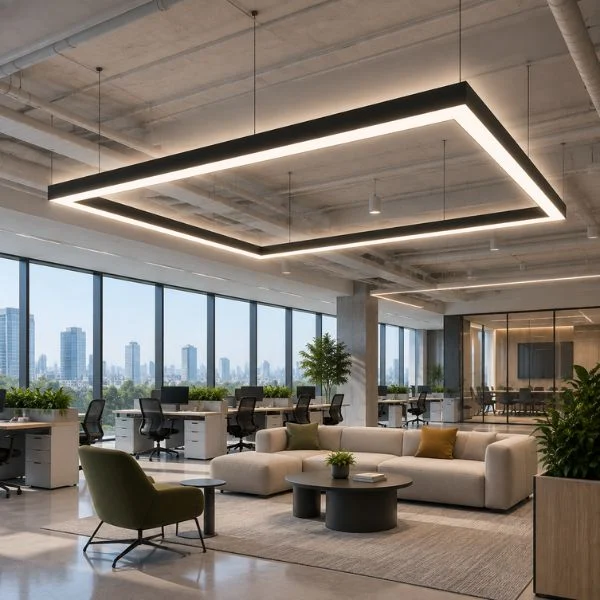
In office areas where IT professionals manage network operations, managing screen glare is non-negotiable. I prioritize indirect lighting or recessed solutions like our regressed linear hanging light to distribute light evenly. This prevents harsh reflections on monitor surfaces, which reduces eye strain and minimizes fatigue during long shifts.
Determining Recommended Light Levels and Foot-Candles
Lighting intensity must be tailored to the specific task:
- General Server Rooms: A range of 20 to 30 foot-candles (FC) is usually sufficient for general maintenance and equipment identification.
- Office and Control Desks: These areas require higher levels, typically between 30 and 50 FC, to ensure accuracy when reviewing schematics or managing configurations.
- Emergency Egress: Lighting must maintain at least 1 FC on the floor surface during power loss to ensure safe evacuation.
Lighting Placement for Distinct Facilities and Functional Zones
Strategic placement is vital to avoid shadows in high-density areas:
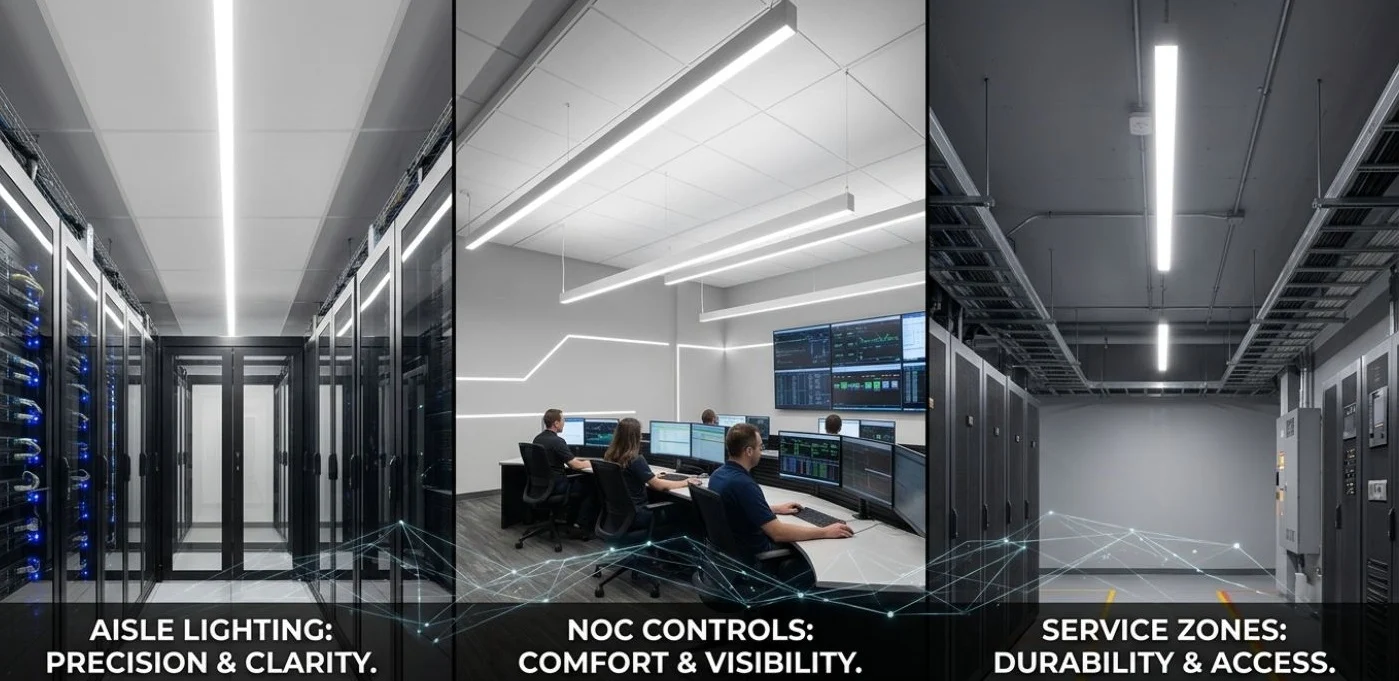
- Aisle Lighting: Fixtures should be positioned directly over the center of the aisles between server racks to illuminate both the front and back of the equipment without causing blinding glare to technicians.
- Workstations: Position lighting parallel to the primary line of sight to keep ambient light consistent.
- Utility and Support Zones: Use focused lighting in areas containing cooling infrastructure or power distribution units to ensure technicians can read gauges and warning labels clearly.
Why LED Technology is the Best Choice for Data Centers
Upgrading to the right data center office lighting is one of the easiest ways to cut operational costs while improving the workspace. Legacy lighting systems simply cannot compete with the efficiency, longevity, and light quality that modern solid-state technology brings to a mission-critical facility.
Maximum Energy Efficiency and Cost Savings
Data centers are notorious power consumers. Every watt saved on illumination reduces the load on both the electrical grid and the facility’s cooling infrastructure.
- Direct Wattage Reduction: Switching to LED solutions instantly cuts lighting energy consumption by up to 60% to 80% compared to traditional fluorescent or HID fixtures.
- Lower Thermal Load: Traditional bulbs waste massive amounts of energy as heat. LEDs run cool, which directly lowers the burden on your HVAC system and improves overall Power Usage Effectiveness (PUE).
- Smart Integration: These fixtures pair perfectly with modern dimmers and sensors to ensure you only pay for light when and where it is actually needed.
Extended Lifespan and High Reliability in Critical Zones
In a 24/7/365 environment, maintenance disruptions are a liability. You cannot afford to have technicians changing bulbs over sensitive server racks on a regular basis.
Our heavy-duty commercial fixtures are built to withstand the unique demands of continuous operations. For utility and maintenance spaces that require rugged durability against dust and moisture, implementing a 4′ vapor tight LED fixture ensures uninterrupted performance and eliminates frequent maintenance cycles. With a lifespan that often exceeds 50,000 to 100,000 hours, these systems keep critical zones brightly illuminated for years without intervention.
Flicker-Free Performance and Visual Comfort
The comfort of your tech team and system administrators directly impacts operational accuracy. Poor lighting causes fatigue, leading to costly human errors during critical equipment configurations.
| Benefit | Impact on Data Center Personnel |
|---|---|
| Zero Visible Flicker | Eliminates eye strain, headaches, and fatigue during long shifts. |
| High Color Rendering Index (CRI) | Allows technicians to accurately identify colored wires and labels in dense racks. |
| Uniform Beam Distribution | Reduces harsh shadows and dark spots in tight server aisles. |
By choosing high-quality LED technology, you protect your bottom line while creating a safer, more productive environment for your staff.
Types of Data Center Lighting Fixtures
Choosing the right data center office lighting fixtures impacts everything from operational efficiency to maintenance costs. Different zones within a facility require targeted illumination strategies to balance energy consumption with visibility.
Linear Trunking Systems for Precise Illumination
Linear trunking systems are the go-to choice for containment aisles and server rows. They deliver continuous, shadow-free illumination exactly where technicians need it most. These modular systems snap together quickly, reducing installation labor while keeping the light focused directly on server racks without wasting energy on empty floor space.
High Bays for Large Infrastructure and Utility Spaces
For wide-open infrastructure areas, mechanical rooms, and loading docks, high-performance fixtures are required to clear high ceilings. Utilizing heavy-duty industrial fixtures ensures broad, uniform coverage across large utility spaces. For facilities requiring specialized, rugged setups in demanding utility environments, heavy-duty wet location lighting fixtures provide the necessary dust and moisture resistance to keep backup systems running safely.
Low-Voltage and DC-Powered LED Lighting Options
Running lighting directly on DC power is a growing trend in modern data centers. By cutting out the AC-to-DC conversion step, these systems eliminate rectifier energy losses and minimize heat generation. Low-voltage DC lighting integrates directly with the facility’s microgrid or backup power systems, boosting overall reliability and simplifying the emergency backup architecture.
Quick Fixture Selection Guide
| Fixture Type | Best For | Key Advantage |
|---|---|---|
| Linear Trunking | Server aisles, containment zones, data center offices | Continuous light, low glare, fast modular install |
| High Bays | High-ceiling utility zones, power rooms | Maximum lumens, wide coverage, high durability |
| DC-Powered LEDs | Critical server halls, green facilities | No conversion loss, ultra-low heat, high efficiency |
Smart Controls and Automation for Modern Data Centers
Managing data center office lighting requires a shift from manual switches to automated precision. By leveraging smart controls, facilities can dynamically adjust illumination based on real-time needs, slashing energy overhead while keeping critical workspaces functional.
Intelligent Controls and Dimming Systems
Implementing intelligent dimming systems allows operators to tune brightness levels precisely where and when needed. In mixed-use environments where staff monitor active server performance alongside administrative duties, customizable dimming helps balance visibility and comfort. Just as tailored illumination improves focus in school classroom linear lighting, modern data center controls allow teams to program schedules that dim non-essential areas during off-peak hours without compromising baseline security.
Automated Motion and Occupancy Sensors
Data centers feature vast layouts with many zones left unoccupied for hours. Automated motion and occupancy sensors ensure that lights operate only when personnel are present.
- PIR (Passive Infrared) Sensors: Best for enclosed office spaces and break rooms, detecting body heat to keep lights active.
- Ultrasonic Sensors: Ideal for high-density rack aisles where structural obstructions might block a direct line of sight.
- Dual-Technology Sensors: Combines both methods to eliminate false-offs in critical maintenance zones.
Integration with Green Data Center Management Software
True efficiency happens when data center office lighting connects directly with Data Center Infrastructure Management (DCIM) platforms. This integration treats lighting as a core component of the facility’s total energy ecosystem.
| Integration Feature | Operational Benefit |
|---|---|
| Real-Time Energy Tracking | Monitors exact wattage usage per zone to identify waste. |
| Automated Load Shedding | Automatically dims non-critical office lights during peak demand spikes. |
| Predictive Maintenance Alerts | Flags fixtures experiencing erratic power draws before a total failure occurs. |
Tying your lighting automation into green management software provides the hard data required to hit strict sustainability targets and lower operational costs.
How to Plan and Execute a Professional Data Center Office Lighting Layout
Planning a commercial layout requires balancing visual comfort for staff with strict energy and operational demands. A precise strategy ensures you do not over-spend on fixtures or waste power.
Calculating Fixture Spacing and True Cost of Ownership
Getting the fixture spacing right prevents dark spots and overlapping hot spots. In data center offices, we space fixtures based on the ceiling height and the beam angle of the luminaires.
When evaluating the true cost of ownership, look beyond the initial purchase price. Factor in energy consumption, maintenance cycles, and lifespan. Transitioning to efficient led light for commercial use drastically drops operational costs and slashes cooling loads.
- Spacing Ratio: Maintain a 1:1 or 1:1.2 spacing-to-mounting-height ratio for uniform coverage.
- Total Cost Checklist: Combine fixture cost, installation labor, yearly energy consumption, and potential downtime losses.
Custom Photometric Planning and Design Evaluation
Never guess your lighting needs. We use custom photometric planning—3D computer simulations—to map out exactly how light behaves in the space before buying a single fixture.
| Evaluation Metric | Target Objective | Why It Matters |
|---|---|---|
| Illuminance Uniformity | 0.6 or higher ratio | Eliminates eye strain between bright and dim zones. |
| Glare Rating (UGR) | Less than 19 | Keeps computer screens readable and comfortable. |
| Color Rendering (CRI) | 80 to 90 Ra | Ensures accurate wire color identification in mixed office/server spaces. |
Proper Installation, Commissioning, and Maintenance
A successful data center office lighting layout depends heavily on the final execution. Installation must align perfectly with the server rack grid and office desk orientations to prevent shadows.
- Commissioning: Test dimming controls, occupancy sensors, and emergency backups under full load conditions.
- Maintenance: Choose fixtures with accessible drivers so components can be replaced quickly without disrupting daily operations.
Future Trends in Sustainable Data Center Lighting
As data centers scale up to meet global demands, sustainability is shifting from a buzzword to a core operational requirement. Modern facility design must balance heavy computational loads with eco-friendly infrastructure. Upgrading to smarter, more sustainable data center office lighting systems plays a critical role in slashing carbon footprints while keeping facility management seamless.
Advanced Emergency and Security Lighting Systems
Security and uptime are non-negotiable in critical facilities. Future-ready emergency lighting integrates directly with central building management systems to provide instant visibility during power anomalies.
- Smart Redundancy: Next-generation emergency fixtures utilize localized backup batteries that communicate health status automatically, eliminating manual testing cycles.
- Path-of-Travel Automation: In the event of a breach or outage, intelligent security lighting dynamically adjusts color and brightness to guide personnel safely through complex server halls or toward secure exits.
Eco-Friendly Materials for Green Data Centers
Sustainable facility certification requires a deep look at product life cycles. We focus on sourcing lighting components that minimize environmental impact from production to disposal.
- Circular Economy Design: Modern fixtures utilize modular parts, allowing facilities to replace individual LED drivers or arrays without discarding the entire aluminum housing.
- Harmful Substance Reduction: Using 100% mercury-free materials ensures compliance with strict international environmental standards, simplifying electronic waste recycling at end-of-life.
Human-Centric Lighting for Integrated Office Areas
Data centers aren’t just home to servers; they house engineering, security, and administrative teams working demanding, 24/7 schedules. Human-centric lighting (HCL) bridges the gap between machine efficiency and human biological needs.
- Circadian Rhythm Support: Automated color tuning shifts from crisp, energizing cool light during the day to warmer tones during night shifts, reducing eye strain and improving sleep patterns for overnight operators.
- Unified Office Design: Implementing adaptable setups, such as a sleek linear LED pendant light, creates a cohesive, premium aesthetic that transitions seamlessly from executive workspaces to tech bays.
| Sustainability Metric | Conventional Lighting | Future-Ready LED Systems |
|---|---|---|
| Average Lifespan | 15,000 – 20,000 hours | 50,000 – 100,000 hours |
| Material Toxicity | High (Mercury/Heavy Metals) | Zero Mercury (RoHS Compliant) |
| Control Integration | Basic On/Off Switches | Full BMS & Circadian Automation |
STAY IN THE LOOP
Subscribe to our free newsletter.
Leave A Comment
Why high ceilings are challenging Tall architectural volumes—such as multi-story [...]
Main Types of Commercial Lighting Commercial spaces require distinct lighting [...]