What restaurant lighting needs to achieve
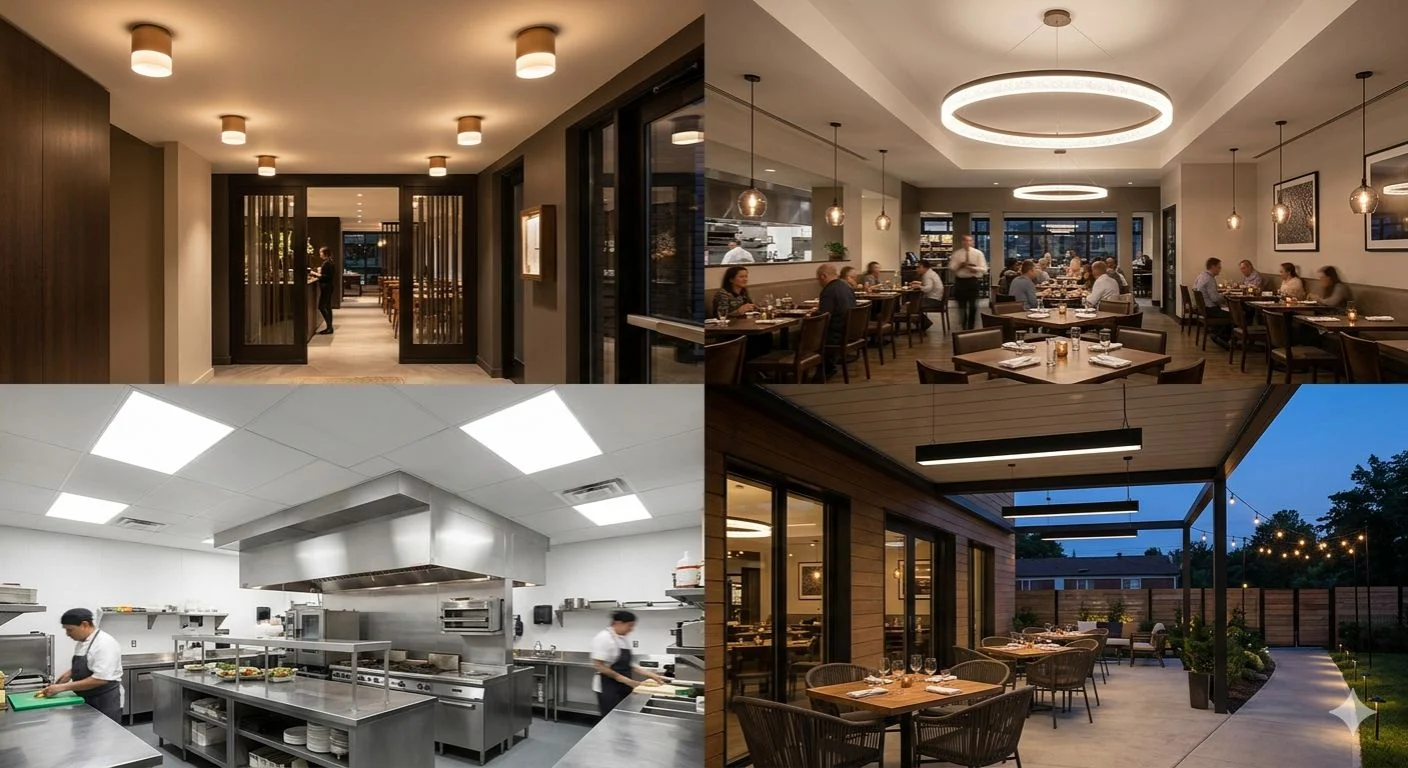
Successful restaurant lighting design goes far beyond basic illumination. It is a strategic architectural tool that directly shapes guest perception, influences dining behavior, and reinforces your brand identity. An effective lighting plan balances aesthetic appeal, visual comfort, and operational performance.
Core Objectives of Strategic Restaurant Lighting
- Define Brand Atmosphere and Mood: Lighting immediately communicates the dining concept—establishing an intimate, relaxed setting for fine dining or a vibrant, energetic space for fast-casual venues.
- Enhance Food Presentation: High-performance commercial restaurant lights make ingredients appear fresh, rich, and visually appealing, directly elevating the culinary experience.
- Guide Spatial Navigation: Balanced illumination creates intuitive visual pathways, guiding guests smoothly from the entryway to dining zones, service counters, and restrooms.
- Facilitate Operational Efficiency: Staff need targeted, glare-free light to read tickets, prepare dishes, serve tables, and process transactions accurately and safely.
- Drive Commercial Performance: Carefully calibrated brightness levels influence guest dwell time, encouraging dessert and beverage orders while supporting optimal table turnover rates.
| Strategic Goal | Key Architectural Focus | Direct Business Impact |
|---|---|---|
| Atmospheric Control | Contrast ratios & warm color temperatures | Defines brand prestige and emotional comfort |
| Culinary Highlighting | High color fidelity over tables | Enhances perceived food quality and presentation |
| Operational Clarity | Glare-free task illumination | Increases service speed, safety, and accuracy |
| Revenue Optimization | Dynamic zoning and scene setting | Balances dwell time and average spend per guest |
Ambient, task and accent layers
A successful restaurant lighting design relies on three distinct layers working together in harmony. Relying on a single light source leaves a dining room feeling flat, sterile, or disorienting. By balancing ambient, task, and accent lighting, we create depth, establish visual hierarchy, and build an inviting atmosphere for guests while supporting staff efficiency.
1. Ambient Lighting (The Mood Setter)
Ambient light forms the base level of illumination across the entire space. It sets the baseline mood, ensures comfortable navigation, and prevents harsh contrasts between dark corners and bright tables. Fixture Types: Recessed architectural downlights, cove lighting, diffuse chandeliers, or ceiling flush mounts. Primary Role: Establishes overall brightness and comfort across the dining room and corridors.
2. Task Lighting (The Operational Core)
Task lighting delivers focused illumination to specific areas where work or interaction happens. In a hospitality setting, this applies to both customer touchpoints and back-of-house operations. Key Locations: Dining tables (for reading menus and viewing food), bar tops, host stands, POS stations, and kitchen service passes. Fixture Types: Low-glare pendants, integrated under-cabinet fixtures, adjustable table lamps, and directional track heads.
3. Accent Lighting (The Visual Drama)
Accent lighting draws the eye to unique architectural features, artwork, textured walls, and premium displays. It adds visual interest and character, elevating standard dining rooms into memorable spaces. Key Targets: Wine displays, back bars, textured stonework, wall art, and interior greenery. Fixture Types: Narrow-beam spotlights, wall grazing fixtures, cURL Too many subrequests by single Worker invocation. To configure this limit, refer to https://developers.cloudflare.com/workers/wrangler/configuration/#limits LED tape, and picture lights.
Layering Breakdown for Commercial Restaurant Lights
| 조명 계층 | 주요 목적 | Best Fixture Options | Key Considerations |
|---|---|---|---|
| 환경 | General illumination & safe movement | Cove LEDs, architectural downlights | Keep dimmable to shift mood effortlessly |
| cURL Too many subrequests by single Worker invocation. To configure this limit, refer to https://developers.cloudflare.com/workers/wrangler/configuration/#limits | Reading menus, bartending, food prep | Low-hanging pendants, under-counter tape | Shield bulbs to eliminate direct glare |
| cURL Too many subrequests by single Worker invocation. To configure this limit, refer to https://developers.cloudflare.com/workers/wrangler/configuration/#limits | Highlighting decor & architectural assets | Wall washers, adjustable track spots | Use 3x the ambient level to create focus |
Combining these three elements ensures every corner of the venue serves a purpose—enhancing the dining experience without sacrificing functionality.
Dining-area lighting
The dining floor is the heart of every guest experience. In our restaurant lighting design projects, dining area lighting must balance intimate comfort with precise visual clarity. Guests want to see their food clearly, appreciate the plating, and read menus comfortably without feeling exposed under harsh, flood-style illumination.
Mastering Table Illumination and Visual Comfort
We focus on creating distinct pools of light over each table while keeping the surrounding ambient levels softer. This separation forms a sense of personal space, even in an open dining room.
- Focus on the Table Surface: Direct beams downward to accent tableware and dishes, keeping beam spreads narrow enough to avoid shining directly into guests' eyes.
- Prevent Direct Glare: Use fixtures with deep-set optics, honeycombs, or diffused lenses. Bare or exposed bulbs at eye level fatigue guests quickly.
- Perimeter Definition: For booth perimeters and architectural ceiling transitions, integrating clean 2-inch recessed linear lighting delivers subtle structure without spilling uncontrolled lumens across dining spaces.
| Seating Type | Primary Lighting Choice | Target Effect |
|---|---|---|
| Open Floor Tables | Focused narrow-beam downlights or low-glare pendants | Crisp table highlights, clear personal zones |
| Wall Booths & Banquettes | 선형 graze / soft wall sconces | Cozy enclosure with textured vertical warmth |
| Communal Tables | 연속형 architectural pendants or linear runs | Unified visual anchor, even light distribution |
Flexibility for Variable Floor Plans
Commercial restaurant lights over dining spaces must adapt as seating configurations shift. We specify narrow-to-medium beam distributions paired with dedicated zone controls. This allows staff to dim unused sections during slower services while keeping active dining tables vibrant and welcoming.
Bar and counter lighting
The bar is often the energetic anchor of a venue. In our restaurant lighting design projects, we treat bar and counter spaces as multi-zone stages where functional task work and atmospheric mood lighting must balance seamlessly.
Essential lighting zones for bars
To build an inviting counter space that also allows staff to work efficiently, we divide bar lighting into three distinct layers:
- The Countertop Surface: Focused downlighting is critical here. Low-glare narrow-beam spots or decorative pendant restaurant lighting suspended 30 to 36 inches above the counter provide enough clarity for guests to read menus and bartenders to craft drinks without blinding anyone seated.
- The Back-Bar Display: The back bar serves as the primary visual backdrop. For bottle tiers and feature shelving, integrating 매립형 선형 벽면 세척 조명 brings rich vertical illumination to glassware and textured backdrops, pulling eyes across the room.
- Under-Counter and Kick-Plates: Concealed LED tape mounted beneath the customer-facing counter edge or along the baseboards defines the bar's silhouette, provides soft foot-level orientation, and anchors the bar within the wider room.
Key lighting specs for bar setups
| 위치 | 조명기구 유형 | Target Output | 주요 이점 |
|---|---|---|---|
| Countertop | Low-glare pendants or mini-downlights | 150–200 Lux | Glare-free drink prep & dining |
| Back-Bar Shelving | Linear accent / wall wash strips | 200–300 Lux | Highlights bottles, creates depth |
| Under-Counter Lip | Diffused linear LED tape | 50–100 Lux | Soft ambient glow, highlights textures |
Using warm color temperatures (2200K–2700K) with high CRI (90+) across all commercial restaurant lights at the bar ensures that spirits, garnishes, and cocktails look vibrant and appetizing throughout service.
Circulation lighting
Circulation pathways—such as host stands, hallways, stairwells, and routes to the restrooms—require clear visibility for safety without overwhelming the relaxed mood of the dining floor. In an effective restaurant lighting design, circulation lighting quietly guides guests and staff without spilling unwanted glare into intimate seating zones.
Guiding Flow Without Breaking the Mood
We focus on soft, directional illumination that defines walking paths and highlights architectural boundaries:
- Low-Level Step & Wall Lights: Recessed step fixtures and low-mounted baseboard lights provide safe footing along stairs and ramps while keeping light beams directed downward.
- Recessed Linear Grazers: Discreet ceiling slots or perimeter wall grazing create clear visual cues along main corridors, drawing the eye naturally toward key service areas.
- Transition Zones: Entrances to restrooms and kitchen service doors need a balanced luminance level to prevent abrupt brightness shifts when guests move away from dimly lit tables.
| Circulation Zone | 권장 조명 기구 유형 | Target Lux Level | 주요 목표 |
|---|---|---|---|
| Main Walkways | Low-glare recessed downlights | 100–150 Lux | Safe navigation without spill |
| Stairs & Steps | Embedded LED step lights | 50–100 Lux | Slip-and-fall prevention |
| Restroom Hallways | Indirect linear wall washers | 100–120 Lux | Comfortable visual transition |
Partnering with experienced 건축 조명 제조업체 allows us to specify custom beam spreads, honeycomb louvers, and hidden glare shields. These precision commercial restaurant lights keep paths well-marked, compliant with safety standards, and perfectly integrated into the venue's overall interior style.
Pendant and architectural linear options
When we craft a restaurant lighting design, fixtures must balance aesthetic identity with functional performance. Combining pendant restaurant lighting with architectural linears allows us to define zones, accentuate interior structures, and maintain balanced illumination throughout dining spaces.
Choosing the right architectural fixtures
Pendants provide localized intimacy over individual tables, while linear fixtures deliver clean, continuous lines across open layouts and communal counters.
- Linear profiles for long zones: We install a slim architectural linear pendant light over bars, long banquettes, and open kitchen passes to anchor the architectural layout.
- Direct/Indirect distribution: Using an architectural up and down pendant light casts direct task light onto table surfaces while softly illuminating high ceilings to avoid the cave effect.
- Geometric accents: Circular and bespoke architectural lights break up rigid ceiling geometries in main dining halls.
Fixture selection overview
| 조명기구 유형 | Ideal Application | 시각적 임팩트 | 주요 강점 |
|---|---|---|---|
| Slim Linear Pendants | Bar counters, communal dining | Minimalist, streamlined | Continuous, even glare-free light |
| Up/Down Linears | Open exposed ceilings | Spatial, balanced | Eliminates dark ceiling shadows |
| 장식 펜던트 | Booths, 2-to-4 top tables | Intimate, decorative | Defines personal guest space |
| Circular 건축용 펜던트 | Entryways, central dining areas | Bold, focal point | Distributes wide ambient glow |
Integrating commercial restaurant lights into your ceiling plan ensures the space looks striking while keeping the lighting comfortable for long dinner services.
CCT, CRI and dimming
Technical lighting specs make or break the dining experience. When we build a commercial restaurant lighting layout, we focus on three core metrics: Color Temperature (CCT), Color Rendering Index (CRI), and precision dimming controls.
Getting the Color Temperature (CCT) Right
Warm light creates comfort, stimulates appetite, and keeps guests lingering longer. For dining areas, we stick to warm spectrums, adjusting slightly depending on the venue concept:
- 2200K – 2400K (Candlelight Glow): Ideal for intimate bars, lounges, and upscale evening dining.
- 2700K (Warm White): The gold standard for casual and fine dining restaurant lighting design.
- 3000K – 3500K (Neutral Warm): Best suited for bustling breakfast spots, delis, and fast-casual concepts.
For spaces that transition from daytime lunch service to cozy evening dining, utilizing 5CCT field-adjustable LED options gives operators the flexibility to fine-tune Kelvin levels on-site during installation.
Why High CRI Is Non-Negotiable
Food needs to look appetizing, and guests need to look vibrant under dining area lighting. Low-quality fixtures wash out rich food tones, making steaks look gray and greens look dull.
| 측정 단위 | Minimum Target | Preferred Standard | 중요한 이유 |
|---|---|---|---|
| CRI (Ra) | 80+ | 90+ to 95+ | Accurate representation of real-world food and interior colors |
| R9 (Red Output) | 50+ | 80+ | Essential for meats, wines, wood finishes, and warm skin tones |
Selecting fixtures with a high color rendering index of LED lights ensures every dish looks exactly as the chef intended under commercial restaurant lights.
Smooth, Flicker-Free Dimming
A restaurant lighting design requires dynamic control throughout the day. Standard residential dimmers fail here; commercial systems require continuous, flicker-free dimming down to 1% or 0.1%.
- 0-10V & DALI Systems: Best for commercial architectural lighting restaurant setups, offering smooth, programmable dimming curves without stepping or buzzing.
- Warm Dimming (Dim-to-Warm): Fixtures that drop from 3000K down to 1800K as they dim replicate the classic ambiance of incandescent bulbs while delivering full LED energy efficiency.
Creating day-to-night scenes
A successful restaurant lighting design must adapt seamlessly as the day progresses. A bustling lunch rush requires an energizing, well-lit environment, while dinner service demands intimacy, warmth, and drama. Managing this shift without disrupting guests comes down to automated scene scheduling and multi-zone dimming controls.
Preset lighting schedules for seamless transitions
Setting dedicated operational scenes ensures your commercial restaurant lights deliver the right mood at the right hour:
- Morning & Lunch (100% – 70% Output): Bright, balanced ambient lighting paired with natural daylight. Higher light levels create an energetic, clean atmosphere suited for fast turnover and casual meetings.
- Late Afternoon Transition (60% – 50% Output): A gentle ramp-down that bridges the gap between afternoon sun and dusk, softening the room before evening guests arrive.
- Dinner Service (40% – 25% Output): Ambient light drops significantly, allowing table-level accents, pendants, and architectural wall washes to create depth and visual warmth.
- Late-Night & Bar Mode (20% – 10% Output): Low-level ambient illumination focused entirely on accentuating the bar, artwork, and architectural perimeters for a lounge-like vibe.
| Service Phase | Target Output | Recommended Color Feel | Primary Focal Point |
|---|---|---|---|
| Lunch | High (70–100%) | Neutral Warm (3000K) | General floor & dining area |
| Early Dinner | Medium (40–60%) | Warm (2700K) | Tabletops & counters |
| Late Night | Low (10–30%) | Ultra Warm (2200K–2400K) | Bar displays & accent perimeters |
Smart zoning and dimming execution
To pull off dynamic scene transitions, separate your dining area lighting into distinct, programmable zones—such as perimeter grazing, table pendants, circulation paths, and bar backlights.
In larger dining halls and open ceilings, using an 8-foot LED suspended linear fixture equipped with smooth 0–10V or DALI dimming drivers provides continuous architectural coverage that fades down cleanly without stepping, flickering, or jarring your seated guests.
Checklist
Executing a successful restaurant lighting design requires balancing aesthetic atmosphere, operational visibility, and regulatory compliance. Before finalizing fixture schedules or opening the doors, review this essential checklist to make sure every space meets performance standards.
Restaurant Lighting Design Audit
| Space / Focus Area | Key Requirements | Verification Standard |
|---|---|---|
| Dining Area Lighting | 2200K–2700K CCT, 90+ CRI, 0.1% smooth dimming | Warm, flattering on food and faces, glare-free |
| Bar & Counter | Focused downward optics, decorative pendants, bottle accenting | High visual contrast without shining in customer eyes |
| Kitchen & Prep | 3500K–4000K, IP/wet-rated, high lumen output (50–70 fc) | Safety compliant, shadow-free cutting and plating |
| Pathways & Exits | Low-glare step lights, continuous floor wash, code-compliant egress | Clear navigation without spilling excess light onto tables |
Final Fixture and Controls Review
- Layering & Balance: Verify that ambient, task, and accent fixtures run on separate zones. Integrating 매립형 건축 조명기구로 업그레이드하면 allows clean ambient fill while keeping ceiling lines clutter-free.
- Vertical Illumination: Check that perimeter walls and artwork feature dedicated graze or wash lights to avoid dark perimeter voids. Adding 건축 벽선등 helps anchor eye-level warmth across open dining layouts.
- Preset Scene Calibration: Program automated day-to-night transitions (Lunch, Dinner, Late Night, Cleaning) so staff never have to adjust wall dimmers manually during service.
- 눈부심 제어: Ensure all pendant restaurant lighting and downlights utilize deep-set baffles, honeycomb louvers, or frosted diffusers to prevent direct line-of-sight glare at seated eye levels.
- Fixture Durability: Confirm that all commercial restaurant lights specified for high-traffic or damp areas carry appropriate IP and commercial-grade structural ratings.
계속 소식을 받아보세요
무료 뉴스레터 구독하기.
댓글 남기기
Why high ceilings are challenging Tall architectural volumes—such as multi-story [...]
Main Types of Commercial Lighting Commercial spaces require distinct lighting [...]
Explore showroom lighting design with expert tips on CRI CCT glare control ceiling lights cURL Too many subrequests by single Worker invocation. To configure this limit, refer to https://developers.cloudflare.com/workers/wrangler/configuration/#limits lighting and display focused scenes