
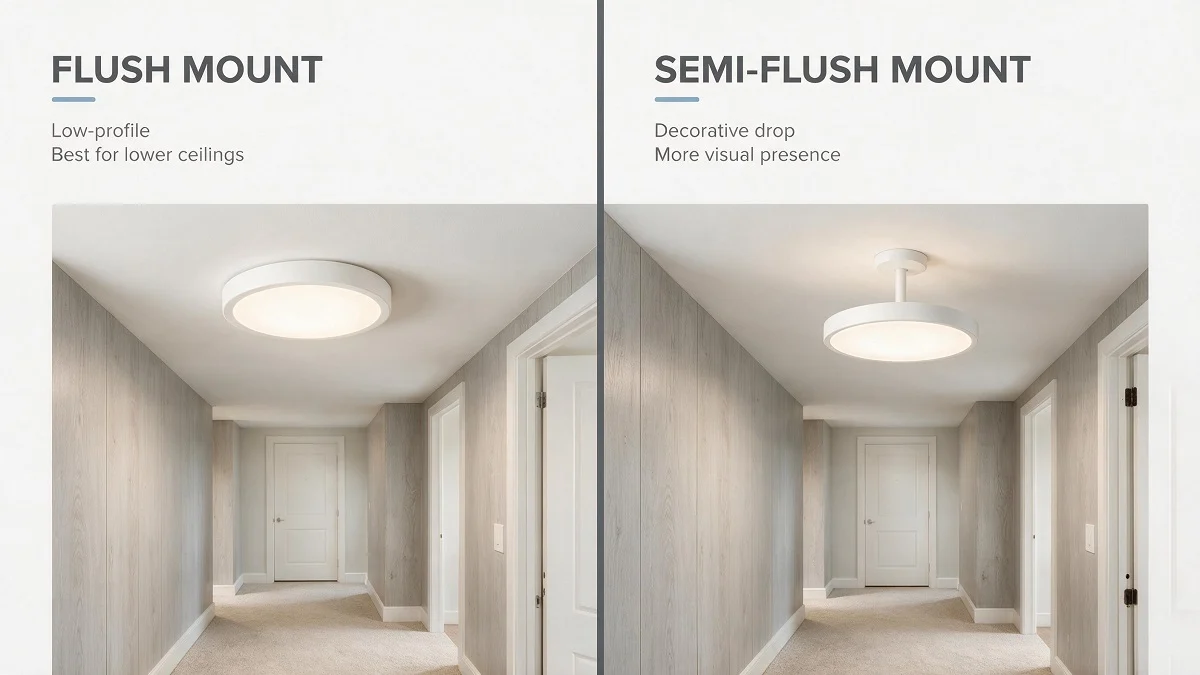
Are you worried about overhead head clearance, or tired of cleaning out insect-filled glass bowls? Selecting the right fixture comes down to understanding physical construction and room geometry. When evaluating a round flush mount light vs semi-flush mount light, structural anatomy is the foundational factor determining airflow, light diffusion, and maintenance.
Flush Mount Construction
A flush mount light attaches directly to the ceiling surface, leaving zero clearance between the drywall and the fixture canopy.
- Zero-Gap Surface Mounting: Secures tight against the junction box for a continuous ceiling plane.
- Ultra-Slim Depth: Modern low-profile ceiling lighting offers depths as thin as 0.71-inch (18mm).
- Shielded Lens Enclosure: A dust-resistant sealed light fixture prevents top-side dust, debris, and insect collection inside the lens.
Semi-Flush Mount Construction
A semi-flush mount fixture extends downward from a ceiling canopy via a short downrod stem or decorative arm, creating an intentional architectural gap.
- Downrod Stem Gap: El semi-flush downrod gap typically positions the light 4 to 12 inches below the ceiling plane.
- Multi-Directional Illumination: Projects light simultaneously across upward, downward, and lateral planes.
- Decorative Shade Structures: Built using clear or frosted glass bowls, exposed vintage bulbs, or textured fabric drums.
Comparative Structure Overview
| Structural Feature | Round Flush Mount Light | Semi-Flush Mount Light |
|---|---|---|
| Ceiling Clearance Gap | 0 inches (Flush mount) | 4 to 12 inches (Downrod gap) |
| Profile Depth | Ultra-slim (Down to 0.71″ / 18mm) | Moderate to deep extension |
| Light Projection | Direct downward / wide diffusion | 360-degree (Upward, downward, lateral) |
| Pest & Dust Resistance | Fully sealed (Zero collection) | Open bowl top (Requires periodic dusting) |
| Architectural Impact | Subtle, space-saving, minimalist | Decorative ceiling focal point |
Ceiling Height & Clearance Guidelines: The 7-Foot Rule
Navegar por el round flush mount light vs semi-flush mount light decision comes down to one non-negotiable metric: vertical clearance. Standard building codes and spatial ergonomics dictate a strict 7-foot ceiling clearance rule. The bottom edge of any ceiling luminaire must maintain at least 84 inches of clearance from the finished floor to prevent head clearance hazards and maintain open sightlines across the room.
Understanding Overhead Floor-to-Fixture Clearance
Calculating effective overhead floor-to-fixture clearance requires matching room height against the fixture drop profile. When retrofitting commercial or residential spaces, ensuring fixtures meet proper UL and ETL safety standards is essential for code compliance alongside physical clearance requirements.
| Ceiling Height | Max Fixture Drop | Recommended Mounting Style | Objetivo principal |
|---|---|---|---|
| 8 Feet (96 in) | 4 to 8 Inches | Round Flush Mount Light | Eliminate headroom hazards & visually expand space |
| 9 Feet (108 in) | 8 to 14 Inches | Semi-Flush Mount Light | Drop light into the active living zone |
| 10 Feet+ (120 in+) | 12 to 24+ Inches | Semi-Flush / Pendant Mount | Fill empty vertical volume in foyers and halls |
7-Foot to 8-Foot Ceilings: Maximizing Headroom and Visual Space
For standard 8-foot ceiling light luminarias, every inch of drop height matters. Installing a heavy or deeply dropped light fixture creates visual clutter and can obstruct sightlines through hallways or high-traffic pathways. We always utilize low-profile ceiling lighting in these compact zones.
- Zero Headroom Risks: Ultra-slim round flush mount fixtures hug drywall tightly, completely eliminating collision risks for tall occupants or inward-swinging cabinet and door frames.
- Perceptual Height Boost: Flush fixtures visually integrate directly into the ceiling plane. By avoiding drop stems, we eliminate harsh horizontal visual breaks, tricking the eye into perceiving a taller, more expansive room.
- Streamlined Sightlines: Keeping overhead lighting tight to the ceiling prevents visual crowding in low-clearance basements, utility rooms, and compact corridors.
9-Foot to 10-Foot+ Ceilings: Dropping Light into the Living Zone
When ceiling heights reach 9 feet or higher, mounting a tight flush fixture can leave the middle and lower sections of the room under-illuminated. This is where semi-flush mount lights deliver superior performance.
- Lowering the Light Center: A semi-flush downrod stem drops the optical diffuser 4 to 12 inches below the ceiling plane. This brings direct and ambient illumination closer to eye level where occupants sit, work, and gather.
- Filling Empty Vertical Volume: Tall hallways, entry foyers, and open-concept living rooms often feel cavernous. Semi-flush fixtures act as architectural anchors, filling dead vertical space without requiring long suspended pendants.
- Ceiling Bounce Uplighting: The open gap between the ceiling and shade allows upward beam projection. Light bounces off ceiling surfaces to deliver soft, indirect ambient illumination throughout larger rooms.
Light Distribution & Optical Engineering
How a fixture distributes light changes the entire feel and functionality of your space. Here is how round flush mounts and semi-flush mounts compare in optics, dimming capabilities, and color control.
Direct Downlighting and Panel Optics
Round flush mount fixtures rely on direct downward illumination to cover wide floor areas evenly.
- Edge-Lit LED Panel Diffuser: Light is directed horizontally across an optical panel and projected downward, completely eliminating bright hot spots for smooth light spread.
- Back-Lit Construction: LEDs face directly downward through a shallow housing. While back-lit models offer high lumen efficiency, edge-lit panels offer a slimmer profile.
- Glare Reduction: Premium designs use an anti-glare optical PC lens to protect eyes while maintaining maximum lumen output.
Ambient Uplighting and Ceiling Bounce
Semi-flush mount fixtures suspend slightly below the ceiling, opening up multi-directional beam angles.
- Ceiling Bounce Effect: Light projects upward against the ceiling surface, creating a soft ambient uplighting performance that bounces warmth throughout the room.
- Shadow Management: Larger canopy mounting plates, shade rims, or thick decorative rims can cast mild shadows upward or laterally if the downrod clearance is too tight.
Versatile Control: Triac Dimming & 5CCT Tuning
We build versatile control directly into modern fixtures so you can customize ambiance on demand.
| Característica | Especificación de Rendimiento | Beneficio clave |
|---|---|---|
| Triac Dimmable Ceiling Mount | Smooth dimming range from 10% to 100% | Adjust light intensity from crisp task lighting to relaxed evening warmth |
| 5CCT Selectable Color Temperature | Integrated DIP-switch selection (2700K to 6500K) | Choose between warm white, cool white, or daylight during setup |
Choosing a modern luz de techo empotrada LED de 5CCT lets you tune light output on site, matching exact color temperature needs without swapping out fixtures.
Direct Comparison: Round Flush Mount Light vs Semi-Flush Mount Light
When evaluating a round flush mount light vs semi-flush mount light, understanding their structural and photometric differences ensures you select the correct fixture profile for your project. Here is how both options compare across critical operational metrics.
| Feature / Specification | Round Flush Mount Light | Semi-Flush Mount Light |
|---|---|---|
| Profile Depth & Drop Height | Ultra-slim low-profile (0.71 in – 2 in) | Extended downrod stem (4 in – 12+ in drop height) |
| Recommended Ceiling Height | 7-foot to 8-foot low clearance ceilings | 9-foot to 10-foot+ elevated ceilings |
| Light Distribution Pattern | Direct downward illumination (110°–120° beam angle) | 360-degree ambient uplighting performance plus downlight |
| Maintenance & Enclosure | Dust-resistant sealed light fixture body | Open shade structures requiring periodic cleaning |
| Aesthetic Integration | Seamless, minimalist, architectural iluminación de montaje en superficie cURL Too many subrequests by single Worker invocation. To configure this limit, refer to https://developers.cloudflare.com/workers/wrangler/configuration/#limits | Decorative focal point with visible hardware depth |
| Mounting Mechanism | Twist-lock base plate directly to junction box | Canopy bracket, mounting ring, and downrod assembly |
| Best Commercial Fit | High-density multi-family residential lighting retrofit projects | Lobbies, boutique retail, dining areas, and suites |
Profile Depth and Ceiling Clearance Guidelines
A round flush mount light mounts flush against the ceiling plane, eliminating the open overhead gap to maximize floor-to-fixture clearance. This design protects head clearance in tight spaces and aligns perfectly with the 7-foot ceiling clearance rule on standard 8-foot ceiling light fixtures. Conversely, semi-flush units utilize a semi-flush downrod gap to drop the shade, creating vertical depth in higher spaces.
Light Spread Mechanics and Optical Performance
Flush mounts push light outward and downward using an anti-glare optical PC lens or an edge-lit LED panel diffuser for uniform coverage without hot spots. Semi-flush fixtures direct light both downward and upward against the ceiling. This ceiling bounce effect softens shadow lines and provides comprehensive ambient light across larger room volumes.
Maintenance, Installation, and Commercial Suitability
We engineer sealed flush mounts with insect-proof housing, drastically reducing maintenance cycles in high-traffic developments. Their universal bracket mounting speeds up installation in large-scale building fit-outs. Selecting between these styles often depends on overall project requirements, which you can evaluate further when comparing the top flush mount ceiling light brands and reviewing overall tipos de luminarias comerciales for multi-family property developments.
Room-by-Room Application Guide: Round Flush Mount Light vs. Semi-Flush Mount Light
Choosing between a round flush mount light vs. semi-flush mount light comes down to the specific functional and spatial demands of each room. Here is how we deploy both styles across residential and commercial spaces for optimal performance and aesthetics.
Corridors, Hallways, and Entry Passages
High-traffic transition areas require maximum clearance to prevent doorway obstruction and visual clutter.
- Round Flush Mount Light: Ideal for standard 8-foot ceilings and tight hallways. Its zero-gap surface mounting eliminates door-swing interference and keeps the sightline completely clear.
- Semi-Flush Mount Light: Best for entryways with 9-foot ceilings or higher. The downward drop adds architectural interest to an otherwise empty vertical volume without feeling intrusive.
Basements, Utility Rooms, and Garages
Low-overhead zones demand compact fixtures that deliver high lumen output without taking up precious headroom.
- Round Flush Mount Light: The absolute winner for low-clearance areas. Ultra-slim profiles (down to 0.71 inches) keep the lighting footprint flush against drywall or junction boxes, eliminating accidental impacts when moving bulky items.
- Semi-Flush Mount Light: Generally avoided in low basements or utility spaces due to hanging stem hazards and dust collection in open shades.
Bedrooms and Living Areas
Living spaces require a balance of glare-free diffusion and relaxed ambient warmth.
- Round Flush Mount Light: Works exceptionally well with edge-lit panel diffusers, delivering smooth, even illumination across low-ceiling master bedrooms and guest rooms.
- Semi-Flush Mount Light: Excels in creating atmosphere. By casting light upward against the ceiling, semi-flush fixtures generate a soft ambient uplighting performance that fills the room with indirect, cozy warmth.
Kitchens and Dining Nooks
Kitchens require precision task lighting, while dining nooks benefit from layered mood lighting.
- Round Flush Mount Light: Provides direct, wide-angle downlighting over main prep zones and walk-through areas, making it easy to spot spills and maintain a clean workspace.
- Semi-Flush Mount Light: A perfect accent above breakfast nooks and kitchen dining corners, offering decorative flair along with multi-directional light leakage across upward and lateral planes.
Commercial and Multi-Family Fit-Outs
For large-scale properties, maintenance efficiency and code compliance are top priorities.
- Round Flush Mount Light: The gold standard for multi-family retrofits. Sealed LED designs prevent dust and bug collection, reducing maintenance calls. They also easily meet Title 24 efficiency standards and align with modern cURL Too many subrequests by single Worker invocation. To configure this limit, refer to https://developers.cloudflare.com/workers/wrangler/configuration/#limits for commercial common areas.
- Semi-Flush Mount Light: Used strategically in executive offices, commercial lobbies, or clubhouse dining areas to elevate the interior design without the installation complexity of heavy chandeliers.
Maintenance, Durability, and Installation Realities
Choosing between a round flush mount light and a semi-flush mount light comes down to long-term upkeep, thermal efficiency, and regulatory compliance.
Dust and Pest Maintenance
- Sealed Round Flush Mount Light: Designed as a dust-resistant sealed light fixture, these units sit completely tight against drywall. Dust and insects cannot get inside the lens, keeping maintenance limited to a quick surface wipe.
- Open Semi-Flush Bowls: The semi-flush downrod gap creates an exposed glass bowl or fabric shade. Airborne particles and bugs gather inside over time, requiring periodic disassembly to clean out debris.
Longevity and Thermal Management
We build integrated LED fixtures with aluminum backplates that act as direct heat sinks to pull heat away from the diodes. Reviewing the key LED vs incandescent bulbs differences shows why solid-state integrated optics outlast traditional bulb replacement cycles, delivering 50,000+ hours of maintenance-free operation.
| Maintenance & Build Spec | Round Flush Mount Light | Semi-Flush Mount Light |
|---|---|---|
| Cleaning Needs | Minimal (Sealed optical lens) | Regular (Open glass rim) |
| cURL Too many subrequests by single Worker invocation. To configure this limit, refer to https://developers.cloudflare.com/workers/wrangler/configuration/#limits | Direct junction plate sink | 360-degree ambient airflow |
| Vibration & Impact | High (Low-profile rigidity) | Moderate (Suspended stem) |
Code Compliance and Safety Standards
Every fixture must meet local building safety codes for residential and commercial spaces. Our lighting lines comply with strict North American certification standards, carrying ETL listings for electrical safety, California Title 24 high-efficacy energy standards, and damp-location ratings for humid zones like bathrooms, kitchens, and covered passages.
Round Flush Mount Light vs Semi-Flush Mount Light: Decision Checklist
Choosing between a round flush mount light vs semi-flush mount light comes down to ceiling height, lighting goals, and how much effort you want to spend on maintenance. I built this quick decision checklist so you can pick the exact fixture for your space without second-guessing.
| Selection Factor | Round Flush Mount Light | Semi-Flush Mount Light |
|---|---|---|
| Ceiling Height | Best for 7ft–8ft ceilings | Best for 9ft+ ceilings |
| Visual Profile | Minimalist, ultra-slim, low-profile | Architectural focal point with downrod gap |
| Distribución de la Luz | Direct downward illumination | 360-degree ambient uplighting & ceiling bounce |
| Mantenimiento | Sealed unit; zero dust or insect collection | Open bowl/shade; requires periodic wiping |
| cURL Too many subrequests by single Worker invocation. To configure this limit, refer to https://developers.cloudflare.com/workers/wrangler/configuration/#limits | Hallways, utility rooms, low-clearance areas | Foyers, dining nooks, master bedrooms |
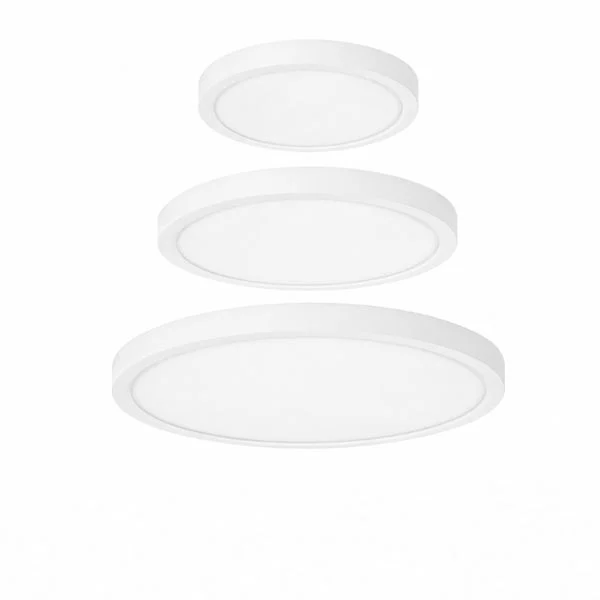
When to Choose a Round Flush Mount Light
A flush mount fixture sits flat against the ceiling box, making it the top choice when every inch of vertical clearance matters.
- Low Ceiling Clearances: Perfect for standard 8-foot or low 7-foot ceilings where low-profile ceiling lighting prevents doorway obstructions and visual clutter.
- Minimalist Design Language: Ideal if you want clean architectural integration that lets the rest of your room’s decor take center stage.
- Low Maintenance Needs: Fully enclosed, dust-resistant sealed designs prevent dead bugs and grime from collecting inside the diffuser.
- High-Traffic Multi-Family Retrofits: If you are upgrading apartment complexes or high-density housing, installing a 12-inch round flush mount ceiling light delivers clean, reliable direct downward illumination. For large-scale projects, explore our specialized 5CCT round flush mount lights for apartment renovation.
When to Choose a Semi-Flush Mount Light
A semi-flush mount hangs down a few inches via a short stem, creating an air gap that changes how light hits the room.
- Tall Ceilings (9 Feet and Above): Drops the light source down into the actual living zone without requiring a long hanging pendant.
- Decorative Design Statements: Excellent when you want a stylish architectural centerpiece featuring glass, fabric drums, or metallic accents.
- Soft Ambient Uplighting Performance: The space between the fixture and the ceiling reflects light upward, bouncing soft ambient light across the entire ceiling plane to eliminate harsh shadows.
Preguntas frecuentes
Can you install a semi-flush mount light on an 8-foot ceiling?
Yes, provided the total fixture drop height remains under 12 inches. Adhering to the 7-foot ceiling clearance rule ensures safe headroom for walking paths. For high-traffic hallways or low doorway clearances, a low-profile round flush mount light is often the safer, zero-hazard option.
Which lighting fixture provides better overall room brightness?
A semi-flush mount light typically delivers fuller room coverage because it bounces light off the ceiling while casting direct illumination downward.
| Fixture Type | Lighting Mechanics | Ideal Primary Application |
|---|---|---|
| Round Flush Mount Light | Direct downward illumination across a wide beam angle | Hallways, basements, low-ceiling rooms |
| Semi-Flush Mount Light | 360-degree ambient uplighting plus direct downward light | Foyers, dining spaces, open living areas |
Are round flush mount lights hard to replace or repair?
No. Modern integrated fixtures utilize standardized twist-and-lock mounting brackets and push-in wiring connectors. Upgrading to a modern 5CCT field-adjustable flush mount LED makes replacement seamless while eliminating recurring bulb changes entirely.
How do I choose between edge-lit and back-lit flush mounts?
- Edge-lit LED panel diffusers: Best for ultra-slim profile needs down to 0.71-inch depths. They project light sideways through a optical guide plate to eliminate glare and harsh hot spots.
- Back-lit LED diffusers: Best for high lumen output per watt. The LEDs sit behind the diffuser lens, offering maximum optical efficacy at a slightly thicker fixture depth.
MANTÉNTE INFORMADO
Suscríbete a nuestro boletín gratuito.
Deja un comentario
Retrofit LED Lighting Solutions Are soaring energy bills, relentless ballast [...]

Struggling to cut operational costs while upgrading your facility’s lighting [...]
The Financial & Operational Business Case Upgrading to energy efficient [...]

Are you trying to lower project procurement costs without compromising [...]