

Understanding Your Ceiling Type First
Before we even discuss lumens or color temperature, we have to address the infrastructure. You cannot select the right false ceiling lights for office buying guide without first identifying exactly how the fixtures will mount. In my experience supplying architectural lighting, the ceiling type dictates the form factor, installation method, and ultimately, the aesthetic finish of the workspace.
Grid Ceilings (T-Bar/Modular)
For standard corporate environments, the T-Bar grid is king. These modular false ceiling fixtures are designed for efficiency and ease of maintenance.
- The Standard: We typically see 2×2 or 2×4 layouts here.
- The Fit: You need commercial LED panel lights or troffers that drop directly into the grid.
- The Advantage: Maintenance is effortless since the driver is easily accessible by lifting the adjacent tile.
Gypsum and POP Ceilings
If you are aiming for a cleaner, high-end architectural look, you are likely working with Gypsum or Plaster of Paris (POP). This infrastructure allows for continuous, smooth surfaces perfect for recessed office lighting solutions.
- Seamless Integration: This is where we install trimless linear profiles and magnetic track systems.
- Precision Required: Unlike drop ceilings, the cutouts here must be precise. We use high-grade aluminum profiles to ensure the edges remain sharp and the heat dissipation is managed effectively within the enclosed plenum.
Open or Industrial Ceilings
Modern startups and renovated lofts often skip the false ceiling entirely. When dealing with exposed concrete or beams, the debate shifts to surface mounted vs recessed lights.
- Suspended Options: We use aircraft cables to hang linear profiles, bringing the light source closer to the desk.
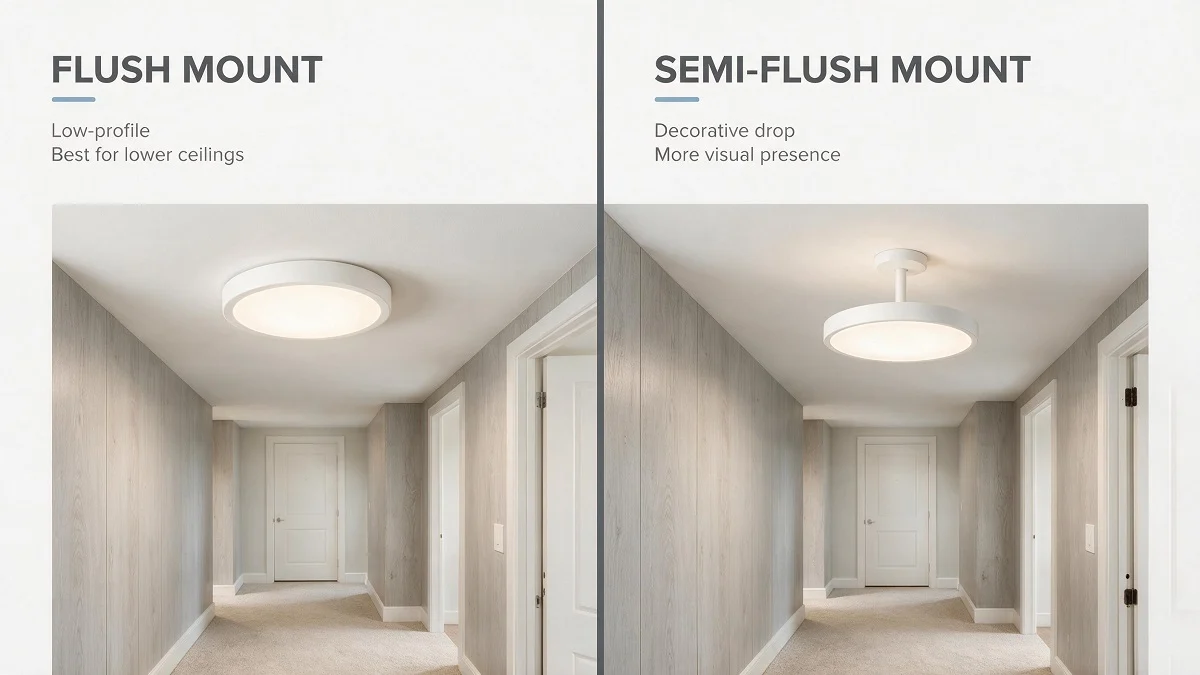
- Surface Mounting: For lower slab heights, surface-mounted downlights or tracks bolt directly to the structural ceiling, maintaining that raw, industrial aesthetic without sacrificing light quality.
Core Types of Office False Ceiling Lights
Choosing the right fixtures isn’t just about filling a hole in the ceiling; it is about matching the light source to the specific function of the workspace. We categorize our professional recessed office lighting solutions into three distinct groups, each serving a unique purpose in modern commercial environments.
LED Panel Lights (The Workhorse)
For standard grid ceilings, commercial LED panel lights are the industry standard for a reason. They provide uniform, shadow-free ambient lighting that covers large areas efficiently.
- Back-lit Panels: These place the LEDs directly behind the diffuser, offering higher efficiency and preventing the “yellowing” effect over time.
- Edge-lit Panels: These are thinner and aesthetically sleeker, ideal for shallow ceiling voids where depth is an issue.
COB Downlights (The Focus Creator)
While panels provide general wash, COB downlights for conference rooms and reception areas provide necessary contrast and focus. We utilize high-grade chips from brands like Osram and Cree to deliver intense, directional light. These are essential for task lighting over workstations or highlighting architectural features. The key here is deep-recessed optics to ensure the light source is hidden, minimizing glare for employees sitting underneath.
Linear Profile Lights (The Modern Aesthetic)
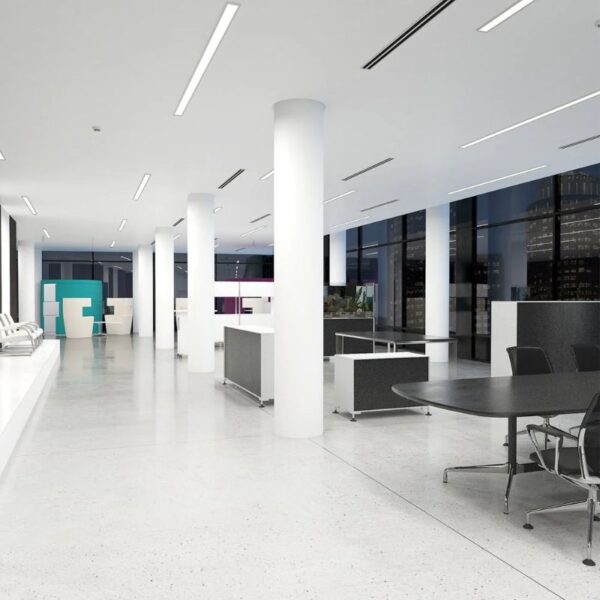
Linear profile lighting for offices has shifted from a trend to a staple in architectural design. These fixtures are perfect for corridors, boardrooms, and open-plan areas where you want the lighting to act as a design element. They can be recessed into gypsum for a trimless look or suspended. For instance, a 4′ linear pendant light fixture creates a continuous, clean line of light that visually elongates a room while delivering high-performance illumination through extruded aluminum housing.
The Technical Buying Checklist (The Must-Haves)
When I source false ceiling lights for office projects, I look past the aesthetic design first and go straight to the data sheet. If the internal specifications don’t hold up, the fixture isn’t worth the installation cost. Here is the technical breakdown you need to ensure your workspace is productive rather than painful.
Color Temperature (Kelvin): Setting the Vibe
Choosing the right color temperature is critical for employee focus. In the US market, we have largely moved away from the harsh, blue-tinted lights of the past. The debate of 4000K vs 6500K for office spaces usually ends with 4000K being the winner for general use.
| Kelvin Value | Light Appearance | Best Application |
|---|---|---|
| 3000K (Warm) | Soft, Yellowish | Break rooms, lobbies, and reception areas. |
| 4000K (Neutral) | Crisp, White | Open offices, conference rooms, and workstations. |
| 6000K+ (Cool) | Blue-White | Medical labs or high-precision manufacturing (avoid in standard offices). |
Brightness & Efficiency: Lumens vs. Watts
Stop buying lights based on wattage. Watts only tell you how much energy the fixture consumes, not how much light it gives you. You need to look at Lumens (lm) for brightness and Luminous Efficacy (lm/W) for efficiency.
- The Goal: Look for energy-efficient office ceiling lights that offer at least 100-130 lumens per watt.
- The Calculation: If you are calculating lumens for office space, a standard workstation needs about 30-50 foot-candles (approx. 300-500 lux). High efficacy means you get that brightness without driving up your utility bill.
Visual Comfort (UGR & CRI)
Nothing kills productivity faster than eye strain. This is determined by two main factors: UGR and CRI.
- UGR (Unified Glare Rating): For any area with computer screens, you need anti-glare workspace lighting (UGR<19). This prevents the “veiling reflection” on monitors that causes headaches. Using fixtures like suspended direct-indirect lighting can significantly improve visual comfort by distributing light upwards and downwards, reducing harsh contrasts.
- CRI (Color Rendering Index): This measures how true colors look under the light. High CRI commercial lighting (CRI >80 or >90) ensures that your blue branding doesn’t look grey and your wood furniture doesn’t look washed out.
Flicker-Free Technology
Cheap LEDs often have an invisible strobe effect caused by low-quality drivers. While your eyes might not register it, your brain does, leading to fatigue and migraines. Always specify flicker-free LED drivers in your purchase order. It is a small detail that makes a massive difference in a 40-hour work week.
Durability & Build Quality: The Hidden Cost Savers
When outfitting an office, the initial price tag on a fixture is often a trap. I have seen countless businesses opt for budget lighting only to spend triple that amount on maintenance and replacements within two years. In the US market, where labor costs for maintenance are high, durability is not a luxury—it is an operational necessity.
Heat Dissipation: Aluminum vs. Plastic
Heat is the number one enemy of LED longevity. Many budget-friendly options use plastic housings that trap heat, effectively cooking the internal components over time. We strictly utilize aluminum die-cast LED downlights and extruded aluminum profiles. Aluminum acts as a superior heat sink, efficiently pulling thermal energy away from the LED chip. This ensures the light maintains its brightness and color accuracy for years rather than months.
Driver Quality for 24/7 Operations
The driver is the heart of any LED system. For offices that operate round-the-clock or have extended hours, standard drivers often fail prematurely due to overheating or power surges.
- Component Sourcing: We rely on premium global brands like Osram, Philips, and Tridonic for our internal components to ensure reliability.
- Stability: High-quality, flicker-free LED drivers prevent the invisible strobe effect that causes eye strain and migraines, keeping your team productive.
- Safety: Isolated drivers with built-in surge protection are essential for meeting safety standards. You can review our certifications and compliance details to understand the safety benchmarks we adhere to.
Maintenance Realities
Replacing a fixture in a false ceiling disrupts workflow. It involves ladders, moving desks, and potential downtime. Commercial LED panel lights and recessed fixtures should be “install and forget” solutions. By prioritizing robust build quality and superior thermal management now, you eliminate the headache of constant replacements later. For more insights on selecting long-lasting fixtures, read our definitive guide to recessed office lighting.
Designing the Layout: A Quick Rule of Thumb
Great lights in the wrong spots will still look terrible. Before you start drilling into the false ceiling, you need a plan that balances functionality with aesthetics. We always recommend mapping this out to ensure visual comfort and uniform coverage across the workspace.
Spacing and Shadow Avoidance
Positioning is critical to prevent eye strain. If you place a downlight directly behind a seated employee, their body blocks the light, casting a shadow right on their keyboard.
- Uniformity: Space fixtures so their beam angles overlap slightly at desk height (usually 30 inches off the floor).
- Perimeter: Keep lights at least 2-3 feet away from walls unless you are specifically aiming for a wall-washing effect.
Layering Ambient and Accent Lighting
A flat, boring office usually suffers from having only one type of light. We achieve a modern look by mixing general illumination with focused beams. Use recessed panels or 4-foot LED suspended linear fixtures for your main ambient layer to define the space. Then, add COB spotlights or magnetic track heads to highlight artwork, reception desks, or breakout zones.
Calculating Lumens for Office Space
How many fixtures do you actually need? While we use simulation software for precise results, you can use this simple formula for a rough estimate:
(Office Area in Sq. Ft. × Target Lux) ÷ Fixture Lumens = Estimated Quantity
- Standard Office: Aim for 500 Lux (approx. 50 foot-candles) on work surfaces.
- Corridors: 300 Lux is generally sufficient.
- Detailed Drafting: 750 Lux for high-precision tasks.
Always check the lumen output on the spec sheet. High-efficiency fixtures with premium drivers (like the Tridonic or Osram units we use) deliver more light with less power, often allowing you to reduce the total fixture count while maintaining brightness.
STAY IN THE LOOP
Subscribe to our free newsletter.
Leave A Comment
Retrofit LED Lighting Solutions Are soaring energy bills, relentless ballast [...]

Struggling to cut operational costs while upgrading your facility’s lighting [...]
The Financial & Operational Business Case Upgrading to energy efficient [...]
Are you worried about overhead head clearance, or tired of [...]