
Curved Architectural Linear Lighting
Curved Linear Lighting Systems for Commercial Interiors
Create arcs, quarter circles, soft transitions and custom curved lighting paths with project-configurable LED linear systems. Prillumen supports curved linear pendant lighting, surface-mounted curved profiles and radius-based architectural lighting solutions for commercial projects.
Design Direction
Softer Lines for Architecture That Does Not Follow a Grid
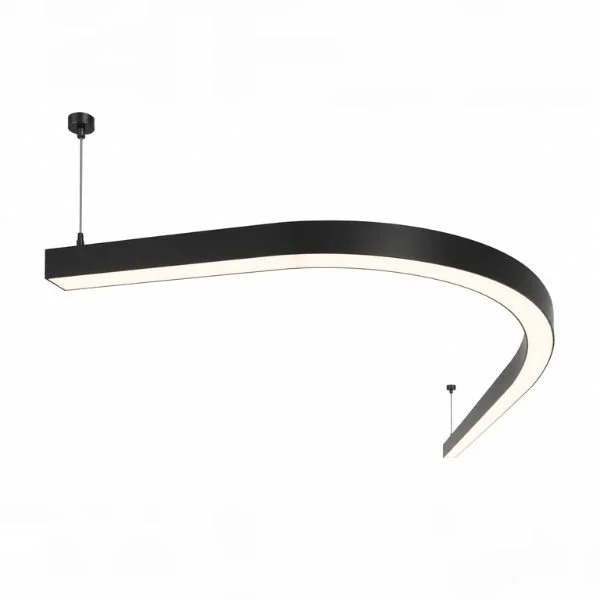
Curved linear lighting is used when a project needs a continuous luminous path without the rigidity of straight fixtures. It can follow reception desks, circulation paths, lounge seating, curved walls, feature ceilings and branded commercial interiors.
Single or connected 2-inch wide curved linear modules for directional transitions and soft ceiling movement.
90-degree curved lighting elements for corners, rounded layouts and geometric transitions.
Combine curved sections with straight linear modules to create longer continuous lighting paths.
Review radius, arc length and endpoint dimensions before production for project-specific layouts.
Curved Lighting Systems
Curved Linear Modules for Radius-Based Lighting Layouts
Start with the curve size, then coordinate the layout with straight runs, corners, mounting method and project drawings. These curved modules give buyers a clearer product entry point before reviewing a custom curved linear lighting system.
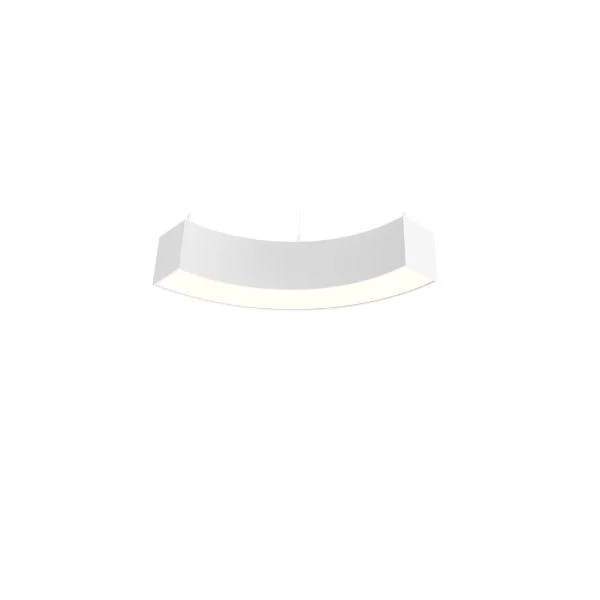
600mm Curved Linear Module
Compact curved LED linear lighting module for smaller arcs, feature corners and radius-based lighting details in commercial interiors.
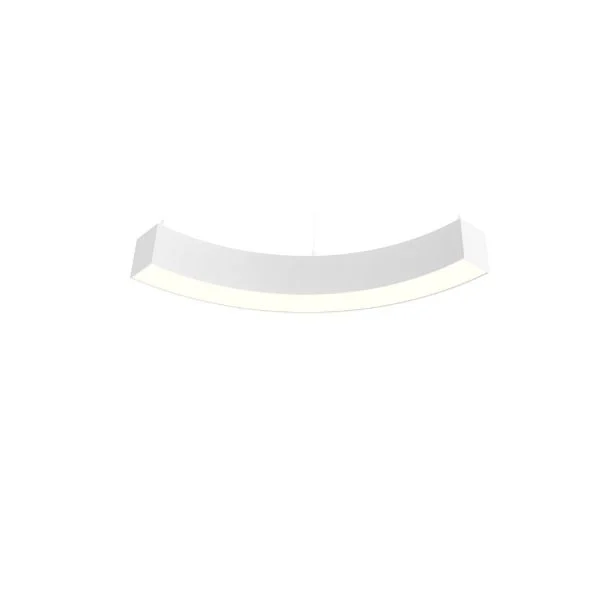
900mm Curved Linear Module
Mid-size curved linear lighting section for smoother ceiling transitions, suspended arcs and curved pendant lighting layouts.
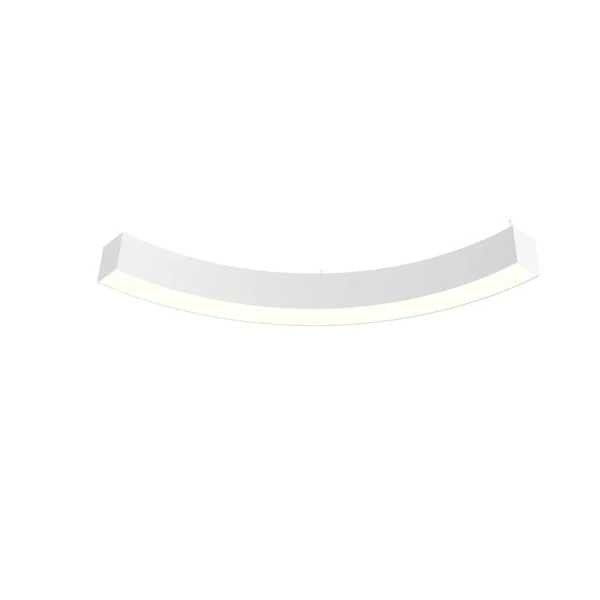
1200mm Curved Linear Module
Longer curved linear module for larger architectural lighting paths, open commercial ceilings and custom continuous curve compositions.
Quarter-Circle Curved Linear Module Specifications
Each curved module is a 1/4 shape of a ring and can work as a curved illuminated corner or connect with straight linear fixtures to build larger lighting patterns. Model codes are omitted here; final ordering details can be confirmed during quotation.
| Module Series | Power Options | Tension | Options de Température de Couleur (CCT) | Efficacité | Lumen Range | Size |
|---|---|---|---|---|---|---|
| D48 1/4 Ring | 20 / 25 / 30 / 35W | AC120-277V / 120-347V | 27K / 30K / 35K / 40K / 50K | 115 lm/W | 2300-4025 lm | 1/4 of D47.24 x 2.76 x 3.35" |
| D36 1/4 Ring | 15 / 18 / 23 / 28W | AC120-277V / 120-347V | 27K / 30K / 35K / 40K / 50K | 115 lm/W | 1495-3220 lm | 1/4 of D35.43 x 2.76 x 3.35" |
| D24 1/4 Ring | 5 / 10 / 15 / 20W | AC120-277V / 120-347V | 27K / 30K / 35K / 40K / 50K | 115 lm/W | 575-2300 lm | 1/4 of D23.62 x 2.76 x 3.35" |
Geometry Requirements
Radius, Arc Length and Connections Define the Result
Curved linear lighting needs measurable geometry. A clear drawing allows the factory to review bending radius, curve extent, straight-module connection and mounting method before quotation.
| Exigence | What to Confirm | cURL Too many subrequests by single Worker invocation. To configure this limit, refer to https://developers.cloudflare.com/workers/wrangler/configuration/#limits |
|---|---|---|
| Rayon | Target radius or centerline radius | Determines whether the curved profile can be manufactured accurately. |
| Arc Extent | Arc length, angle, chord length or endpoint dimensions | Controls the final shape and how the curve meets surrounding architecture. |
| Connection | End caps, straight modules, additional arcs or junction details | Helps create continuous lighting without visual gaps or mismatched transitions. |
| Montage | Suspended, surface mounted or selected integrated conditions | Defines hardware, driver access, installation sequence and ceiling coordination. |
Straight + Curved Integration
Build Continuous Lighting Paths With Curved and Linear Modules
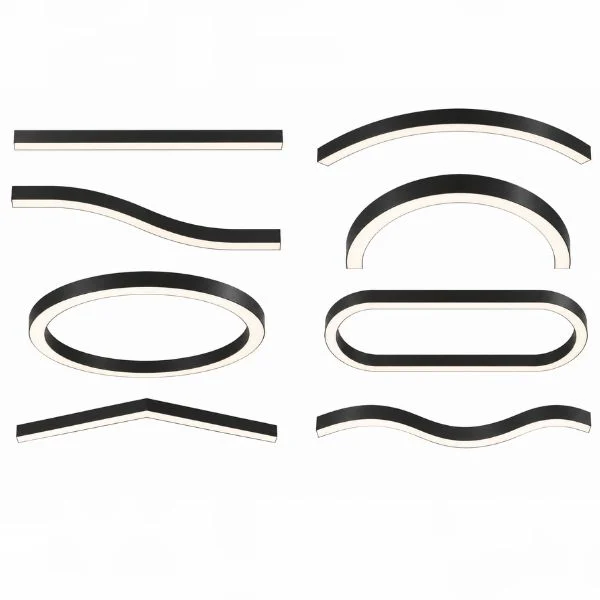
Many architectural curved lighting projects are not purely circular. They combine straight runs, arcs and endpoint details to guide movement, frame interior zones and create a softer alternative to rectangular geometric lighting.
Specification Support
What Prillumen Reviews Before Production
Measured Drawings
Review radius, dimensions, ceiling plan, endpoint positions and any straight-to-curve transitions.
Performance d’éclairage
Confirm output, CCT, CRI, diffuser style, direct or direct-indirect distribution and visual comfort goals.
Electrical Planning
Coordinate voltage, dimming, driver location, power feed, emergency requirements and control compatibility.
Production Method
Evaluate whether the curved lighting should ship as modular sections, numbered assemblies or selected factory-built segments.
Real Production Photos
Curved Linear Lighting in Production
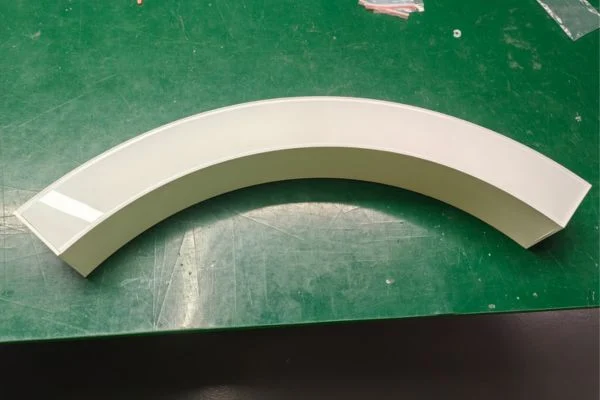
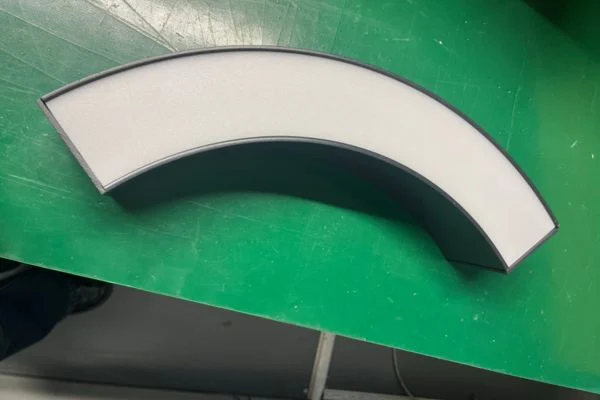
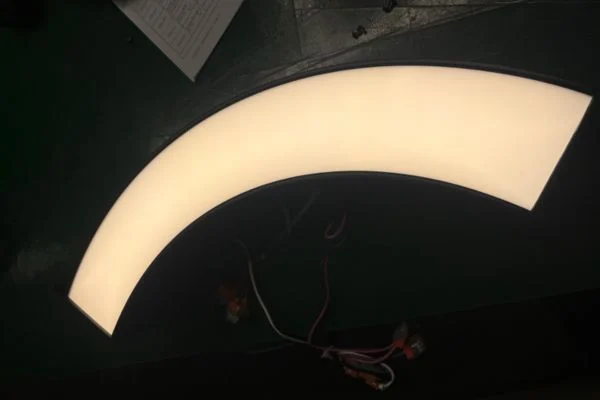
Real workshop images help project buyers understand how curved linear lighting modules are reviewed during production, including curved body preparation, fixture assembly and pre-shipment inspection before a custom architectural lighting project moves forward.
Applications
Commercial Applications for Curved Linear Lighting
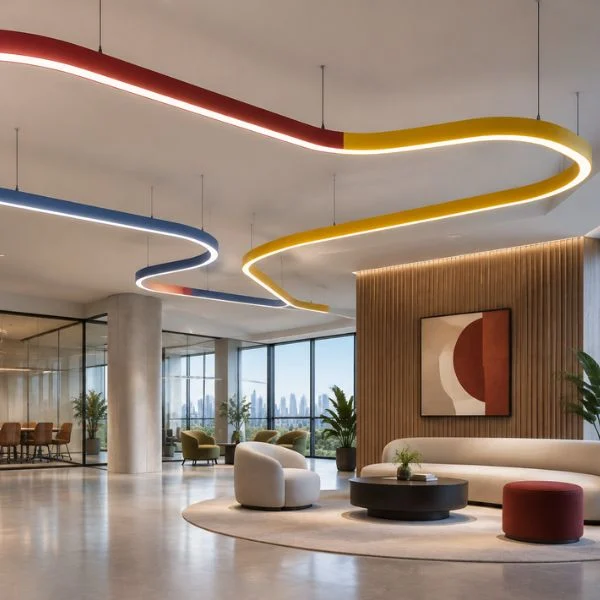
Use real interior conditions to decide whether the curved lighting should act as a ceiling feature, circulation guide, ambient layer or branded architectural element.
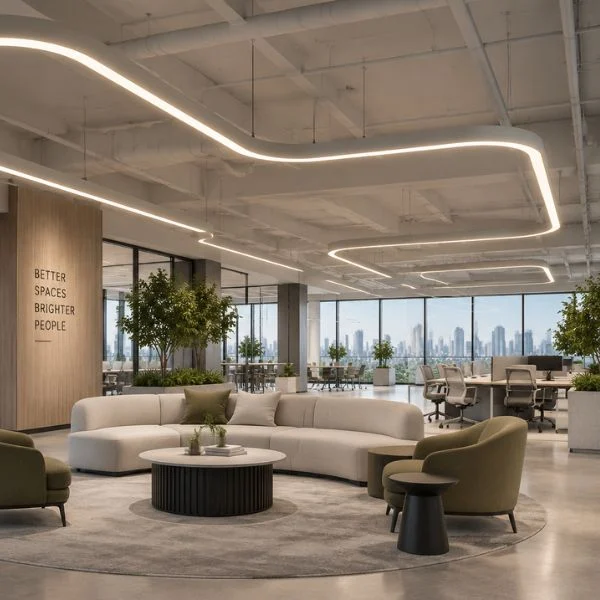
Bureaux et lieux de travail
Curved linear pendant lighting softens open office ceilings, collaboration zones, meeting rooms and reception spaces.
Hospitality
Hotels, lounges and restaurants use curved lighting to create fluid ceiling features and a more memorable guest experience.
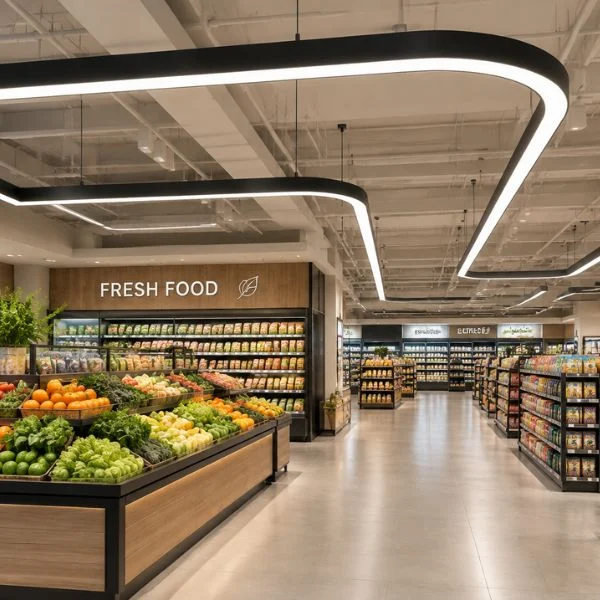
Commerce de détail
Curved LED linear lighting can guide customer movement, frame display zones and support branded store environments.
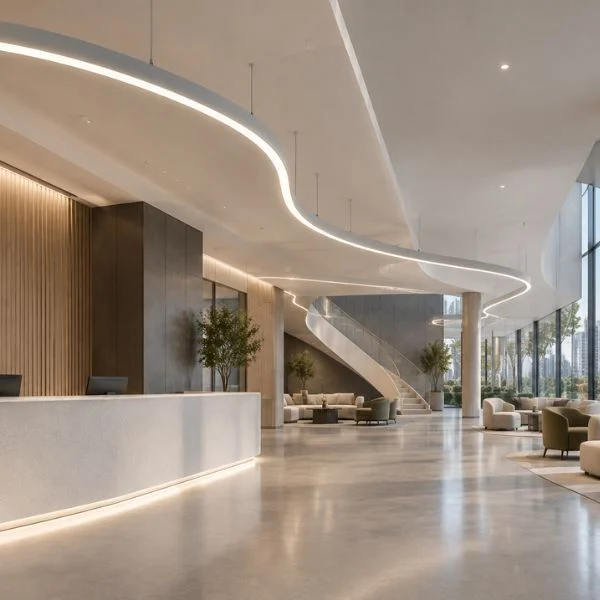
Public Interiors
Arcs and curved runs help organize libraries, galleries, corridors, lobbies and shared amenity spaces.
B2B Project Workflow
From Concept Curve to Production-Ready Lighting Layout
For B2B buyers, the curved shape should be reviewed early with project information. The best RFQ packages include a plan drawing, radius or endpoint dimensions, required fixture quantity, finish, CCT, CRI, voltage, dimming and delivery schedule.
Buying Guide
Curved Linear Lighting Buying Guide
Curved linear lighting gives architects and lighting designers an alternative to layouts built entirely from straight lines. It can follow circular forms, soften transitions between linear runs, define circulation paths, or become a visual feature within a ceiling.
But not every curved lighting system is built in the same way. Some curved light fixtures are manufactured to a project-specific radius, some use bendable or flexible profiles, while others combine standardized curved and straight sections. Understanding these differences makes it easier to select a curved lighting system that fits both the design concept and the practical requirements of the project.
What Types of Curved Linear Lighting Are Available?
Most architectural curved lighting solutions can be grouped into three broad categories. The right choice depends on the geometry of the project, the required visual effect and how much adjustment is expected during installation.
Pre-formed curved fixtures are manufactured as defined arcs, circles or other curved sections. Their geometry is established during manufacturing rather than adjusted on site. This approach can provide a controlled shape and a consistent appearance, but the layout must be coordinated around the manufactured curve.
Modular curved lighting systems combine repeatable curved sections with straight linear fixtures. Designers can use different quantities and combinations of modules to form circles, semicircles, racetrack layouts and other planned geometric compositions. Prillumen’s curved linear system follows this modular approach, using three standardized 90-degree quarter-circle arc families together with matching straight sections.
Bendable or flexible linear lighting is designed to follow changing radii or irregular architectural forms. It can be useful when the project requires curves that cannot be resolved with predefined arc geometry. This does not make flexible lighting universally better; it simply serves a different design condition.
Curved, Circular and Geometric Lighting Are Not Exactly the Same
These terms often overlap in architectural lighting searches, but they describe slightly different ideas. Curved linear lighting describes a linear luminous form that follows an arc or curved path. Circular lighting forms a complete ring or circle. Arc lighting refers to only part of a circle. Geometric linear lighting is broader and can combine straight lines, curves, corners and repeated modules into a larger composition.
A modular system can therefore belong to more than one category. Four identical quarter-circle sections can create circular lighting, while the same arcs combined with straight sections can form a racetrack, soft-corner rectangle or another geometric layout. This distinction is useful for designers because it connects the visual language to the way the lighting system is actually built.
How Radius and Diameter Change a Curved Lighting Design
Radius determines how tight or broad a curve appears. A smaller radius creates a tighter turn, while a larger radius produces a more gradual visual transition. For a complete circle, the relationship is simple: the diameter is twice the radius. For modular systems, designers also need to consider the angle represented by each curved section.
| Nominal Series | Actual Diameter | Approx. Radius | Arc |
|---|---|---|---|
| 24 inch | 23.62 inch | 11.81 inch | 90 degrees |
| 36 inch | 35.43 inch | 17.72 inch | 90 degrees |
| 48 inch | 47.24 inch | 23.62 inch | 90 degrees |
Four matching 90-degree sections complete a circle. Two create a semicircle. When straight sections are introduced between curved modules, the same basic geometry can be extended into larger architectural forms. This is why a dimensioned reflected ceiling plan is more useful than a reference image alone.
Why Combine Curved and Straight Linear Lighting?
A room rarely consists entirely of curves. Architectural plans typically combine long directional lines with changes in movement, rounded boundaries and focal areas. Combining curved and straight lighting allows the luminaire layout to respond to those different conditions.
Straight sections can reinforce direction and extend across larger distances, while curved sections change direction without introducing a conventional sharp corner. In an office, a long straight run may follow circulation before turning around a collaboration area. In retail, a racetrack configuration can frame a merchandising zone. In a lobby, repeated arcs can soften an otherwise rectilinear ceiling composition. In a large shared space, curved transitions can connect separate linear runs into one recognizable lighting feature.
Modular Curves vs. Custom-Bent Curved Lighting
| Modular Curved Lighting | Custom-Bent / Flexible Lighting |
|---|---|
| Defined arc sizes | Radius may be project-specific |
| Repeatable components | Geometry may be unique |
| Works well with planned geometric layouts | Better suited to irregular or free-form curves |
| Straight and curved modules can be combined | Often designed around one continuous path |
| Geometry must fit available modules | Greater freedom where variable radii are required |
The choice depends on the architecture rather than on which system is universally better. If a project requires an irregular organic line with continuously changing curvature, a flexible or custom-bent solution may be more appropriate. If the design can be developed from circles, arcs and straight sections, a modular system can provide a more defined set of components from which to build the layout.
Prillumen’s curved linear system belongs to the modular category. It should therefore be evaluated against the intended geometry rather than specified as an arbitrary-radius bendable fixture.
Pendant, Surface or Recessed Curved Lighting?
Curved pendant lighting makes the geometry itself highly visible. Suspended systems work particularly well where the lighting composition is intended to become an architectural feature above reception areas, lounges, meeting spaces or open office zones.
Surface-mounted curved lighting keeps the fixture close to the ceiling while retaining the visible curved form. It is useful where recessed construction is not practical, where the ceiling is already finished, or where the fixture is meant to remain part of the architectural expression.
Recessed curved lighting places more emphasis on the luminous geometry and less on the fixture housing. It may be considered where the lighting line is intended to feel integrated with the ceiling, but it requires additional ceiling, access and installation review.
Where Does Curved Linear Lighting Work Best?
Curved linear lighting is most useful when its geometry has a relationship with the architecture. Adding curves simply for decoration can make a ceiling visually complicated; using them to reinforce space, movement or focal areas usually produces a more coherent result.
Workplace interiors can use curved lighting around collaboration zones, reception areas and circulation paths. Retail environments can use curves to guide customer movement and frame merchandising zones. Hospitality interiors often use arcs and curved pendant lighting in lobbies, lounges, reception areas and dining spaces. Education, gallery and public interiors can use curved runs to create architectural rhythm in commons, corridors and gathering areas. The strongest applications usually begin with the floor plan or reflected ceiling plan rather than with a fixture shape selected in isolation.
What Should Designers Check Before Specifying Curved Linear Lighting?
Geometry first. Confirm the overall dimensions, required radius and relationship between curved and straight runs. For modular systems in particular, the best starting point is a dimensioned layout that can be compared with available straight lengths and arc diameters.
Look beyond the rendering. Review actual module dimensions and connection details. A visually attractive concept image does not confirm that the same geometry can be manufactured or shipped in the intended way.
Consider the entire lighting layout. Evaluate output across all modules rather than looking only at the wattage or lumens of one curved section. The lighting effect depends on mounting height, spacing, diffuser appearance, CCT, CRI and dimming requirements.
Check the connections. Straight-to-curve and curve-to-curve joints have a strong influence on the finished appearance of architectural linear lighting. Feed locations, suspension points and installation sequence should be reviewed before production.
Choosing the Right Curved Lighting Approach
Curved linear lighting can range from a simple illuminated arc to a large architectural composition made from straight and curved sections. The important distinction is how the curve is created.
Designers who need irregular or continuously changing radii should investigate flexible or project-specific bending systems. Projects based on repeatable arcs, circles and straight runs can instead be developed around modular curved lighting.
For Prillumen’s system, the design starts with three 90-degree arc families: 24 inch, 36 inch and 48 inch, together with compatible 1FT-4FT straight sections. These defined building blocks establish what can be configured while keeping the product scope clear.
FAQ
Curved Linear Lighting Questions
Can curved linear lighting be made to a custom radius?
Yes. Curved LED linear lighting can be reviewed around a project-specific radius, arc length and endpoint condition. The required radius should be confirmed with drawings because tighter curves, profile size and mounting method all affect feasibility.
Can curved sections connect with straight linear lighting?
Yes. Many curved linear lighting systems combine curved modules with straight linear sections. The connection detail should be reviewed before production so the visual line, suspension points, power feed and diffuser appearance remain coordinated.
Is curved linear lighting available as pendant and surface mounted?
Curved lighting can be evaluated for suspended pendant and surface-mounted applications depending on the selected profile and project requirements. Recessed or integrated curved applications require additional ceiling and access review.
What information is needed for a curved lighting quotation?
For faster B2B quotation, provide drawings, radius or endpoint dimensions, arc angle, fixture quantity, mounting method, finish, CCT, CRI, wattage or lumen target, voltage, dimming and delivery schedule.
Have a Curved Linear Lighting Concept?
Share your drawings, radius target, sketch or reference image. Prillumen can help turn curved lighting concepts into production-ready architectural lighting systems.